• Skip to main content
  • Skip to primary sidebar

Collection Agency USA

collections

by

Commercial Collections Oregon: Recover Cash Without Court

An unpaid commercial invoice in Oregon can look straightforward until you examine what sits behind it.

Is it a software contract in Hillsboro? Equipment supplied to a contractor in Bend? A manufacturing invoice in Portland? Agricultural products delivered in the Willamette Valley?

The right recovery strategy can depend on the contract, the type of transaction, the age of the account and the debtor’s financial condition.

CA-USA helps businesses recover past-due commercial accounts across Portland, Hillsboro, Beaverton, Salem, Eugene, Bend, Medford and throughout Oregon using professional negotiation, contract review, bankruptcy screening, business verification, UCC-aware collection practices and commercial credit reporting where appropriate.

Our objective is to recover the money without unnecessarily damaging a customer, vendor or referral relationship.

Attorney referral is considered only after reasonable collection efforts fail, the documentation and economics support escalation, and the client approves the next step.

Oregon commercial collection agency for B2B debt recovery, unpaid business invoices, business credit bureau reporting, bankruptcy screening, and nationwide commercial collections.

CA-USA provides a low cost, compliant, reputation-safe approach, equipped with all 50-state collections coverage, offering free credit reporting, free pre-litigation checks, free bankruptcy scrubs, and zero onboarding fees. Secure – SOC 2 Type II compliant. Over 2,000 online reviews rate us 4.85 out of 5.  Over 20 years experience , delivering excellent B2B collection results.

You’ll receive the direct mobile number of a dedicated representative, ensuring prompt support by call or text whenever you need assistance.

Need a Commercial Collection Agency? Contact us


Oregon Commercial Recovery Starts With Three Questions

What Does the Contract Actually Say?

Before stronger collection activity begins, we review the available documentation, including:

  • Contracts and credit applications
  • Purchase orders
  • Invoices and statements
  • Delivery or completion records
  • Emails and payment promises
  • Personal guarantees
  • Security agreements
  • Relevant UCC information

If a customer disputes $5,000 of a $50,000 balance, that does not automatically mean the remaining $45,000 should stay unpaid.

Strong documentation helps separate a genuine dispute from a payment delay.

Which Oregon Deadline Applies?

Oregon commercial debts do not all operate on the same legal clock.

Many contract claims generally have a six-year limitation period.

Contracts involving the sale of goods generally fall under Oregon’s UCC four-year limitation period.

Construction accounts can involve much shorter lien deadlines.

The better question is not simply:

“How old is this invoice?”

It is:

“What type of transaction created the debt, and which deadline applies?”

Why Has the Business Stopped Paying?

A slow-paying business and a failing business should not automatically receive the same strategy.

We look for warning signs such as:

  • Repeated broken payment promises
  • Sudden invoice disputes
  • Business relocation
  • Returned communications
  • Multiple creditor problems
  • Temporary cash-flow pressure
  • Bankruptcy
  • Continued operations with deliberate nonpayment

That helps determine whether negotiation, a payment arrangement, commercial credit reporting or eventual legal review makes sense.

Oregon Has a Special Rule About Collection Agency Fees

Oregon gives commercial creditors an important option when their contracts are written correctly.

A creditor using a private collection agency may potentially add a reasonable collection fee to a commercial debt when:

  • The agreement or contract creating the debt already authorizes the fee, and
  • The amount added does not exceed the collection agency’s fee.

That makes collection-cost language worth considering before an account ever becomes delinquent.

Professional Negotiation Comes Before Legal Action

Our first objective is to reach someone who can actually resolve the balance, such as an owner, CFO, controller, finance manager or accounts-payable decision-maker.

We focus on four practical questions:

Is the balance acknowledged?

Is part of it genuinely disputed?

Why hasn’t it been paid?

What can realistically be resolved now?

For a viable Oregon business facing temporary cash-flow pressure, a structured payment arrangement may produce a better commercial result than immediate legal action.

Repeatedly broken payment promises call for a different strategy.
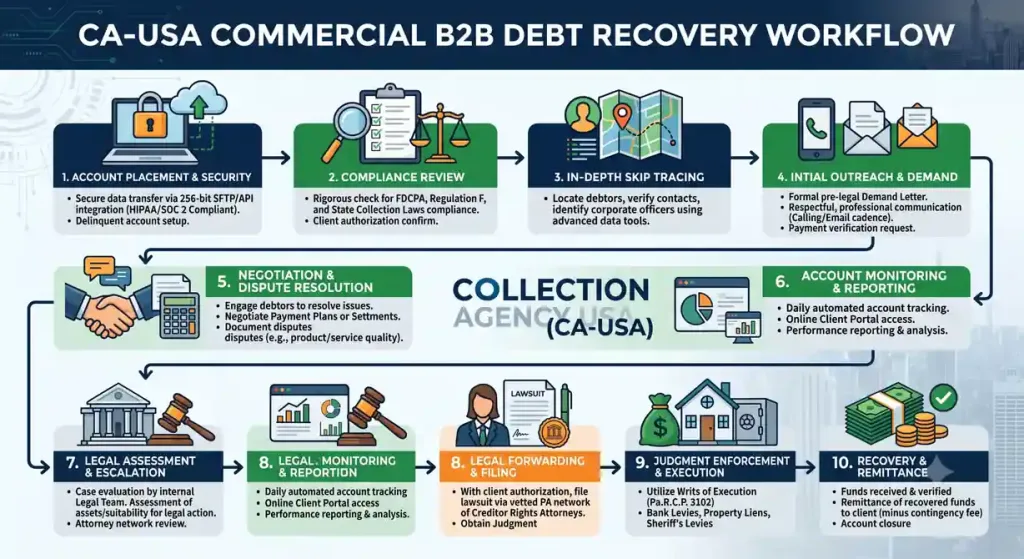
A 10-step flowchart infographic titled CA-USA Commercial B2B Debt Recovery Workflow detailing the debt collection process. Steps move sequentially from Account Placement & Security using 256-bit SFTP/API and SOC 2 compliance, through In-Depth Skip Tracing, Initial Outreach, and Negotiation. The process includes Legal Assessment, Legal Forwarding & Filing to obtain a judgment, and Judgment Enforcement using Writs of Execution and bank levies. The workflow concludes with Recovery & Remittance of funds. Each step has modern icons, process summaries, and regulatory references. The central logo shows Collection Agency USA (CA-USA)

Commercial Credit Reporting Provides Non-Legal Leverage

Eligible delinquent business accounts may be reportable to participating commercial credit bureaus when applicable documentation and reporting requirements are satisfied.

Commercial payment history can influence how lenders, vendors and other businesses evaluate a company.

That creates an additional non-legal incentive to resolve an unpaid obligation without immediately moving the account toward court.

For nationwide commercial recovery, see our B2B Commercial Debt Recovery guide.

Oregon UCC Review: The Legal Debtor Name Matters

For a registered organization, an Oregon UCC financing statement generally needs the correct legal name shown in its organizational record.

A financing statement using only the debtor’s trade name may be insufficient.

This can matter when a customer operates through a:

  • DBA
  • LLC
  • Corporation
  • Trade name
  • Related operating company

The correct legal entity can affect UCC searches, security interests, creditor priority, guarantees and eventual legal review.

A UCC filing also does not prove that a debtor has cash available. It can instead reveal whether other creditors already claim interests in equipment, inventory, receivables or other collateral.

Oregon Construction Receivables Have Much Shorter Deadlines

Contractors, subcontractors, equipment companies and material suppliers should not treat construction lien rights like an ordinary unpaid invoice.

Certain Oregon construction-lien claimants generally have 75 days to perfect lien rights, depending on the claimant and completion of the work.

A perfected lien generally also has a separate 120-day enforcement period, subject to statutory exceptions.

Sending an account to collections does not automatically preserve lien rights.

Construction receivables should therefore be reviewed early.

An Oregon LLC Debt Is Not Automatically the Owner’s Debt

Oregon generally treats an LLC’s debts as obligations of the company.

An owner or manager is not automatically personally liable simply because they own or manage the LLC.

A valid personal guarantee or another legally recognized basis for individual liability may change that.

The important question is not simply:

“Who owns the company?”

It is:

“What did that person actually agree to?”


Industries We Serve Across Oregon

Semiconductors & High Technology

The Portland-Hillsboro Silicon Forest supports semiconductor companies, technology businesses, engineering firms, equipment vendors and specialized suppliers.

Forestry, Wood Products & Manufacturing

Oregon’s forest-products and manufacturing sectors generate commercial receivables involving lumber, machinery, equipment, transportation and wholesale supply.

Agriculture, Food & Beverage

Farm suppliers, processors, packaging companies and distributors often encounter seasonal and supply-chain-related payment issues.

Businesses serving agriculture can also review our Collection Agency for Farm Supply & Agriculture Businesses resource.

Outdoor Gear & Apparel

Oregon’s outdoor, footwear and apparel ecosystem creates B2B receivables across design, manufacturing, distribution, logistics and professional services.

Construction & Trades

Contractors, subcontractors, material suppliers and equipment companies may face both ordinary collection issues and much shorter lien deadlines.

Professional & Technical Services

Software, engineering, staffing, consulting, marketing and other professional firms can accumulate significant unpaid B2B receivables.


Performance-Based Value (Aligned Incentives)

For Oregon commercial accounts, we use contingency-only pricing: typically 10% to 45%, based on balance size, age, and complexity—quoted upfront.

Higher balances and younger debt usually receive the lowest rates.

And here’s the metric that matters: we achieve ~80% recovery on fresh commercial accounts (under 200 days).
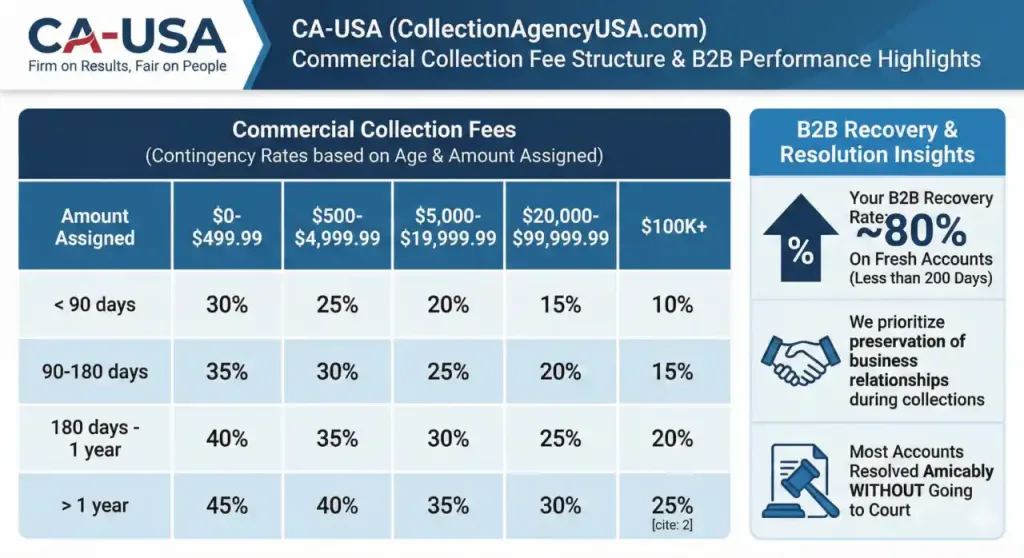
Commercial agency cost in Oregon. Its based on amount due and age. Newer accounts and those with higher balances are charged a lower fee.

For more detail, see What Should a B2B Commercial Collection Agency Charge?.


Trust & Compliance

Oregon Collection Agency Registration

Oregon regulates third-party collection agencies through its Division of Financial Regulation and NMLS registration system.

CA-USA maintains applicable collection licensing and registration coverage for the accounts it services.

Contract & Invoice Review

We review documentation that can materially affect recovery rather than treating every account as an invoice-only problem.

Bankruptcy Screening

Accounts are screened before escalation so ordinary collection activity does not continue blindly after a bankruptcy filing.

Business Verification & Skip Tracing

Lawful business-information resources help confirm legal entities, operating status, addresses and relevant decision-makers.

Commercial Credit Reporting

Eligible delinquent commercial accounts may be reported to participating commercial credit bureaus when appropriate and permitted.

Reputation-Safe Collection

We remain firm about the balance while keeping communication professional and commercially sensible.

Secure Portal & SOC 2 Type II

Client information and account documentation are handled through a secure environment backed by SOC 2 Type II controls.

Nationwide Collection Licensing Coverage

CA-USA maintains nationwide collection licensing coverage, including required state licenses, registrations and bonds.

Attorney Referral — Last Resort

Legal escalation is considered only after reasonable collection and negotiation efforts fail, the economics support further action and the client approves the next step.

FAQs About Oregon Commercial Collections

Does Oregon require collection agencies to register for commercial debt collection?

Oregon’s Division of Financial Regulation registers third-party collection agencies through NMLS. Registration requirements and exemptions can depend on the company’s activities and how accounts are serviced.

Can I charge an Oregon business customer my collection agency fee?

Possibly. Oregon permits a creditor using a private collection agency to add a reasonable collection fee to qualifying commercial debt when the agreement creating the debt authorized the fee. The amount added cannot exceed the collection agency’s fee.

How long can an unpaid commercial invoice be collected in Oregon?

Many Oregon contract claims generally have a six-year limitation period. Contracts involving the sale of goods generally fall under Oregon’s UCC four-year limitation period. The applicable deadline depends on the transaction.

What should Oregon contractors know before sending an account to collections?

Construction-lien deadlines can be much shorter than ordinary contract limitation periods. Certain Oregon claimants generally have 75 days to perfect lien rights, followed by separate enforcement requirements. Collection activity does not automatically preserve those rights.

Can I collect an Oregon LLC’s unpaid debt from its owner?

Not simply because the person owns or manages the LLC. Oregon generally treats LLC debts as obligations of the company. A personal guarantee or another legally recognized basis for personal liability may change the situation.

Can an Oregon commercial account be reported to a business credit bureau?

Eligible delinquent commercial accounts may be reportable to participating commercial credit bureaus when documentation and reporting requirements are satisfied.

When does CA-USA refer an Oregon commercial account to an attorney?

Attorney referral is a last resort. CA-USA first uses documentation review, business verification, professional outreach, dispute resolution, negotiation, commercial credit reporting where appropriate and other non-legal recovery tools.

Legal referral is considered only after reasonable collection efforts fail, further escalation makes economic sense and the client approves it.

Ready to Recover an Oregon Business Account?

Good commercial recovery starts with three questions:

What does the contract say?

Which Oregon deadline applies?

Why has the debtor stopped paying?

CA-USA combines commercial negotiation, documentation review, debtor intelligence, UCC-aware analysis, commercial credit reporting and measured escalation to help recover overdue B2B receivables.

If you’re preparing accounts for placement, see How to Assign Your Accounts to a Collection Agency for the information and documents that help us begin efficiently.

Firm on the balance. Professional with the people. Legal only after reasonable recovery efforts have failed.


Oregon businesses run on tight timing—freight on I-5, suppliers along I-84, and contractors moving job-to-job across the Willamette Valley.

When invoices stall, it’s not just “late payment.” It’s a chain reaction: delayed purchasing, delayed hiring, delayed growth. If you sell B2B in Oregon, your collections approach must protect relationships while still producing results.

Recover your B2B debts? Contact us

Filed Under: collections

by

South Carolina Commercial Collection Agency: Firm Results, Fair on People

South Carolina moves a lot more than tourists and freight.

It moves vehicles, aircraft components, machinery, tires, raw materials, manufactured products and millions of dollars in B2B invoices through some of the country’s most important supply chains.

When one company in that chain stops paying, the problem can quickly move upstream.

CA-USA helps businesses recover past-due commercial accounts across Charleston, Greenville, Spartanburg, Columbia, Rock Hill, Myrtle Beach and throughout South Carolina using professional negotiation, documentation review, bankruptcy screening, business verification, UCC-aware collection practices and commercial credit reporting where appropriate.

The objective is straightforward:

Recover the balance without unnecessarily destroying a commercially valuable relationship.

Legal referral is considered only after reasonable collection and negotiation efforts fail, the documentation and economics justify further escalation, and the client approves the next step.

South Carolina commercial collection agency for B2B debt recovery, unpaid business invoices, business credit bureau reporting, bankruptcy screening, and nationwide commercial collections.


CA-USA provides a low cost, compliant, reputation-safe approach, equipped with all 50-state collections coverage, offering free credit reporting, free pre-litigation check, free bankruptcy scrubs, and zero onboarding fees. Secure – SOC 2 Type II compliant. Over 2,000 online reviews rate us 4.85 out of 5.  Over 20 years experience , delivering excellent B2B collection results.

We’ll provide you with the direct mobile number of a dedicated representative, so support is always just a call or text away whenever you need it.

Need a South Carolina Commercial Collection Agency? Contact us


South Carolina Is a Supply-Chain Collection Market

South Carolina’s commercial economy is unusually interconnected.

An automotive supplier in Spartanburg may depend on a manufacturer, logistics provider, toolmaker and engineering company.

A Charleston importer may owe freight, warehousing and distribution vendors.

An aerospace supplier may have high-dollar invoices tied to components, tooling or specialized services.

A construction company may depend on several tiers of subcontractors and material suppliers.

When payment stops, we do not want to know only how much is owed.

We want to know:

Where does this invoice sit in the commercial relationship?

That often tells us more about recovery strategy than the balance alone.

Four South Carolina Rules Can Change the Recovery Strategy

1. Many Contract Claims Run on a Three-Year Clock

South Carolina generally provides a three-year limitation period for actions based on contracts, obligations and liabilities unless another specific rule applies.

That is shorter than many businesses expect.

An old invoice should therefore not sit indefinitely simply because communication with the debtor continues.

For a broader explanation of how deadlines vary, see our Statute of Limitations for Debt Collection resource.

2. Sales of Goods Are Different — South Carolina Generally Gives Six Years

This is where South Carolina becomes particularly interesting for B2B suppliers.

South Carolina’s UCC generally provides six years to bring an action for breach of a contract for sale.

That can matter to businesses selling:

  • Automotive components
  • Aerospace parts
  • Machinery
  • Equipment
  • Tires
  • Plastics
  • Building materials
  • Agricultural products
  • Wholesale inventory

In other words:

A service contract and a sale-of-goods transaction may operate on very different clocks.

The underlying transaction needs to be identified before assuming the deadline.

3. The Legal Debtor Name Matters Under South Carolina’s UCC

A financing statement covering a registered organization generally needs the debtor’s correct legal name from its public organizational record.

South Carolina law specifically says that providing only a debtor’s trade name is not sufficient.

That becomes important when customers operate through:

  • DBAs
  • Trade names
  • LLCs
  • Corporations
  • Subsidiaries
  • Related operating companies

A salesperson may know the customer by one name while the actual contracting—and potentially secured—entity has another.

That distinction can affect UCC searches, security interests, creditor priority and eventual legal strategy.

4. Construction Accounts Have a Much Faster Deadline

South Carolina construction receivables deserve immediate attention.

Certain mechanics’ lien claimants generally must serve and file the required lien statement within 90 days after they stop providing qualifying labor or materials.

A lien generally also requires an enforcement action and notice of pendency within six months after the claimant ceases providing labor or materials.

Collection activity does not automatically preserve lien rights.

Contractors, subcontractors, equipment companies and material suppliers should therefore review lien deadlines separately from ordinary debt collection.

Not Every Unpaid Invoice Is the Same Problem

Before deciding how hard an account should be pushed, we want to understand which problem we are actually dealing with.

The Customer Acknowledges the Debt but Is Slow

This may be a cash-flow or prioritization issue.

Professional persistence, executive-level contact and a realistic payment arrangement can sometimes solve the problem without destroying the relationship.

Part of the Invoice Is Disputed

If $10,000 of a $70,000 balance is legitimately disputed, we do not automatically accept the idea that the entire $70,000 should remain unpaid.

The undisputed amount may still be collectible while the smaller disagreement is resolved.

The Company Has Gone Quiet

Silence can signal something more serious:

  • Address changes
  • Ownership changes
  • Business closure
  • Financial stress
  • Multiple creditors
  • Bankruptcy
  • Deliberate avoidance

Business verification and skip tracing become more important at this stage.

The Wrong Entity Was Invoiced or Identified

This happens more often than many creditors realize.

The storefront name, email signature or DBA may not be the entity that signed the contract.

Correct debtor identification becomes particularly important when UCC rights, guarantees or legal referral are involved.

Professional Pressure Without Unnecessary Damage

Commercial recovery is not about making the loudest demand.

It is about getting the right person to make a decision.

Depending on the debtor, that can mean:

  • Owner
  • CFO
  • Controller
  • Finance director
  • Accounts payable manager
  • Managing member
  • Senior executive

Our initial objective is to establish:

Is the balance acknowledged?

What, if anything, is genuinely disputed?

Why has payment stopped?

What resolution can actually be completed?

That can lead to payment in full, resolution of a disputed portion or a structured payment arrangement.

If those efforts repeatedly fail, stronger options can be evaluated.


Commercial Credit Reporting Can Add Non-Legal Leverage

Eligible delinquent commercial accounts may be reportable to participating commercial credit bureaus when applicable documentation and reporting requirements are satisfied.

Payment history matters because other businesses and lenders may use commercial credit information when deciding whether to extend future credit.

That creates a meaningful consequence for unresolved business debt without automatically turning the account into litigation.

For our nationwide commercial recovery approach, see B2B Commercial Debt Recovery.


An LLC’s Debt Is Not Automatically the Owner’s Debt

South Carolina law generally treats the debts and obligations of an LLC as obligations of the company.

A member or manager is not personally liable merely because that person owns or manages the LLC.

A valid personal guarantee or another legally recognized basis for personal liability can change the analysis.

That means finding the owner is not enough.

The important question is:

Did the owner actually agree to be personally responsible?


Where South Carolina B2B Receivables Get Complex

Automotive, EV & Supplier Networks

South Carolina has one of the country’s strongest automotive manufacturing ecosystems.

Receivables can involve components, tooling, engineering, transportation, maintenance, materials and tiered supplier relationships.

Aerospace & Aviation

Charleston and Greenville support a large aerospace ecosystem involving manufacturers, engineering companies, parts suppliers, tooling businesses and technical-service providers.

South Carolina Commerce reports more than 400 private-sector aerospace firms in the state’s cluster.

Port, Freight & Distribution

The Charleston region connects importers, exporters, freight companies, warehouses, manufacturers, distributors and third-party logistics providers.

These receivables often move across multiple companies and multiple states, making accurate entity identification particularly important.

Advanced Manufacturing

Machinery, plastics, tires, metal products, advanced materials and industrial suppliers all commonly operate on commercial credit terms.

Large invoice balances can accumulate quickly when a customer begins delaying payment.

Agribusiness

Producers, processors, packaging companies, equipment vendors, distributors and agricultural suppliers face seasonal and supply-chain payment risks.

Construction & Building Materials

Contractors, subcontractors, equipment-rental companies and material suppliers face both ordinary invoice collection issues and separate mechanics’ lien deadlines.

Technology & Professional Services

Software, engineering, staffing, consulting, marketing and business-service firms frequently extend unsecured credit simply by completing work before payment arrives.


Performance-Based Value — Our Incentives Stay Aligned

For South Carolina commercial accounts, CA-USA uses contingency-only pricing, typically 10% to 45%, depending on balance size, account age and complexity—quoted upfront.

Higher balances and younger accounts generally receive lower rates.

Cost of B2B commercial debt collection in South Carolina

On qualifying fresh commercial accounts under approximately 200 days old and supported by adequate documentation, CA-USA’s internal results can approach ~80% recovery.

Results naturally vary by debtor condition, age, documentation, disputes and other factors.

For pricing details, see What Should a B2B Commercial Collection Agency Charge?.


What Happens Before an Account Ever Reaches an Attorney?

Most accounts should not begin with legal action.

Before attorney referral, CA-USA may use:

Contract & Invoice Review

We examine what was agreed, what was delivered and what remains unpaid.

Business Verification & Skip Tracing

We confirm legal entities, locations, operating status and relevant decision-makers.

Bankruptcy Screening

Collection strategy changes immediately when bankruptcy protection applies.

UCC-Aware Review

Security agreements and relevant filings can materially affect creditor leverage.

Dispute Resolution

A legitimate dispute should be isolated rather than allowing an entire account to remain unpaid indefinitely.

Commercial Credit Reporting

Eligible accounts may receive additional non-legal leverage through participating commercial credit bureaus.

Negotiation & Payment Arrangements

A realistic agreement with a viable business can sometimes recover more efficiently than litigation.

Attorney Referral — Last Resort

Legal escalation is considered only after reasonable collection efforts fail, the account supports further escalation and the client authorizes the next step.

Trust, Security & Nationwide Coverage

CA-USA combines commercial collection experience with:

  • More than 20 years of collection experience
  • Nationwide collection licensing coverage, including required licenses, registrations and bonds where applicable
  • SOC 2 Type II controls
  • Secure client account submission
  • Bankruptcy screening
  • Business skip tracing
  • Commercial credit reporting where eligible
  • Dedicated support
  • Reputation-conscious collection tactics

Our collectors do this work every day.

That experience matters when an account needs persistence without unnecessary escalation.

FAQs About South Carolina Commercial Collections

What is different about B2B debt collection in South Carolina?

South Carolina has several rules that can materially affect commercial recovery. Many ordinary contract claims generally have a three-year limitation period, while contracts for the sale of goods generally receive a six-year period under South Carolina’s UCC. Construction lien rights can involve much shorter 90-day and six-month deadlines.

How long can I collect an unpaid South Carolina business invoice?

Many South Carolina contract claims generally have a three-year limitation period. However, contracts for the sale of goods generally fall under South Carolina’s UCC six-year limitation period. Other rules may apply depending on the obligation, so the transaction and documentation should be reviewed before assuming a deadline.

Why does South Carolina give six years for the sale of goods?

South Carolina’s version of UCC Section 2-725 provides a six-year limitation period for breach of a contract for sale. This can be particularly important for manufacturers, wholesalers, automotive suppliers, machinery vendors and other businesses selling goods rather than services.

Can I collect a South Carolina LLC’s debt from its owner?

Not simply because someone owns or manages the LLC. South Carolina generally treats the company’s debts and obligations as those of the LLC. A personal guarantee or another legally recognized basis for personal liability may change the analysis.

Does using a DBA or trade name matter when collecting South Carolina B2B debt?

Yes. The trade name used in everyday business may not identify the actual legal debtor. This becomes especially important for contracts and UCC financing statements. South Carolina’s UCC specifically provides that a financing statement using only a debtor’s trade name does not sufficiently provide the debtor’s name.

What should South Carolina contractors know before sending an invoice to collections?

Certain mechanics’ lien rights generally require a lien statement to be served and filed within 90 days after qualifying labor or materials stop being provided. A separate enforcement deadline also applies. Sending an account to collections does not automatically preserve those lien rights.

Can a South Carolina commercial debt be reported to a business credit bureau?

Eligible delinquent commercial accounts may be reportable to participating commercial credit bureaus when applicable documentation and reporting requirements are satisfied.

When does CA-USA refer a South Carolina commercial account to an attorney?

Attorney referral is a last resort. CA-USA first uses documentation review, business verification, professional outreach, dispute resolution, negotiation, commercial credit reporting where appropriate and other non-legal recovery tools. Legal referral is considered only after reasonable collection efforts fail, escalation makes commercial sense and the client approves it.

Ready to Recover a South Carolina Business Account?

Commercial recovery works best when the strategy matches the transaction.

Business professionals discussing South Carolina commercial debt collection and shaking hands in an office overlooking the Jersey City skyline.”

Before escalating, ask:

Is this a service contract or sale of goods?

Who is the actual legal debtor?

What does the documentation prove?

Is a shorter lien or limitation deadline running?

Why has payment stopped?

CA-USA combines professional negotiation, debtor intelligence, documentation review, UCC-aware analysis, commercial credit reporting and measured escalation to help South Carolina businesses recover overdue B2B receivables.

If you’re ready to place accounts, see How to Assign Your Accounts to a Collection Agency for the documentation and information that help us begin efficiently.

Firm on the balance. Professional with the people. Legal only after reasonable recovery efforts have failed.

Recover your South Carolina B2B debts? Contact us

Filed Under: collections

by

Top New Jersey Commercial Collection Agency for B2B Debt Recovery

New Jersey is one of the country’s densest commercial corridors.

A container can arrive through Port Newark–Elizabeth, move through a warehouse or distributor, supply a pharmaceutical or manufacturing company, and create several B2B invoices before the product ever reaches its final customer.

When one business in that chain stops paying, the problem can spread quickly.

CA-USA helps businesses recover past-due commercial accounts across Newark, Jersey City, Elizabeth, Edison, Trenton, Princeton, Parsippany, New Brunswick and throughout New Jersey using professional & respectful negotiation, contract and invoice review, bankruptcy screening, business verification, UCC-aware collection practices and commercial credit reporting where appropriate.

Our objective is not maximum pressure.

It is to determine who legally owes the money, why payment stopped, what the documents prove and which recovery tools actually make commercial sense.

Attorney referral is considered only after reasonable collection and negotiation efforts fail, the documentation and economics justify escalation, and the client approves the next step.

Business professionals discussing New Jersey commercial debt collection and shaking hands in an office overlooking the Jersey City skyline.

CA-USA provides a low cost, compliant, reputation-safe approach, equipped with all 50-state collections coverage, offering free credit reporting, free pre-litigation checks, free bankruptcy scrubs, and zero onboarding fees. Secure – SOC 2 Type II compliant. Over 2,000 online reviews rate us 4.85 out of 5.  Over 20 years experience , delivering excellent B2B collection results.

We’ll provide you with the direct mobile number of a dedicated representative, so support is always just a call or text away whenever you need it.

Need a NJ Commercial Collection Agency? Contact us


The Commercial Reconciliation Workflow

CA-USA uses a structured commercial collection process designed for complex New Jersey B2B accounts.

A 10-step flowchart infographic titled CA-USA Commercial B2B Debt Recovery Workflow detailing the debt collection process. Steps move sequentially from Account Placement & Security using 256-bit SFTP/API and SOC 2 compliance, through In-Depth Skip Tracing, Initial Outreach, and Negotiation. The process includes Legal Assessment, Legal Forwarding & Filing to obtain a judgment, and Judgment Enforcement using Writs of Execution and bank levies. The workflow concludes with Recovery & Remittance of funds. Each step has modern icons, process summaries, and regulatory references. The central logo shows Collection Agency USA (CA-USA)

For our broader nationwide approach, see B2B Commercial Debt Recovery.


New Jersey Commercial Debt Often Travels Through a Chain

A New Jersey commercial receivable frequently involves more than one buyer and seller.

Consider a logistics transaction:

Importer → freight provider → warehouse → distributor → retailer

Or a life-sciences transaction:

Research company → laboratory → equipment supplier → manufacturer → distributor

When payment fails somewhere in that chain, simply sending another demand letter may not tell us enough.

We want to understand:

  • Which legal entity contracted for the goods or services?
  • Was delivery or performance completed?
  • Is any portion of the invoice genuinely disputed?
  • Has the debtor changed locations or entities?
  • Is there a personal guarantee?
  • Does a security interest exist?
  • Has bankruptcy been filed?
  • Is another creditor already ahead of you?

In New Jersey’s fast-moving commercial environment, documentation and debtor identification can be as important as persistence.

New Jersey Collection Agencies Have a Specific Bond Requirement

New Jersey requires businesses operating as collection agencies or collecting accounts for others to maintain applicable collection-agency bonding requirements.

The state’s current collection-agency bond filing process uses a $5,000 bond.

That makes state compliance more than a generic trust statement.

CA-USA maintains applicable licensing, registration and bonding coverage for the accounts it services.

There Is No Single New Jersey Deadline for Every B2B Invoice

Many Contractual Claims — Generally Six Years

New Jersey generally provides a six-year limitation period for many contractual claims and liabilities.

But that rule should not be applied automatically to every commercial invoice.

For more on how deadlines vary, see our Statute of Limitations for Debt Collection resource.

Sale of Goods — Generally Four Years

Contracts involving the sale of goods generally fall under New Jersey’s UCC four-year limitation period.

That distinction can matter to:

  • Pharmaceutical suppliers
  • Medical-device vendors
  • Manufacturers
  • Equipment companies
  • Wholesalers
  • Food distributors
  • Packaging suppliers
  • Industrial suppliers

A written invoice should therefore not automatically be treated as a six-year claim.

The transaction itself matters.

When a Debtor Says “We Dispute It,” Find the Actual Dispute

Commercial disputes are rarely all-or-nothing.

Suppose a New Jersey distributor owes $85,000 but claims $9,000 of the shipment was incorrect.

The question should not immediately become:

“Do we sue for $85,000?”

A better first question is:

“Why is the undisputed $76,000 still unpaid?”

We review available:

  • Contracts
  • Credit applications
  • Purchase orders
  • Invoices
  • Statements
  • Delivery confirmations
  • Completion records
  • Emails and correspondence
  • Payment promises
  • Credits
  • Personal guarantees
  • Security agreements

Separating a legitimate dispute from a payment excuse can unlock money without unnecessarily damaging a commercially valuable relationship.

New Jersey UCC Searches Start With the Correct Legal Entity

New Jersey’s UCC makes debtor identification especially important.

For a registered organization, a financing statement generally needs the company’s correct legal name from its organizational record.

Using only a debtor’s trade name may be insufficient.

That matters when a customer operates through:

  • A DBA
  • Trade name
  • LLC
  • Corporation
  • Subsidiary
  • Related operating company

In New Jersey, where businesses often operate through multiple corporate entities, invoicing the familiar business name is not always enough.

The correct legal entity can affect:

Contract enforcement → UCC searches → security interests → creditor priority → guarantees → attorney review

A UCC filing also does not mean the debtor has money available.

It may instead indicate that a bank or another creditor already has a security interest in equipment, inventory, receivables or other collateral.

A New Jersey LLC’s Debt Is Not Automatically the Owner’s Debt

New Jersey generally treats the debts and liabilities of an LLC as obligations of the company.

They do not automatically become the debts of an owner or manager merely because that person owns or manages the business.

A properly executed personal guarantee or another legally recognized basis for personal liability can change the analysis.

That is why finding the owner is not enough.

The real question is:

Did that person actually agree to guarantee the obligation?

New Jersey Construction Accounts Need Faster Attention

Commercial construction invoices run on a much faster timetable than ordinary contract claims.

For non-residential construction, eligible New Jersey contractors, subcontractors and suppliers generally have 90 days after the last qualifying work, services, materials or equipment to record a lien claim.

Separate enforcement deadlines also apply.

Sending an account to collections does not automatically preserve construction-lien rights.

For contractors and suppliers, a 90-day lien deadline can matter far more than the ordinary age of the invoice.

Commercial Credit Reporting Adds Non-Legal Leverage

Eligible delinquent commercial accounts may be reportable to participating commercial credit bureaus when applicable documentation and reporting requirements are satisfied.

Commercial payment history can affect how lenders, suppliers and other businesses evaluate a company when extending future credit.

That provides an additional commercial consequence for continued nonpayment without automatically turning every delinquent account into litigation.

The goal is not to threaten to destroy a company’s credit.

It is another professional recovery tool.

New Jersey Industries Where B2B Receivables Become Complex

Life Sciences, Pharma & Medical Technology

New Jersey has one of the country’s strongest pharmaceutical, biotechnology, medical-technology and life-sciences ecosystems.

Commercial balances can involve:

  • Laboratory equipment
  • Research services
  • Medical devices
  • Packaging
  • Technology
  • Staffing
  • Manufacturing
  • Distribution
  • Specialized professional services

These accounts can be highly documented and contract-heavy, making careful review especially important.

Transportation, Warehousing & Logistics

New Jersey’s location between major Northeast markets makes logistics one of its defining commercial industries.

Receivables may involve:

  • Freight
  • Warehousing
  • Distribution
  • Trucking
  • Import/export services
  • Equipment
  • Packaging
  • Third-party logistics

Port Newark–Elizabeth further connects the state to international cargo, rail, warehousing and distribution networks.

Advanced Manufacturing

New Jersey’s manufacturers span pharmaceuticals, medical devices, aerospace components, electronics, food products and precision manufacturing.

Commercial claims may involve high-value equipment, components, tooling, purchase orders and UCC issues.

Technology & Professional Services

Software, IT, engineering, staffing, consulting and professional-service businesses often extend substantial unsecured credit simply by performing work before receiving payment.

Food & Beverage

New Jersey’s food manufacturers, distributors, packaging businesses, cold-storage operators and logistics providers create another substantial B2B network where delivery documentation and payment terms matter.

Performance-Based Value: Alignment of Interests

Our “Firm on Results, Fair on People” philosophy is backed by a transparent, contingency-only pricing model. At CA-USA, we are on the same team. Because our fee is tied directly to your success, we are fully invested in your recovery. To move things forward with maximum speed and seriousness, we ask that you share all contracts and communication proofs promptly; the more data we have, the faster we can pressure the debtor.

Our fees range from 10% to 45%, dictated by the balance size, the age of the debt, and the complexity of the case. By design, higher balances and younger debt receive our most competitive rates.

Commercial collections cost is based on Amount assigned and age of the debt.

The 80% Performance Edge

Timing is the single greatest predictor of success in the commercial collection agency industry. CA-USA has achieved recovery rates around 80% on qualifying, well-documented commercial accounts placed less than 200 days past due. Actual recovery varies by account. By intervening before a debt “ages out,” we maximize the likelihood of a full recovery while minimizing the need for heavy-handed legal tactics.

For a deeper explanation of pricing, see What Should a B2B Commercial Collection Agency Charge?.

What We Do Before Recommending Legal Escalation

Contract & Invoice Review

We establish what was agreed, what was delivered and what remains unpaid.

Business Verification & Skip Tracing

We verify legal entities, operating status, updated addresses and relevant decision-makers.

Bankruptcy Screening

If bankruptcy protection applies, ordinary collection activity must change immediately.

Dispute Resolution

We identify the actual disputed amount rather than allowing an entire balance to remain unresolved indefinitely.

UCC-Aware Review

Security agreements and relevant financing information can materially affect creditor leverage.

Commercial Credit Reporting

Eligible accounts may receive additional non-legal leverage through participating commercial credit bureaus.

Negotiation & Payment Arrangements

A viable company experiencing temporary financial pressure may respond better to a structured payment solution than immediate litigation.

Attorney Referral — Last Resort

Attorney referral is considered only after reasonable collection and negotiation efforts fail, the account supports further escalation and the client approves the next step.

Trust, Security & New Jersey Compliance

CA-USA combines:

  • More than 20 years of collection experience
  • New Jersey collection-agency bond compliance where applicable
  • Nationwide collection licensing coverage, including required state licenses, registrations and bonds
  • SOC 2 Type II controls
  • Bankruptcy screening
  • Business skip tracing and verification
  • Commercial credit reporting where eligible
  • Dedicated support
  • Reputation-conscious negotiation
  • Attorney referral only as a final escalation

Firm on the balance does not have to mean reckless with the relationship.

FAQs About New Jersey Commercial Collections

Does New Jersey require a collection agency license or bond?

New Jersey requires businesses operating as collection agencies or collecting accounts for others to maintain applicable collection-agency bonding requirements. The state’s current collection-agency bond filing process uses a $5,000 bond.

How long can I collect an unpaid New Jersey business invoice?

Many New Jersey contractual claims generally have a six-year limitation period. Contracts involving the sale of goods generally fall under New Jersey’s UCC four-year limitation period. Other rules and exceptions may apply depending on the transaction, so the underlying agreement should be reviewed before assuming a deadline.

Why does the legal business name matter in New Jersey commercial collections?

The entity operating under a trade name may not be the entity legally responsible for the debt. Correct identification becomes especially important for contracts, guarantees and UCC financing statements. Using only a trade name can also create problems when determining secured-creditor rights.

Can I collect a New Jersey LLC’s debt from its owner?

Not merely because someone owns or manages the LLC. New Jersey generally treats an LLC’s debts and liabilities as obligations of the company. A valid personal guarantee or another legally recognized basis for personal liability may change the analysis.

What should New Jersey contractors know before sending an account to collections?

For non-residential construction, eligible New Jersey contractors, subcontractors and suppliers generally have 90 days after the last qualifying work, services, materials or equipment to record a lien claim. Separate enforcement deadlines apply. Sending an account to collections does not itself preserve lien rights.

Can an unpaid New Jersey B2B account be reported to a commercial credit bureau?

Eligible delinquent commercial accounts may be reportable to participating business credit bureaus when applicable documentation and reporting requirements are satisfied.

What documents should I provide with a New Jersey commercial collection account?

Useful documentation can include contracts, credit applications, purchase orders, invoices, statements, delivery records, correspondence, payment history, disputes, guarantees and relevant security agreements or UCC information. Better documentation generally makes it easier to identify the correct recovery strategy.

When does CA-USA refer a New Jersey commercial account to an attorney?

Attorney referral is a last resort. CA-USA first uses documentation review, business verification, professional outreach, dispute resolution, negotiation, commercial credit reporting where appropriate and other non-legal recovery tools.

Legal referral is considered only after reasonable collection efforts fail, escalation makes commercial sense and the client approves it.

Ready to Recover a New Jersey Business Account?

New Jersey commercial debt often moves through complicated relationships and multiple legal entities.

Before escalating, ask:

Who actually owes the money?

Is this a service obligation or a sale of goods?

What does the documentation prove?

Is a UCC or construction deadline running?

Why has payment stopped?

CA-USA combines commercial negotiation, documentation review, debtor intelligence, UCC-aware analysis, commercial credit reporting and measured escalation to help recover overdue B2B receivables.

For information on preparing your placement, see How to Assign Your Accounts to a Collection Agency.

Firm on the balance. Professional with the people. Legal only after reasonable recovery efforts have failed.


New Jersey B2B Debt Recovery: Securing Your Revenue

Need a New Jersey Commercial Collection Agency? Contact us

Filed Under: collections

by

Ohio Commercial Collections Built for B2B Owners Who Value Relationships

Unpaid commercial invoices can quickly turn into a cash-flow problem. Collection Agency USA (CA-USA) provides B2B commercial debt recovery for Ohio businesses, using professional negotiation, contract and invoice review, business verification, bankruptcy screening, skip tracing, and commercial credit reporting.

From manufacturers and suppliers around Cleveland and Toledo to logistics companies in Columbus, aerospace businesses around Dayton, and service companies across Cincinnati and Akron, Ohio B2B accounts can involve contracts, purchase orders, disputed invoices, personal guarantees, security interests, and complicated payment histories.

Our approach is straightforward: recover the money while protecting the business relationship whenever possible.

Ohio commercial collection agency for B2B debt recovery, unpaid business invoices, business credit reporting, bankruptcy screening, and nationwide commercial collections.

CA-USA provides a low cost, compliant, reputation-safe approach, equipped with all 50-state collections coverage, offering free credit reporting, free pre-litigation analysis, free bankruptcy scrubs, and zero onboarding fees. Secure – SOC 2 Type II compliant. Over 2,000 online reviews rate us 4.85 out of 5.  Over 20 years experience, delivering excellent B2B collection results.

We’ll provide you with the direct mobile number of a dedicated representative, so support is always just a call or text away whenever you need it.

Need an Ohio Commercial Collection Agency? Contact us


Why Ohio B2B Debt Needs a Commercial Collection Strategy

Commercial debt is not simply larger consumer debt.

An unpaid B2B account may involve a master service agreement, purchase order, delivery dispute, change order, personal guarantee, security agreement, or an ongoing customer relationship.

Common responses include:

  • “The invoice is still being approved.”
  • “We’re waiting for our customer to pay us.”
  • “Part of the invoice is disputed.”
  • “Call us next month.”

A skilled commercial collector looks beyond those responses and asks:

What is actually owed? Who can authorize payment? Is there a legitimate dispute? Is the debtor financially active? What leverage is available without unnecessarily damaging the relationship?


When Should an Ohio Business Account Go to Collections?

Consider professional collection when an invoice is materially overdue, internal reminders are being ignored, promises to pay keep getting broken, or the debtor stops responding.

A useful commercial tactic is to separate a real dispute from the undisputed debt.

For example, if a customer owes $72,000 but disputes only $8,000, the immediate question becomes:

Why is the undisputed $64,000 still unpaid?

That changes the negotiation. Instead of allowing one disputed line item to freeze the entire account, the collector can press for payment of the undisputed portion while the remaining issue is reviewed.


Performance-Based Value (Where Our Interests Align With Yours)

Our commercial collections are pure contingency—you only pay when money is recovered. Fees typically range 10% to 45%, based on balance size, age of the account, and complexity.

Ohio B2B commercial collection agency contingency rates by debt balance and account age
A simple rule holds: higher balances and younger accounts receive the lowest rates. Older, disputed, or hard-to-locate accounts require more work—and pricing reflects that.

If you’re sitting on fresh receivables, we bring urgency. On commercial accounts under 200 days, we average ~80% recovery. That’s not luck. That’s process, pressure, and professionalism.


Recent Ohio Commercial Recoveries

$78,400 Industrial Supply Balance — Dispute Isolated, 71% Recovered

An industrial supplier had a customer withholding an entire $78,400 balance because of a dispute involving only part of one shipment.

Rather than arguing over the whole account, the file was broken into disputed and undisputed charges. Documentation confirmed that most invoices had been accepted without objection.

The collection discussion then shifted from:

“Do you owe $78,400?”

to:

“Why is the undisputed balance still unpaid?”

A structured payment arrangement recovered approximately $55,700, while the genuinely disputed portion was handled separately.

Recovery: 71%

This approach avoided allowing a relatively narrow dispute to become an excuse for withholding the entire receivable.


$46,800 B2B Service Account — Business Verification Changed the Negotiation

A service company had been repeatedly told that its customer was experiencing severe financial problems and could not make payment.

Before accepting that explanation, business records and available account information were reviewed. The company was still operating, taking new business, and maintaining an active commercial presence.

Instead of immediately escalating legally, the collector approached the account from a different angle: the issue appeared to be payment priority rather than an inability to operate.

The conversation moved to a short, realistic payment schedule backed by consistent follow-up.

Approximately $33,000 was recovered without litigation.

Recovery: 70%

The key was verifying the debtor’s situation before deciding which recovery strategy made sense.


Ohio Contract Deadlines Make Waiting Risky

Ohio does not give every commercial obligation the same legal timeline.

Written contracts generally have a six-year limitation period, while certain non-written agreements generally have a four-year period.

For manufacturers, wholesalers, distributors, and equipment suppliers, another distinction matters: contracts for the sale of goods generally fall under Ohio’s UCC four-year period.

The underlying transaction therefore matters.

And even when years remain legally, waiting can still hurt recovery. Employees leave, businesses close, records become harder to locate, and competing creditors may appear.


Ohio Manufacturing Accounts Benefit From UCC-Aware Review

Ohio’s manufacturing, automotive, industrial equipment, and distribution sectors make UCC issues particularly relevant.

When appropriate, CA-USA reviews available:

  • Contracts and purchase orders
  • Personal guarantees
  • Security agreements
  • UCC information
  • Invoice and delivery records

A UCC filing may reveal security interests or competing creditors, but it does not automatically prove whether the debtor has available cash.

It is one part of the commercial recovery picture.


An Ohio LLC’s Debt Is Not Automatically the Owner’s Debt

A common creditor question is:

“The company owes me money. Can I collect it from the owner?”

Usually not simply because someone owns or manages the LLC.

The situation can change when there is a valid personal guarantee or another recognized basis for individual liability.

That is why credit applications, guarantees, contracts, amendments, and signature pages should be preserved and submitted with the collection account.


Commercial Credit Reporting Can Add Non-Legal Leverage

Litigation should not be the first response to every unpaid commercial invoice.

For eligible delinquent accounts, business credit bureau reporting can provide additional leverage.

A delinquent commercial account may affect a company’s ability to obtain financing, vendor terms, or trade credit. That can encourage a debtor that has ignored normal collection requests to come back to the table.

CA-USA offers free business credit bureau reporting on eligible commercial accounts, subject to applicable documentation and reporting requirements.

The objective is not unnecessary escalation. It is to create enough legitimate commercial leverage to produce payment.


The CA-USA Ohio Commercial Collection Process

Once an account is placed, CA-USA follows a structured process:

1. Documentation Review
Contracts, invoices, purchase orders, correspondence, disputes, and guarantees are reviewed.

2. Business Verification & Screening
Business information, bankruptcy status, skip-tracing information, and other relevant account data are checked where appropriate.

3. Professional Outreach
Contact is directed toward people who can actually authorize payment — owners, controllers, CFOs, or accounts-payable managers.

4. Negotiation
The goal is payment in full where possible, or a practical short-term arrangement when appropriate.

5. Additional Commercial Leverage
Business credit reporting and other lawful non-legal recovery tools may be considered when negotiation stalls.

6. Attorney Referral as a Last Resort
If negotiations fail, we can recommend attorney escalation. Any legal action is pursued only after receiving your written approval.

A 10-step flowchart infographic titled CA-USA Commercial B2B Debt Recovery Workflow detailing the debt collection process. Steps move sequentially from Account Placement & Security using 256-bit SFTP/API and SOC 2 compliance, through In-Depth Skip Tracing, Initial Outreach, and Negotiation. The process includes Legal Assessment, Legal Forwarding & Filing to obtain a judgment, and Judgment Enforcement using Writs of Execution and bank levies. The workflow concludes with Recovery & Remittance of funds. Each step has modern icons, process summaries, and regulatory references. The central logo shows Collection Agency USA (CA-USA)


What Should You Send With an Ohio Commercial Account?

Good documentation gives the collector more leverage and fewer unanswered questions.

Whenever available, provide:

  • Signed contracts or credit applications
  • Purchase orders
  • Invoices and statements
  • Proof of delivery or completion
  • Payment history
  • Email correspondence
  • Dispute records
  • Personal guarantees
  • Security agreements
  • Relevant UCC information

A strong collection file should quickly establish:

What was agreed? What was delivered? What became due? What remains unpaid?


Firm on the Balance. Professional With the People.

Some overdue customers may still be valuable customers.

CA-USA’s commercial approach is designed to distinguish a temporarily slow-paying customer from a company deliberately avoiding a legitimate obligation.

Negotiation comes first. Legal action comes later, if necessary.

The objective is to recover the receivable without unnecessarily destroying a relationship that may still have future value.


Frequently Asked Questions About Ohio Commercial Collections

Does the FDCPA apply to commercial B2B debt in Ohio?

The federal FDCPA generally applies to debts incurred primarily for personal, family, or household purposes and ordinarily does not cover genuine B2B debts. Commercial collections can still be subject to contracts, Ohio law, bankruptcy restrictions, UCC provisions, and other applicable requirements.

How long can an unpaid Ohio business invoice be pursued?

Written contractual claims generally have a six-year limitation period in Ohio. Certain non-written contracts generally have a four-year period, while contracts for the sale of goods generally fall under the UCC four-year period. The specific transaction and documentation should be reviewed before relying on a deadline.

How does Ohio’s UCC affect commercial collections?

The UCC may affect sales of goods, security interests, financing statements, collateral, and creditor priority. Relevant contracts, guarantees, security agreements, and UCC information should be reviewed when they could affect recovery options.

Can an Ohio B2B account be reported to business credit bureaus?

Eligible delinquent commercial accounts may be reportable when applicable documentation, accuracy, and reporting requirements are satisfied. Commercial credit reporting can provide additional non-legal leverage.

Can we collect an Ohio LLC’s debt from its owner?

Not merely because the individual owns the LLC. A valid personal guarantee or another legally recognized basis for individual liability may change the analysis.

What documents should I send with an Ohio commercial account?

Contracts, invoices, purchase orders, statements, proof of delivery or completion, payment history, correspondence, dispute records, guarantees, security agreements, and relevant UCC information are all useful.

When does CA-USA refer an Ohio account to an attorney?

Attorney referral is a last escalation. Documentation review, business verification, professional negotiation, dispute resolution, and other appropriate recovery tools are used first. Legal referral is considered only when further escalation makes commercial sense and the client approves it.


Ready to Recover an Ohio Business Account?

Ohio business professionals reviewing B2B commercial collection services with the Columbus skyline and Ohio state flag.

CA-USA handles commercial B2B collections throughout Columbus, Cleveland, Cincinnati, Dayton, Toledo, Akron, and the rest of Ohio.

Need a Commercial Collection Agency? Contact Us

Serving Hundreds of Businesses !

Easy to use • Fully Compliant with Federal and State Laws • USA Citizens-Only Team • 24×7 Secure Portal • High Recovery Rates • Over 20 years Experience • Free Commercial Credit Bureau reporting • Low fee • Highly Rated !

Filed Under: collections

by

Connecticut Commercial Collection Agency: Protect Your Business Relationships

Connecticut may be geographically small, but its B2B invoices can be anything but small.

Insurance and financial-services firms in Hartford and Stamford, aerospace suppliers across central Connecticut, life-sciences businesses around New Haven, manufacturers along the I-91 corridor and professional-service companies throughout Fairfield County routinely extend substantial commercial credit.

When one of those customers stops paying, the smartest recovery strategy is usually not the most aggressive one.

It starts with three questions:

Who legally owes the money?

What do the contract and supporting documents actually prove?

What has changed since the invoice became overdue?

CA-USA helps recover past-due commercial accounts across Hartford, Stamford, New Haven, Bridgeport, Norwalk, Danbury, Waterbury and throughout Connecticut using professional negotiation, documentation review, bankruptcy screening, business verification, UCC-aware collection practices and commercial credit reporting where appropriate.

Our objective is to recover the balance without unnecessarily damaging a commercially valuable relationship.

Attorney referral is considered only after reasonable collection efforts fail, the documentation and economics support further escalation, and the client approves the next step.

Connecticut commercial collection agency helping businesses recover B2B debt across Hartford, Stamford, New Haven and Bridgeport


CA-USA provides a low cost, compliant, reputation-safe approach, equipped with all 50-state collections coverage, offering free credit reporting, free per-litigation checks, free bankruptcy scrubs, and zero onboarding fees. Secure – SOC 2 Type II compliant. Over 2,000 online reviews rate us 4.85 out of 5.  Over 20 years experience , delivering excellent B2B collection results.

We’ll provide you with the direct mobile number of a dedicated representative, so support is always just a call or text away whenever you need it.

Need a Connecticut Commercial Collection Agency? Contact us

For nationwide commercial recovery strategy, see our B2B Commercial Debt Recovery guide.


Connecticut Commercial Recovery Is Mostly About Diagnosing the Account Correctly

An overdue balance can represent very different problems.

A buyer may acknowledge the invoice but be experiencing temporary liquidity pressure.

Another business may suddenly dispute work it accepted months earlier.

A third may have changed legal entities, moved its accounts-payable operation out of state or begun showing signs of serious financial distress.

We review available:

  • Contracts and credit applications
  • Purchase orders
  • Invoices and statements
  • Delivery or completion records
  • Email correspondence
  • Payment promises
  • Dispute history
  • Personal guarantees
  • Security agreements
  • Relevant UCC information

That allows the strategy to respond to the actual problem instead of simply increasing the volume of collection calls.

Connecticut Has Two Important Commercial Collection Clocks

Many Contract and Account Claims — Generally Six Years

Connecticut generally provides a six-year limitation period for actions involving an account, simple or implied contract, or written contract.

That does not mean a business should wait anywhere near six years.

Documentation weakens, personnel change and debtor condition can deteriorate long before the legal deadline arrives.

Sales of Goods — Generally Four Years

Connecticut’s UCC generally provides a four-year limitation period for breach of a contract for sale.

That distinction can matter significantly to:

  • Aerospace suppliers
  • Manufacturers
  • Equipment vendors
  • Medical-device companies
  • Distributors
  • Wholesalers
  • Industrial suppliers

A written invoice does not automatically mean every Connecticut commercial claim gets six years.

The nature of the transaction matters.

For a broader discussion of collection deadlines, see our Statute of Limitations for Debt Collection resource.

Connecticut UCC Searches Begin With the Correct Legal Name

Connecticut’s UCC requires particular care when identifying a registered business debtor.

A financing statement generally needs the organization’s correct legal name from its public organizational record.

A financing statement providing only the debtor’s trade name is not sufficient.

That matters when customers operate through:

  • DBAs
  • Trade names
  • LLCs
  • Corporations
  • Subsidiaries
  • Related companies

A salesperson may know the customer by one name while the agreement was actually signed by another legal entity.

That difference can affect contract recovery, UCC searches, security interests, creditor priority and eventual legal review.

A Connecticut LLC’s Debt Is Not Automatically the Owner’s Debt

Connecticut law generally treats an LLC’s debt as an obligation of the company.

A member or manager is not personally liable merely because that person owns or manages the LLC.

A properly executed personal guarantee or another legally recognized basis for liability may change the result.

So finding the owner is only part of the investigation.

The more important question is:

Did that person actually agree to be personally responsible?

Construction Receivables Move Much Faster

Connecticut contractors, subcontractors and material suppliers should not treat lien rights like an ordinary six-year contract claim.

A Connecticut mechanic’s lien generally must be recorded within 90 days after the claimant stops furnishing qualifying services or materials.

A copy generally must then be served on the owner within 30 days after the lien certificate is recorded.

And a perfected mechanic’s lien generally must be foreclosed within one year or it expires.

Sending an invoice to collections does not automatically preserve lien rights.

Construction accounts therefore deserve early review.

Professional Negotiation Before Legal Pressure

A good commercial collector tries to reach the person who can actually authorize payment:

  • Owner
  • CFO
  • Controller
  • Finance director
  • Accounts-payable manager
  • Senior executive

We want to determine:

Is the balance acknowledged?

Is part of it genuinely disputed?

Is this temporary cash-flow pressure or something more serious?

What realistic resolution can be completed now?

If a Connecticut customer disputes $8,000 of a $60,000 account, the entire balance should not automatically remain frozen.

The first question becomes:

Why is the undisputed $52,000 still unpaid?

Separating the real dispute from the rest of the receivable can often move an account forward without immediate legal escalation.

Commercial Credit Reporting Provides Non-Legal Leverage

Eligible delinquent commercial accounts may be reportable to participating business credit bureaus when applicable documentation and reporting requirements are satisfied.

Commercial payment history may influence how lenders and suppliers evaluate a business.

That creates a legitimate non-legal consequence for continued nonpayment without turning every overdue invoice into litigation.

Connecticut Industries Where B2B Debt Gets Complicated

Insurance & Financial Services

Hartford remains synonymous with insurance, while Stamford and Fairfield County support major financial-services and corporate operations.

These receivables can involve consulting, technology, staffing, data services, professional fees and sophisticated contract disputes.

Aerospace, Defense & Precision Manufacturing

Connecticut has a deep aerospace and defense supply chain supported by precision manufacturers, engineering companies, tooling businesses and specialized vendors.

High-value component and equipment invoices make documentation and UCC considerations particularly important.

Life Sciences & Medical Technology

New Haven and surrounding markets support biotechnology, research, medical technology and laboratory businesses where receivables can involve equipment, research services, staffing and specialized suppliers.

Technology & Professional Services

Software, IT, engineering, consulting and staffing firms frequently extend unsecured commercial credit simply by completing work before payment arrives.

Construction & Trades

Contractors, subcontractors, material suppliers and equipment companies face both ordinary collection issues and much shorter lien deadlines.

Recent Recovery Snapshots

Equipment Supplier — 74% Recovery

A debtor disputed part of a large equipment invoice after months of silence. Instead of treating the whole balance as contested, the file was broken into documented, undisputed and genuinely disputed amounts. Delivery records supported most of the balance, executive-level contact restarted negotiations, and the undisputed portion was prioritized first.

Recovery: 74% of the placed balance without legal escalation.

Professional Services Account — 88% Recovery

The debtor operated under multiple related business names and accounts payable kept redirecting responsibility. The recovery strategy began by identifying the actual contracting entity, confirming there was no active bankruptcy and locating the finance decision-maker rather than continuing generic AP follow-up. A structured resolution followed.

Recovery: 88% of the placed balance.

Performance-Based Value (Pure Contingency, Aligned Incentives)

Our commercial collections model in Connecticut is 100% contingency-based. You pay only when we recover.

Fees typically range 10%–45%, based on balance size, account age, documentation strength and complexity.

Higher balances and younger debts generally receive the lowest rates, and pricing is confirmed in advance.

The cost of commercial collections in CT is based on age and balance of the debt

For qualifying fresh commercial accounts under approximately 200 days old and supported by adequate documentation, CA-USA’s internal results can approach ~80% recovery.

Results vary according to account age, debtor condition, documentation, disputes and other factors.

For more detail, see What Should a B2B Commercial Collection Agency Charge?

Trust, Security & Measured Escalation

CA-USA combines:

  • More than 20 years of collection experience
  • Nationwide collection licensing coverage where required
  • SOC 2 Type II controls
  • Contract and invoice review
  • Business verification and skip tracing
  • Bankruptcy screening
  • UCC-aware review
  • Commercial credit reporting where eligible
  • Dedicated support
  • Reputation-conscious negotiation

Connecticut separately licenses consumer collection agencies through its Department of Banking. Pure commercial B2B accounts are different from consumer debt, so we avoid implying that Connecticut’s consumer licensing statute automatically governs every business-to-business receivable.

Attorney Referral — Last Resort

Legal escalation is considered only after reasonable collection and negotiation efforts fail, the economics and documentation support further action, and the client approves the next step.


FAQs About Connecticut Commercial Collections

How long can I collect an unpaid business invoice in Connecticut?

Many Connecticut account and contract claims generally have a six-year limitation period. Contracts involving the sale of goods generally fall under Connecticut’s UCC four-year limitation period. The underlying transaction should be reviewed before assuming which deadline applies.

Does Connecticut require a collection agency license for B2B commercial debt?

Connecticut’s Department of Banking licenses “consumer collection agencies,” and the statute focuses on collection from consumer debtors. Pure B2B commercial receivables are therefore different from consumer collection activity. CA-USA maintains nationwide licensing and registration coverage for accounts and jurisdictions where those requirements apply.

How quickly must a Connecticut mechanic’s lien be filed?

A Connecticut mechanic’s lien generally must be recorded within 90 days after the claimant stops furnishing qualifying services or materials. A copy generally must be served on the property owner within 30 days after recording, and the lien generally must be foreclosed within one year to remain effective.

Can I collect a Connecticut LLC’s business debt from its owner?

Not simply because someone owns or manages the LLC. Connecticut law generally treats the debt as an obligation of the company. A personal guarantee or another legally recognized basis for personal liability can change the analysis.

Does a DBA or trade name matter in a Connecticut UCC filing?

Yes. For a registered organization, Connecticut’s UCC generally requires the correct legal organizational name. A financing statement using only the debtor’s trade name does not sufficiently provide the debtor’s name.

What documents should I send with a Connecticut commercial collection account?

Useful records include contracts, credit applications, purchase orders, invoices, statements, delivery or completion records, correspondence, payment history, dispute information, personal guarantees and relevant security agreements or UCC documentation. Stronger documentation usually makes it easier to determine the right recovery strategy.

Ready to Recover a Connecticut Business Account?

Effective commercial recovery starts by understanding the account before escalating it.

Who actually owes the money?

Which Connecticut deadline applies?

What does the documentation prove?

Why has payment stopped?

CA-USA combines commercial negotiation, debtor intelligence, documentation review, UCC-aware analysis, commercial credit reporting and measured escalation to help recover overdue B2B receivables.


Image representing commercial collections in Connecticut by CA-USA

Firm on the balance. Professional with the people. Legal only after reasonable recovery efforts have failed.

Need a Connecticut Commercial Collection Agency? Contact Us

Serving Hundreds of Businesses !

Easy to use • Fully Compliant with Federal and State Laws • USA Citizens-Only Team • 24×7 Secure Portal • High Recovery Rates • Over 20 years Experience • Free Commercial Credit Bureau reporting • Low fee • Highly Rated !

Filed Under: collections

by

Texas Commercial Collection Agency for B2B Debt Recovery

Texas commercial debt can become complicated fast.

A Houston energy supplier may be waiting on a seven-figure equipment invoice. A Dallas distributor may be dealing with a customer operating through several related LLCs. An Austin technology company may be facing a contract dispute after months of accepted services. A San Antonio contractor may have lien deadlines running while accounts payable keeps promising that “the check is coming.”

Those situations should not all receive the same collection strategy.

CA-USA helps businesses recover past-due commercial accounts across Houston, Dallas, Fort Worth, Austin, San Antonio, Plano, Irving, El Paso and throughout Texas using professional negotiation, contract and invoice review, bankruptcy screening, business verification, UCC-aware collection practices and commercial credit reporting where appropriate.

Our objective is simple:

Understand the debtor, preserve legitimate leverage, and recover the money without unnecessarily destroying a valuable commercial relationship.

Attorney referral is considered only after reasonable collection and negotiation efforts fail, the documentation and economics support escalation, and the client approves the next step. 

Texas commercial collection agency serving businesses in Austin, Dallas, Houston, San Antonio and across the state with B2B debt recovery, business credit reporting and nationwide collection support.


CA-USA provides a low cost, compliant, reputation-safe approach, equipped with all 50-state collections coverage, offering free credit reporting, free pre-litigation checks, free bankruptcy scrubs, and zero onboarding fees. Secure – SOC 2 Type II compliant. Over 2,000 online reviews rate us 4.85 out of 5.  Over 20 years experience , delivering excellent B2B collection results.

You’ll be assigned a direct representative who is available by cell phone whenever you need support.

Need a Commercial Collection Agency in Texas? Contact us

For our broader commercial recovery framework, see B2B Commercial Debt Recovery.


Texas B2B Recovery Starts With the Business Behind the Invoice

In a large commercial market like Texas, the company your salesperson knows may not be the company legally responsible for the debt.

A customer may operate through:

  • Parent and subsidiary companies
  • Multiple LLCs
  • DBAs and trade names
  • Separate operating companies
  • Project-specific entities
  • Related companies sharing personnel or addresses

Before increasing collection pressure, we want to establish:

Who signed the agreement?

Who received the goods or services?

Which company was invoiced?

Is another related entity being incorrectly treated as responsible?

Did an owner sign a personal guarantee?

Good debtor identification can completely change a recovery strategy.

Texas Gives Most Debt Claims a Four-Year Clock

Texas generally requires an action for debt to be brought within four years after the claim accrues.

Open or stated accounts and certain merchant accounts also generally operate under a four-year limitation period.

Texas therefore differs from states where ordinary contract claims may run six years or longer.

A four-year legal window does not mean a business should wait four years to place an account.

By then:

  • Documentation may be harder to locate
  • Employees may have left
  • The debtor may have moved
  • Other creditors may have priority
  • The business may be insolvent or bankrupt

For more detail on how deadlines vary, see our Statute of Limitations for Debt Collection guide.

Texas UCC Sales Also Generally Run Four Years

For contracts involving the sale of goods, Texas UCC Section 2.725 generally provides a four-year limitation period.

That can matter substantially for:

  • Oilfield suppliers
  • Equipment companies
  • Manufacturers
  • Semiconductor vendors
  • Aerospace suppliers
  • Auto-parts companies
  • Food distributors
  • Wholesalers
  • Industrial-material suppliers

The parties may originally agree to shorten the UCC period to no less than one year, but generally cannot extend it beyond four years.

So even when the invoice is written, the underlying contract and transaction still matter.

In Texas UCC Filings, a Trade Name Alone Is Not Enough

Texas law is especially clear on debtor naming.

A financing statement that provides only the debtor’s trade name does not sufficiently provide the debtor’s name.

That makes entity verification important when a customer is known commercially by a DBA or operating name.

For secured creditors, the difference can affect:

UCC searches → perfection → creditor priority → collateral analysis → recovery leverage

A UCC filing does not tell us that the debtor has cash available.

What it can tell us is whether banks or other creditors may already claim interests in inventory, equipment, receivables or other collateral.

That can influence whether negotiation, secured-creditor review or eventual legal escalation makes sense.

A Texas LLC’s Debt Is Not Automatically the Owner’s Debt

Texas provides strong liability protection to LLC members and managers.

An owner or manager is generally not personally liable for the company’s debt simply because of that role.

A valid personal guarantee or another legally recognized basis for personal responsibility may change that.

That is why locating an owner is not the same thing as proving owner liability.

The more useful question is:

What did the owner personally agree to?

Texas Construction Accounts Have Their Own Calendar

Construction receivables should be reviewed early because Texas mechanic’s-lien rules use specific month-based notice and filing deadlines.

For many non-residential projects, an original contractor generally must file the lien affidavit no later than the 15th day of the fourth month after the month in which the work was completed, terminated or abandoned.

Subcontractors and suppliers can have separate notice requirements. For example, certain non-residential claimants generally must send notice of unpaid labor or materials by the 15th day of the third month after the month in which the labor or materials were provided.

Separate lien-filing and foreclosure deadlines also apply.

Simply placing a construction account with a collection agency does not automatically preserve lien rights.

That makes early account review especially important for Texas:

  • Contractors
  • Subcontractors
  • Material suppliers
  • Equipment-rental businesses
  • Fabricators
  • Industrial contractors

When “We Dispute the Invoice” Does Not Mean the Entire Balance Is Disputed

Suppose a Texas manufacturer owes $140,000 but claims that $18,000 of delivered components failed inspection.

That does not automatically explain why the remaining $122,000 is unpaid.

We review:

  • Contracts
  • Purchase orders
  • Invoices
  • Delivery records
  • Inspection or acceptance records
  • Emails
  • Payment promises
  • Credits
  • Dispute history
  • Guarantees
  • Relevant security documents

Breaking a balance into documented, undisputed and genuinely disputed amounts can create a much more effective negotiation than arguing over the entire account.

Commercial Credit Reporting Can Add Non-Legal Leverage

Eligible delinquent business accounts may be reportable to participating commercial credit bureaus when applicable documentation and reporting requirements are satisfied.

Commercial payment history can influence how lenders, vendors and other businesses evaluate future credit decisions.

That can create legitimate non-legal leverage without turning every unpaid invoice into litigation.

Where Texas B2B Receivables Get Complicated

Energy, Oil & Gas

Texas remains a global energy center.

Commercial balances can involve:

  • Oilfield equipment
  • Industrial services
  • Fabrication
  • Transportation
  • Engineering
  • Maintenance
  • Chemicals
  • Energy technology
  • Renewable-energy supply chains

Large balances, multiple subcontractors and sophisticated corporate structures can make correct entity identification especially important.

Advanced Manufacturing & Semiconductors

Texas has major manufacturing clusters in electronics, semiconductors, machinery, automotive production and advanced technology.

These transactions frequently involve purchase orders, goods, equipment, warranties, UCC issues and high-dollar B2B credit.

Aerospace & Defense

Texas supports extensive aerospace, aviation and defense activity involving engineering firms, manufacturers, parts suppliers, tooling businesses and specialized contractors.

Freight, Warehousing & Distribution

Dallas–Fort Worth and Houston are major national logistics markets.

Receivables can involve:

  • Trucking
  • Freight brokerage
  • Warehousing
  • Distribution
  • Equipment
  • Import/export services
  • Third-party logistics

Technology & Professional Services

Austin, Dallas and other major Texas markets support software, engineering, consulting, staffing and technology businesses that often perform substantial work before payment is received.

Construction & Trades

Texas’s enormous construction sector creates high volumes of contractor, subcontractor, material-supplier and equipment-rental receivables where lien timing may matter.

Smart Recovery Examples

Industrial Equipment Account — 79% Recovery

A customer disputed a large equipment balance while payments were being redirected among several related Texas entities.

Instead of pursuing every entity, the file was narrowed to the company that actually signed the purchase documents and accepted delivery. The undisputed invoices were separated from a smaller warranty issue, and negotiations were moved from accounts payable to the finance decision-maker.

Result: 79% of the placed balance recovered without litigation.

Freight & Distribution Account — 68% Recovery

A debtor claimed a broad setoff against multiple freight invoices.

The account review showed that the alleged offset related to one shipment rather than the entire receivable. Supporting delivery and billing records were reconciled, the undisputed invoices were isolated, and a structured resolution was negotiated with management.

Result: 68% recovery of the placed balance.

Alignment of Interests: Performance-Based Value

For Texas commercial accounts, CA-USA works primarily on a pure contingency basis.

You pay when money is successfully recovered.

Rates typically range from 10% to 45%, depending on:

  • Account balance
  • Age
  • Documentation
  • Complexity
  • Debtor condition
  • Legal status

Higher balances and younger accounts generally receive the lowest rates, with pricing confirmed upfront.

A table representing the Commercial collection agency fee.

For qualifying fresh commercial accounts under approximately 200 days old and supported by adequate documentation, CA-USA’s internal results can approach ~80% recovery.

Results vary based on debtor condition, account age, disputes, documentation and other factors.

For more detail, see What Should a B2B Commercial Collection Agency Charge?.

What Happens Before Attorney Referral

Contract & Invoice Review

We determine what was agreed, what was delivered and what remains unpaid.

Business Verification & Skip Tracing

We identify legal entities, current operating status, addresses and decision-makers.

Bankruptcy Screening

A bankruptcy filing can immediately change the permissible recovery path.

Dispute Analysis

We isolate legitimate disputes instead of allowing them to freeze an entire account unnecessarily.

UCC-Aware Review

Security agreements, financing statements and competing creditor claims can affect leverage.

Commercial Credit Reporting

Eligible commercial accounts may receive additional non-legal leverage through participating business credit bureaus.

Negotiation & Payment Arrangements

A structured solution with a viable company may generate a better economic result than immediate litigation.

Attorney Referral — Last Resort

Attorney referral is considered only after reasonable non-legal recovery efforts fail, the documentation and economics support escalation, and the client approves the next step.

A 10-step flowchart infographic titled CA-USA Commercial B2B Debt Recovery Workflow detailing the debt collection process. Steps move sequentially from Account Placement & Security using 256-bit SFTP/API and SOC 2 compliance, through In-Depth Skip Tracing, Initial Outreach, and Negotiation. The process includes Legal Assessment, Legal Forwarding & Filing to obtain a judgment, and Judgment Enforcement using Writs of Execution and bank levies. The workflow concludes with Recovery & Remittance of funds. Each step has modern icons, process summaries, and regulatory references. The central logo shows Collection Agency USA (CA-USA)

Texas Legal Guardrails

  • TRCP Rule 185 (Suit on Sworn Account): Cite this powerful Texas rule that allows summary judgment on open accounts if the debtor fails to file a sworn denial.

  • Texas Property Code Chapter 28: Mention the 18% annual interest penalty under the Texas Prompt Payment Act for commercial construction and contractor defaults.

  • Statutory Pre-Judgment Interest: Reference Texas Finance Code § 302.002 (6% statutory default interest starting 30 days past due) as leverage against stalling debtors.


FAQs About Texas Commercial Collections

How long can a business debt be collected in Texas?

Texas generally provides a four-year limitation period for actions involving debt. Open or stated accounts and certain merchant accounts also generally carry a four-year period. Other rules can apply depending on the transaction, so the underlying contract and account history should be reviewed rather than assuming every debt has the same accrual date.

Does the FDCPA apply to B2B commercial debt in Texas?

The federal FDCPA generally applies to debts incurred primarily for personal, family or household purposes and does not ordinarily cover corporate or business debt. Texas businesses should still use professional, accurate and non-deceptive collection practices, and other laws or contractual rules may apply.

Can I collect a Texas LLC’s debt from its owner?

Usually not merely because the person owns or manages the LLC. Texas law generally protects members and managers from personal liability for company obligations. A personal guarantee or another legally recognized basis for individual liability can change the analysis.

How does a Texas UCC filing affect commercial debt collection?

A properly perfected security interest may give a creditor rights in specified collateral and affect priority against competing creditors. Texas requires accurate debtor identification, and a financing statement using only a debtor’s trade name is insufficient. UCC records should therefore be reviewed before assuming secured-creditor leverage exists.

What are the Texas mechanic’s-lien deadlines for commercial construction?

Texas uses specific month-based notice and filing deadlines. On many non-residential projects, an original contractor generally files the lien affidavit by the 15th day of the fourth month after the month work was completed, terminated or abandoned. Certain subcontractors and suppliers also have earlier notice deadlines, including the 15th day of the third month after qualifying labor or materials were provided. Exact requirements depend on the claimant and project.

When should a Texas business send an unpaid invoice to collections?

There is no single mandatory age. Accounts deserve earlier attention when payment promises repeatedly fail, a previously accepted invoice is suddenly disputed, accounts payable stops responding, the debtor changes entities or locations, or financial distress appears. For many businesses, 60–90 days past due is a practical review point, but debtor behavior can justify earlier placement.

What documents should I send with a Texas B2B collection account?

Useful records include contracts, credit applications, purchase orders, invoices, account statements, delivery or completion records, correspondence, payment history, dispute information, personal guarantees, security agreements and relevant UCC documents. Strong documentation makes it easier to determine who owes the money and which recovery strategy is appropriate.

Can an unpaid Texas business account be reported to a commercial credit bureau?

Eligible delinquent B2B accounts may be reportable to participating commercial credit bureaus when documentation and reporting requirements are satisfied. Commercial credit reporting can create additional non-legal leverage because future lenders and vendors may consider a company’s payment history.

Ready to Recover a Texas Business Account?

Texas commercial collection should begin with the facts, not the threat of a lawsuit.

Ask:

Who legally owes the money?

What does the documentation prove?

Is the debt secured or unsecured?

Is a Texas lien or limitation deadline running?

Why has payment stopped?

CA-USA combines professional negotiation, debtor intelligence, contract review, UCC-aware analysis, commercial credit reporting and measured escalation to recover overdue Texas B2B receivables.

If you are preparing accounts for placement, review How to Assign Your Accounts to a Collection Agency for the documentation and account information that helps us begin efficiently.


Firm on the balance. Professional with the people.

Need a Commercial Collection Agency? Contact Us

Serving Hundreds of Businesses !

Easy to use • Fully Compliant with Federal and State Laws • USA Citizens-Only Team • 24×7 Secure Portal • High Recovery Rates • Over 20 years Experience • Free Commercial Credit Bureau reporting • Low fee • Highly Rated !

Commercial Collection Agency in Texas for B2B Debt Recovery

Filed Under: collections

  • « Go to Previous Page
  • Page 1
  • Page 2
  • Page 3
  • Page 4
  • Interim pages omitted …
  • Page 6
  • Go to Next Page »

Primary Sidebar

CA-USA: A 4.87 Rated Agency!

Collection Agency Good Reviews

Need a Collection Agency?

Kindly fill this form.
We’ll get in touch with you

    Please prove you are human by selecting the star.

    Recent Posts

    • Utah Commercial Collection Agency for B2B Debt Recovery
    • Virginia Commercial Collection Agency | B2B Debt Recovery | Local
    • What Collection Agencies Do That Restoration Companies Can’t Handle In-House
    • Georgia Commercial Debt Recovery: Delivering Exceptional Recovery
    • Vermont Commercial Collection Agency | B2B Debt Recovery

    Featured Posts

    • Commercial Collection Agency: ~80% Recovery on Newer Debt
    • Statute of Limitations for Commercial Debt Collection: A Creditor’s Guide
    • How to Switch Collection Agencies Successfully | Sample Withdrawal Letter
    • Medical Collections: Why a Systematic Approach is so Important?
    • Connecticut Commercial Collection Agency: Protect Your Business Relationships

    Copyright © 2026 ·Copyright: CollectionAgencyUSA.com (CA-USA) | This content is provided for general informational purposes only and should not be considered legal advice. Collection laws and requirements may vary by state, account type, documentation, debtor status, and specific facts. Please consult qualified legal counsel for guidance regarding your particular situation. CA-USA and its authorized collection partners service accounts in accordance with applicable federal and state collection requirements.. Visit our home page to know more about us.

    X
    Need a Collection Agency?
    Contact Us