Unpaid commercial invoices can quickly turn into a cash-flow problem. Collection Agency USA (CA-USA) provides B2B commercial debt recovery for Ohio businesses, using professional negotiation, contract and invoice review, business verification, bankruptcy screening, skip tracing, and commercial credit reporting.
From manufacturers and suppliers around Cleveland and Toledo to logistics companies in Columbus, aerospace businesses around Dayton, and service companies across Cincinnati and Akron, Ohio B2B accounts can involve contracts, purchase orders, disputed invoices, personal guarantees, security interests, and complicated payment histories.
Our approach is straightforward: recover the money while protecting the business relationship whenever possible.
CA-USA provides a low cost, compliant, reputation-safe approach, equipped with all 50-state collections coverage, offering free credit reporting, free pre-litigation analysis, free bankruptcy scrubs, and zero onboarding fees. Secure – SOC 2 Type II compliant. Over 2,000 online reviews rate us 4.85 out of 5. Over 20 years experience, delivering excellent B2B collection results.
We’ll provide you with the direct mobile number of a dedicated representative, so support is always just a call or text away whenever you need it.
Need an Ohio Commercial Collection Agency? Contact us
Why Ohio B2B Debt Needs a Commercial Collection Strategy
Commercial debt is not simply larger consumer debt.
An unpaid B2B account may involve a master service agreement, purchase order, delivery dispute, change order, personal guarantee, security agreement, or an ongoing customer relationship.
Common responses include:
- “The invoice is still being approved.”
- “We’re waiting for our customer to pay us.”
- “Part of the invoice is disputed.”
- “Call us next month.”
A skilled commercial collector looks beyond those responses and asks:
What is actually owed? Who can authorize payment? Is there a legitimate dispute? Is the debtor financially active? What leverage is available without unnecessarily damaging the relationship?
When Should an Ohio Business Account Go to Collections?
Consider professional collection when an invoice is materially overdue, internal reminders are being ignored, promises to pay keep getting broken, or the debtor stops responding.
A useful commercial tactic is to separate a real dispute from the undisputed debt.
For example, if a customer owes $72,000 but disputes only $8,000, the immediate question becomes:
Why is the undisputed $64,000 still unpaid?
That changes the negotiation. Instead of allowing one disputed line item to freeze the entire account, the collector can press for payment of the undisputed portion while the remaining issue is reviewed.
Performance-Based Value (Where Our Interests Align With Yours)
Our commercial collections are pure contingency—you only pay when money is recovered. Fees typically range 10% to 45%, based on balance size, age of the account, and complexity.
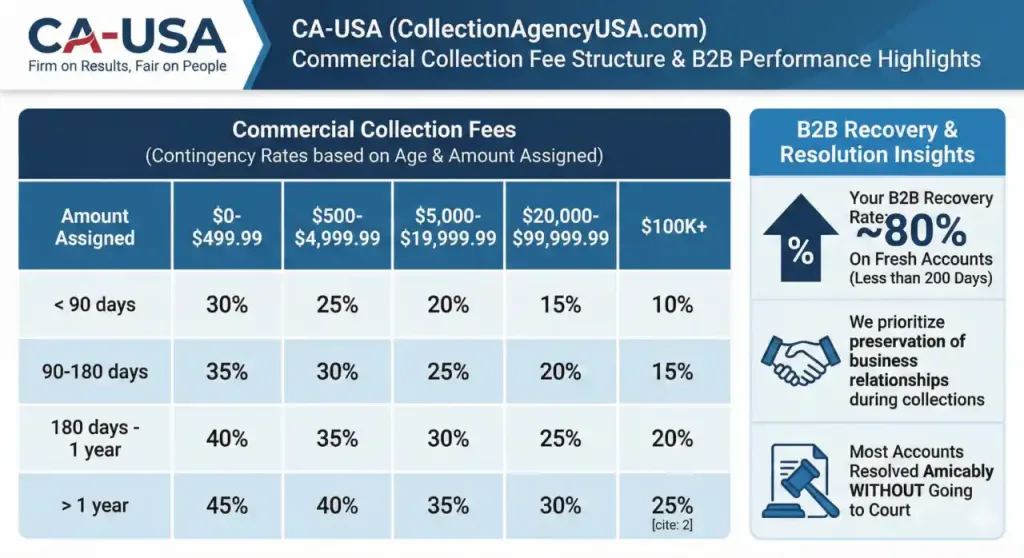
A simple rule holds: higher balances and younger accounts receive the lowest rates. Older, disputed, or hard-to-locate accounts require more work—and pricing reflects that.
If you’re sitting on fresh receivables, we bring urgency. On commercial accounts under 200 days, we average ~80% recovery. That’s not luck. That’s process, pressure, and professionalism.
Recent Ohio Commercial Recoveries
$78,400 Industrial Supply Balance — Dispute Isolated, 71% Recovered
An industrial supplier had a customer withholding an entire $78,400 balance because of a dispute involving only part of one shipment.
Rather than arguing over the whole account, the file was broken into disputed and undisputed charges. Documentation confirmed that most invoices had been accepted without objection.
The collection discussion then shifted from:
“Do you owe $78,400?”
to:
“Why is the undisputed balance still unpaid?”
A structured payment arrangement recovered approximately $55,700, while the genuinely disputed portion was handled separately.
Recovery: 71%
This approach avoided allowing a relatively narrow dispute to become an excuse for withholding the entire receivable.
$46,800 B2B Service Account — Business Verification Changed the Negotiation
A service company had been repeatedly told that its customer was experiencing severe financial problems and could not make payment.
Before accepting that explanation, business records and available account information were reviewed. The company was still operating, taking new business, and maintaining an active commercial presence.
Instead of immediately escalating legally, the collector approached the account from a different angle: the issue appeared to be payment priority rather than an inability to operate.
The conversation moved to a short, realistic payment schedule backed by consistent follow-up.
Approximately $33,000 was recovered without litigation.
Recovery: 70%
The key was verifying the debtor’s situation before deciding which recovery strategy made sense.
Ohio Contract Deadlines Make Waiting Risky
Ohio does not give every commercial obligation the same legal timeline.
Written contracts generally have a six-year limitation period, while certain non-written agreements generally have a four-year period.
For manufacturers, wholesalers, distributors, and equipment suppliers, another distinction matters: contracts for the sale of goods generally fall under Ohio’s UCC four-year period.
The underlying transaction therefore matters.
And even when years remain legally, waiting can still hurt recovery. Employees leave, businesses close, records become harder to locate, and competing creditors may appear.
Ohio Manufacturing Accounts Benefit From UCC-Aware Review
Ohio’s manufacturing, automotive, industrial equipment, and distribution sectors make UCC issues particularly relevant.
When appropriate, CA-USA reviews available:
- Contracts and purchase orders
- Personal guarantees
- Security agreements
- UCC information
- Invoice and delivery records
A UCC filing may reveal security interests or competing creditors, but it does not automatically prove whether the debtor has available cash.
It is one part of the commercial recovery picture.
An Ohio LLC’s Debt Is Not Automatically the Owner’s Debt
A common creditor question is:
“The company owes me money. Can I collect it from the owner?”
Usually not simply because someone owns or manages the LLC.
The situation can change when there is a valid personal guarantee or another recognized basis for individual liability.
That is why credit applications, guarantees, contracts, amendments, and signature pages should be preserved and submitted with the collection account.
Commercial Credit Reporting Can Add Non-Legal Leverage
Litigation should not be the first response to every unpaid commercial invoice.
For eligible delinquent accounts, business credit bureau reporting can provide additional leverage.
A delinquent commercial account may affect a company’s ability to obtain financing, vendor terms, or trade credit. That can encourage a debtor that has ignored normal collection requests to come back to the table.
CA-USA offers free business credit bureau reporting on eligible commercial accounts, subject to applicable documentation and reporting requirements.
The objective is not unnecessary escalation. It is to create enough legitimate commercial leverage to produce payment.
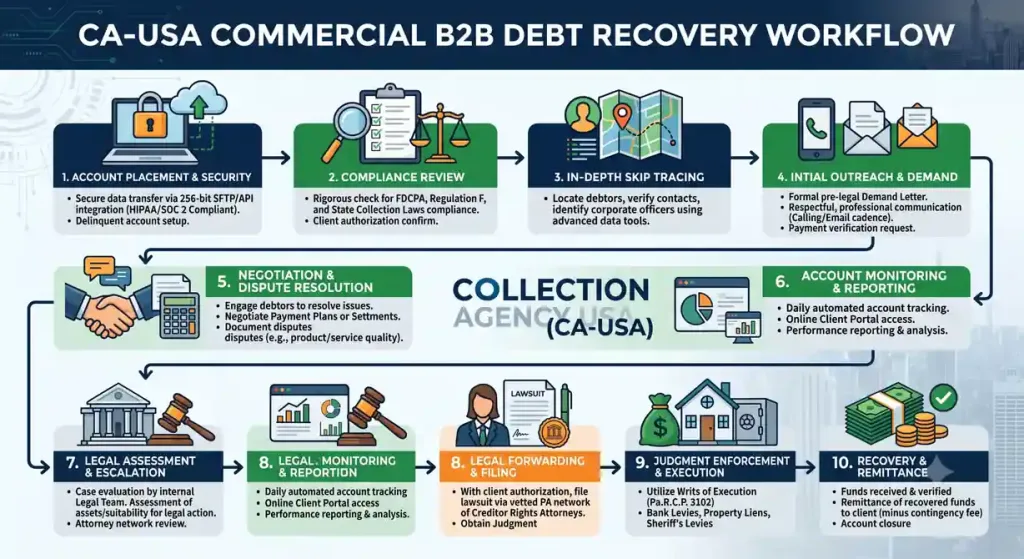
The CA-USA Ohio Commercial Collection Process
Once an account is placed, CA-USA follows a structured process:
1. Documentation Review
Contracts, invoices, purchase orders, correspondence, disputes, and guarantees are reviewed.
2. Business Verification & Screening
Business information, bankruptcy status, skip-tracing information, and other relevant account data are checked where appropriate.
3. Professional Outreach
Contact is directed toward people who can actually authorize payment — owners, controllers, CFOs, or accounts-payable managers.
4. Negotiation
The goal is payment in full where possible, or a practical short-term arrangement when appropriate.
5. Additional Commercial Leverage
Business credit reporting and other lawful non-legal recovery tools may be considered when negotiation stalls.
6. Attorney Referral as a Last Resort
If negotiations fail, we can recommend attorney escalation. Any legal action is pursued only after receiving your written approval.
What Should You Send With an Ohio Commercial Account?
Good documentation gives the collector more leverage and fewer unanswered questions.
Whenever available, provide:
- Signed contracts or credit applications
- Purchase orders
- Invoices and statements
- Proof of delivery or completion
- Payment history
- Email correspondence
- Dispute records
- Personal guarantees
- Security agreements
- Relevant UCC information
A strong collection file should quickly establish:
What was agreed? What was delivered? What became due? What remains unpaid?
Firm on the Balance. Professional With the People.
Some overdue customers may still be valuable customers.
CA-USA’s commercial approach is designed to distinguish a temporarily slow-paying customer from a company deliberately avoiding a legitimate obligation.
Negotiation comes first. Legal action comes later, if necessary.
The objective is to recover the receivable without unnecessarily destroying a relationship that may still have future value.
Frequently Asked Questions About Ohio Commercial Collections
Does the FDCPA apply to commercial B2B debt in Ohio?
The federal FDCPA generally applies to debts incurred primarily for personal, family, or household purposes and ordinarily does not cover genuine B2B debts. Commercial collections can still be subject to contracts, Ohio law, bankruptcy restrictions, UCC provisions, and other applicable requirements.
How long can an unpaid Ohio business invoice be pursued?
Written contractual claims generally have a six-year limitation period in Ohio. Certain non-written contracts generally have a four-year period, while contracts for the sale of goods generally fall under the UCC four-year period. The specific transaction and documentation should be reviewed before relying on a deadline.
How does Ohio’s UCC affect commercial collections?
The UCC may affect sales of goods, security interests, financing statements, collateral, and creditor priority. Relevant contracts, guarantees, security agreements, and UCC information should be reviewed when they could affect recovery options.
Can an Ohio B2B account be reported to business credit bureaus?
Eligible delinquent commercial accounts may be reportable when applicable documentation, accuracy, and reporting requirements are satisfied. Commercial credit reporting can provide additional non-legal leverage.
Can we collect an Ohio LLC’s debt from its owner?
Not merely because the individual owns the LLC. A valid personal guarantee or another legally recognized basis for individual liability may change the analysis.
What documents should I send with an Ohio commercial account?
Contracts, invoices, purchase orders, statements, proof of delivery or completion, payment history, correspondence, dispute records, guarantees, security agreements, and relevant UCC information are all useful.
When does CA-USA refer an Ohio account to an attorney?
Attorney referral is a last escalation. Documentation review, business verification, professional negotiation, dispute resolution, and other appropriate recovery tools are used first. Legal referral is considered only when further escalation makes commercial sense and the client approves it.
Ready to Recover an Ohio Business Account?

CA-USA handles commercial B2B collections throughout Columbus, Cleveland, Cincinnati, Dayton, Toledo, Akron, and the rest of Ohio.
| Need a Commercial Collection Agency? Contact Us Serving Hundreds of Businesses !Easy to use • Fully Compliant with Federal and State Laws • USA Citizens-Only Team • 24×7 Secure Portal • High Recovery Rates • Over 20 years Experience • Free Commercial Credit Bureau reporting • Low fee • Highly Rated ! |