An unpaid commercial invoice in Oregon can look straightforward until you examine what sits behind it.
Is it a software contract in Hillsboro? Equipment supplied to a contractor in Bend? A manufacturing invoice in Portland? Agricultural products delivered in the Willamette Valley?
The right recovery strategy can depend on the contract, the type of transaction, the age of the account and the debtor’s financial condition.
CA-USA helps businesses recover past-due commercial accounts across Portland, Hillsboro, Beaverton, Salem, Eugene, Bend, Medford and throughout Oregon using professional negotiation, contract review, bankruptcy screening, business verification, UCC-aware collection practices and commercial credit reporting where appropriate.
Our objective is to recover the money without unnecessarily damaging a customer, vendor or referral relationship.
Attorney referral is considered only after reasonable collection efforts fail, the documentation and economics support escalation, and the client approves the next step.

CA-USA provides a low cost, compliant, reputation-safe approach, equipped with all 50-state collections coverage, offering free credit reporting, free pre-litigation checks, free bankruptcy scrubs, and zero onboarding fees. Secure – SOC 2 Type II compliant. Over 2,000 online reviews rate us 4.85 out of 5. Over 20 years experience , delivering excellent B2B collection results.
You’ll receive the direct mobile number of a dedicated representative, ensuring prompt support by call or text whenever you need assistance.
Need a Commercial Collection Agency? Contact us
Oregon Commercial Recovery Starts With Three Questions
What Does the Contract Actually Say?
Before stronger collection activity begins, we review the available documentation, including:
- Contracts and credit applications
- Purchase orders
- Invoices and statements
- Delivery or completion records
- Emails and payment promises
- Personal guarantees
- Security agreements
- Relevant UCC information
If a customer disputes $5,000 of a $50,000 balance, that does not automatically mean the remaining $45,000 should stay unpaid.
Strong documentation helps separate a genuine dispute from a payment delay.
Which Oregon Deadline Applies?
Oregon commercial debts do not all operate on the same legal clock.
Many contract claims generally have a six-year limitation period.
Contracts involving the sale of goods generally fall under Oregon’s UCC four-year limitation period.
Construction accounts can involve much shorter lien deadlines.
The better question is not simply:
“How old is this invoice?”
It is:
“What type of transaction created the debt, and which deadline applies?”
Why Has the Business Stopped Paying?
A slow-paying business and a failing business should not automatically receive the same strategy.
We look for warning signs such as:
- Repeated broken payment promises
- Sudden invoice disputes
- Business relocation
- Returned communications
- Multiple creditor problems
- Temporary cash-flow pressure
- Bankruptcy
- Continued operations with deliberate nonpayment
That helps determine whether negotiation, a payment arrangement, commercial credit reporting or eventual legal review makes sense.
Oregon Has a Special Rule About Collection Agency Fees
Oregon gives commercial creditors an important option when their contracts are written correctly.
A creditor using a private collection agency may potentially add a reasonable collection fee to a commercial debt when:
- The agreement or contract creating the debt already authorizes the fee, and
- The amount added does not exceed the collection agency’s fee.
That makes collection-cost language worth considering before an account ever becomes delinquent.
Professional Negotiation Comes Before Legal Action
Our first objective is to reach someone who can actually resolve the balance, such as an owner, CFO, controller, finance manager or accounts-payable decision-maker.
We focus on four practical questions:
Is the balance acknowledged?
Is part of it genuinely disputed?
Why hasn’t it been paid?
What can realistically be resolved now?
For a viable Oregon business facing temporary cash-flow pressure, a structured payment arrangement may produce a better commercial result than immediate legal action.
Repeatedly broken payment promises call for a different strategy.

Commercial Credit Reporting Provides Non-Legal Leverage
Eligible delinquent business accounts may be reportable to participating commercial credit bureaus when applicable documentation and reporting requirements are satisfied.
Commercial payment history can influence how lenders, vendors and other businesses evaluate a company.
That creates an additional non-legal incentive to resolve an unpaid obligation without immediately moving the account toward court.
For nationwide commercial recovery, see our B2B Commercial Debt Recovery guide.
Oregon UCC Review: The Legal Debtor Name Matters
For a registered organization, an Oregon UCC financing statement generally needs the correct legal name shown in its organizational record.
A financing statement using only the debtor’s trade name may be insufficient.
This can matter when a customer operates through a:
- DBA
- LLC
- Corporation
- Trade name
- Related operating company
The correct legal entity can affect UCC searches, security interests, creditor priority, guarantees and eventual legal review.
A UCC filing also does not prove that a debtor has cash available. It can instead reveal whether other creditors already claim interests in equipment, inventory, receivables or other collateral.
Oregon Construction Receivables Have Much Shorter Deadlines
Contractors, subcontractors, equipment companies and material suppliers should not treat construction lien rights like an ordinary unpaid invoice.
Certain Oregon construction-lien claimants generally have 75 days to perfect lien rights, depending on the claimant and completion of the work.
A perfected lien generally also has a separate 120-day enforcement period, subject to statutory exceptions.
Sending an account to collections does not automatically preserve lien rights.
Construction receivables should therefore be reviewed early.
An Oregon LLC Debt Is Not Automatically the Owner’s Debt
Oregon generally treats an LLC’s debts as obligations of the company.
An owner or manager is not automatically personally liable simply because they own or manage the LLC.
A valid personal guarantee or another legally recognized basis for individual liability may change that.
The important question is not simply:
“Who owns the company?”
It is:
“What did that person actually agree to?”
Industries We Serve Across Oregon
Semiconductors & High Technology
The Portland-Hillsboro Silicon Forest supports semiconductor companies, technology businesses, engineering firms, equipment vendors and specialized suppliers.
Forestry, Wood Products & Manufacturing
Oregon’s forest-products and manufacturing sectors generate commercial receivables involving lumber, machinery, equipment, transportation and wholesale supply.
Agriculture, Food & Beverage
Farm suppliers, processors, packaging companies and distributors often encounter seasonal and supply-chain-related payment issues.
Businesses serving agriculture can also review our Collection Agency for Farm Supply & Agriculture Businesses resource.
Outdoor Gear & Apparel
Oregon’s outdoor, footwear and apparel ecosystem creates B2B receivables across design, manufacturing, distribution, logistics and professional services.
Construction & Trades
Contractors, subcontractors, material suppliers and equipment companies may face both ordinary collection issues and much shorter lien deadlines.
Professional & Technical Services
Software, engineering, staffing, consulting, marketing and other professional firms can accumulate significant unpaid B2B receivables.
Performance-Based Value (Aligned Incentives)
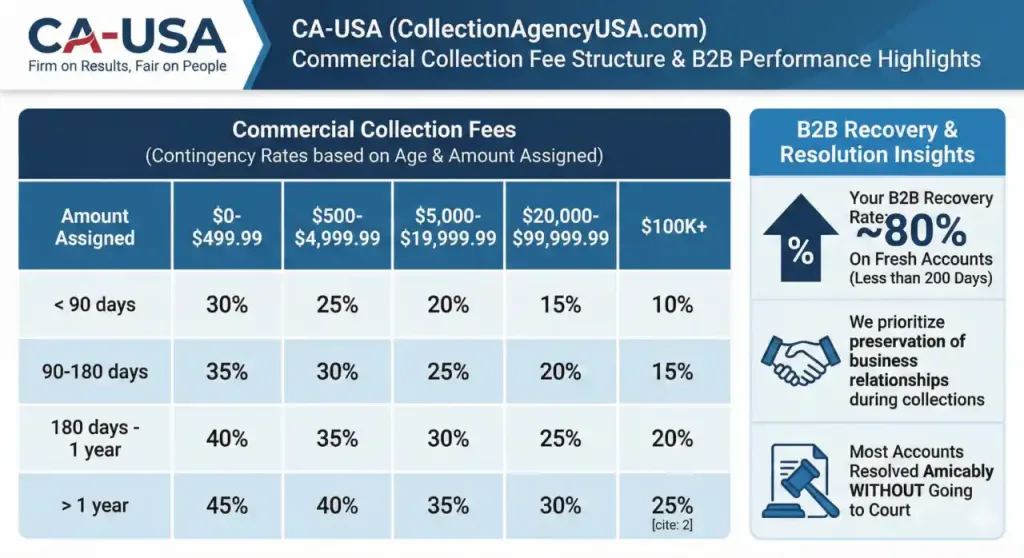
For Oregon commercial accounts, we use contingency-only pricing: typically 10% to 45%, based on balance size, age, and complexity—quoted upfront.
Higher balances and younger debt usually receive the lowest rates.
And here’s the metric that matters: we achieve ~80% recovery on fresh commercial accounts (under 200 days).
For more detail, see What Should a B2B Commercial Collection Agency Charge?.
Trust & Compliance
Oregon Collection Agency Registration
Oregon regulates third-party collection agencies through its Division of Financial Regulation and NMLS registration system.
CA-USA maintains applicable collection licensing and registration coverage for the accounts it services.
Contract & Invoice Review
We review documentation that can materially affect recovery rather than treating every account as an invoice-only problem.
Bankruptcy Screening
Accounts are screened before escalation so ordinary collection activity does not continue blindly after a bankruptcy filing.
Business Verification & Skip Tracing
Lawful business-information resources help confirm legal entities, operating status, addresses and relevant decision-makers.
Commercial Credit Reporting
Eligible delinquent commercial accounts may be reported to participating commercial credit bureaus when appropriate and permitted.
Reputation-Safe Collection
We remain firm about the balance while keeping communication professional and commercially sensible.
Secure Portal & SOC 2 Type II
Client information and account documentation are handled through a secure environment backed by SOC 2 Type II controls.
Nationwide Collection Licensing Coverage
CA-USA maintains nationwide collection licensing coverage, including required state licenses, registrations and bonds.
Attorney Referral — Last Resort
Legal escalation is considered only after reasonable collection and negotiation efforts fail, the economics support further action and the client approves the next step.
FAQs About Oregon Commercial Collections
Does Oregon require collection agencies to register for commercial debt collection?
Oregon’s Division of Financial Regulation registers third-party collection agencies through NMLS. Registration requirements and exemptions can depend on the company’s activities and how accounts are serviced.
Can I charge an Oregon business customer my collection agency fee?
Possibly. Oregon permits a creditor using a private collection agency to add a reasonable collection fee to qualifying commercial debt when the agreement creating the debt authorized the fee. The amount added cannot exceed the collection agency’s fee.
How long can an unpaid commercial invoice be collected in Oregon?
Many Oregon contract claims generally have a six-year limitation period. Contracts involving the sale of goods generally fall under Oregon’s UCC four-year limitation period. The applicable deadline depends on the transaction.
What should Oregon contractors know before sending an account to collections?
Construction-lien deadlines can be much shorter than ordinary contract limitation periods. Certain Oregon claimants generally have 75 days to perfect lien rights, followed by separate enforcement requirements. Collection activity does not automatically preserve those rights.
Can I collect an Oregon LLC’s unpaid debt from its owner?
Not simply because the person owns or manages the LLC. Oregon generally treats LLC debts as obligations of the company. A personal guarantee or another legally recognized basis for personal liability may change the situation.
Can an Oregon commercial account be reported to a business credit bureau?
Eligible delinquent commercial accounts may be reportable to participating commercial credit bureaus when documentation and reporting requirements are satisfied.
When does CA-USA refer an Oregon commercial account to an attorney?
Attorney referral is a last resort. CA-USA first uses documentation review, business verification, professional outreach, dispute resolution, negotiation, commercial credit reporting where appropriate and other non-legal recovery tools.
Legal referral is considered only after reasonable collection efforts fail, further escalation makes economic sense and the client approves it.
Ready to Recover an Oregon Business Account?
Good commercial recovery starts with three questions:
What does the contract say?
Which Oregon deadline applies?
Why has the debtor stopped paying?
CA-USA combines commercial negotiation, documentation review, debtor intelligence, UCC-aware analysis, commercial credit reporting and measured escalation to help recover overdue B2B receivables.
If you’re preparing accounts for placement, see How to Assign Your Accounts to a Collection Agency for the information and documents that help us begin efficiently.
Firm on the balance. Professional with the people. Legal only after reasonable recovery efforts have failed.
Oregon businesses run on tight timing—freight on I-5, suppliers along I-84, and contractors moving job-to-job across the Willamette Valley.
When invoices stall, it’s not just “late payment.” It’s a chain reaction: delayed purchasing, delayed hiring, delayed growth. If you sell B2B in Oregon, your collections approach must protect relationships while still producing results.
Recover your B2B debts? Contact us