
• Skip to main content
  • Skip to primary sidebar

Collection Agency USA

collections

by

Collection Agency for HVAC / Heating & Cooling Companies

HVAC Collection Agency

HVAC companies often face significant Accounts Receivable (AR) challenges that can impact cash flow and overall financial health. As a professional collection agency, we specialize in helping HVAC businesses navigate these issues effectively.

We understand your industry quite well and based on our experience, here are the main reasons of your unpaid invoices. By partnering with a specialized collection agency like ours, you can overcome these obstacles efficiently and ethically. We’re committed to helping you improve your cash flow, reduce bad debts, and enhance your overall financial stability.

We are the industry specialists. Our highest recovery rates are for HVAC and Restoration companies because we understand the unique pressure points of your trade—from Mechanics Liens to insurance intercepts.

Recovering for HVAC Clients Nationwide: Contact Us

Understanding the unique challenges of the HVAC industry allows us to offer tailored solutions that address your specific issues. We understand both B2B and B2C recoveried.

The numbers are brutal:

  • The 90-Day Drop: An unpaid invoice is worth only 87% of its value after 90 days. By 120 days, it plummets to 33%. Waiting to collect is literally expensive.

  • Restoration “Float”: The average restoration job takes 30-90 days to get paid by insurance. But if that check goes to the homeowner and they spend it, your wait time becomes indefinite.

  • HVAC Insolvency: Financial mismanagement due to cash flow gaps is a leading cause of the 95% failure rate for new contracting businesses within 5 years. High overhead + low margins (often 6-12% net) + unpaid invoices = bankruptcy.

Things you can do yourself:

  • Seasonal Demand Leverage – Use peak heating/cooling seasons to encourage clients to clear dues for priority service.

  • Equipment Repossession/Disablement – For leased systems, include clauses allowing repossession or remote shut-off if unpaid.

  • Maintenance Plan Suspension – Pause or revoke ongoing service/maintenance agreements until overdue balances are cleared, giving customers incentive to pay quickly.

How we handle Collections for HVAC Companies
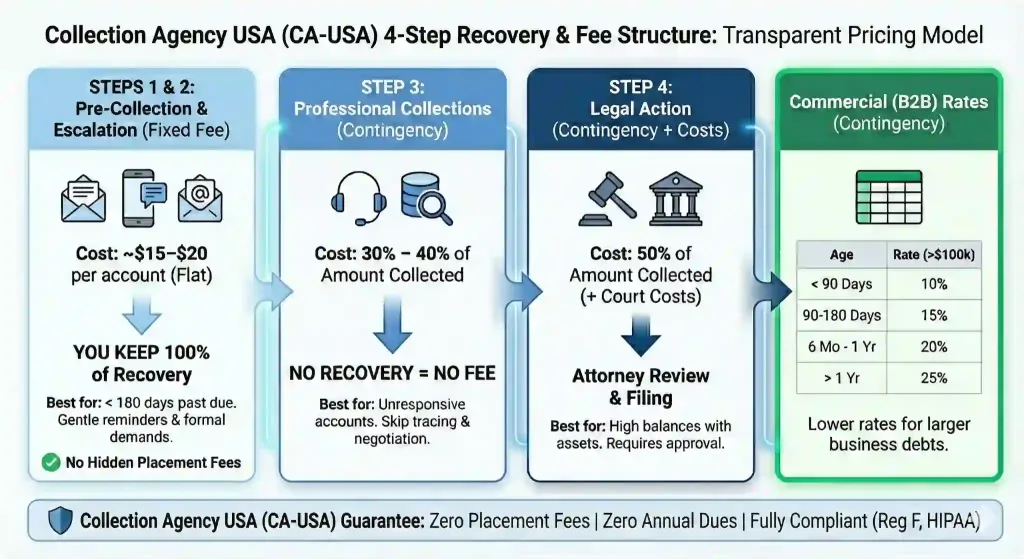
  1. Customized Collection Strategies: We develop strategies that align with your business model, whether you’re dealing with large commercial projects or a high volume of small residential accounts.
  2. Efficient Dispute Resolution: Our team is skilled in resolving billing disputes quickly, minimizing delays in payment and preserving client relationships.
  3. Advanced Skip Tracing: We utilize cutting-edge skip tracing techniques to locate clients who have changed addresses or contact information, ensuring no account falls through the cracks.
  4. Credit Risk Assessment: We assist in conducting thorough credit checks on new clients to mitigate the risk of future bad debts.
  5. Regulatory Compliance: Our processes are fully compliant with industry regulations and laws, protecting your business from legal complications.
  6. Flexible Payment Arrangements: We negotiate payment plans that consider your clients’ financial situations, increasing the likelihood of recovering debts.
  7. Enhanced Communication: Our professional approach ensures clear and respectful communication with your clients, which can improve payment rates and client retention.
  8. No Recovery, No Fee Policy: Our services are contingency-based—you incur no costs unless we successfully recover the owed amounts.

The Specific Challenges You Face (And How We Fix Them)

1. The “Insurance Check” Heist (Restoration)

  • The Stat: 100% of restoration companies report revenue loss due to payment delays or disputes, and 34% take more than a month to recover financially from significant cash flow disruptions.

  • The Fix: We don’t just send letters. We use skip-tracing to locate homeowners who cashed your insurance check and leverage Theft by Conversion statutes to force repayment.

2. The “Job Complete” Dispute (HVAC)

  • The Stat: 27% of invoice delays in trade services are due to disputes over quality or terms.

  • The Fix: We separate legitimate warranty issues from bad-faith stalling. If they signed off on the work, we enforce the contract—often utilizing Confession of Judgment clauses (where legal) to bypass frivolous disputes.

3. The Customer Acquisition Cost (CAC) Trap

  • The Stat: Acquiring a new HVAC customer costs $200–$350. Losing just one customer to a bad collection experience wipes out the profit from 5 future service calls.

  • The Fix: Our “Diplomatic” Phase 1 retains customers. We recover the funds without burning the bridge, allowing you to keep that hard-earned client for future maintenance contracts.

4. The “90-Day” Profit Killer

  • The Stat: An invoice that is 90 days overdue is worth only 87% of its face value. By 120 days, it drops to 33%.

  • The Fix: We offer a Flat-Fee Early Intervention service (approx. $15/account) that targets accounts at Day 60, recovering funds while they are still highly collectible—at a fraction of the cost.

5. The “Seasonal” Cash Flow Gap

  • The Stat: HVAC companies that manage seasonal cash flow poorly are 30% more likely to fail.

  • The Fix: We structure payment plans that bridge the gap. During “shoulder seasons” (Spring/Fall), we secure consistent monthly payments from past-due accounts to smooth out your revenue peaks and valleys.

6. High Failure Rates for New Contractors

  • The Stat: 95% of new restoration and contracting businesses fail within 5 years, largely due to cash flow mismanagement.

  • The Fix: We act as your back-office safety net. By outsourcing collections, you reduce overhead and ensure that every completed job actually turns into revenue, keeping you out of that 95% statistic.

Common AR Challenges Faced by HVAC Companies

  1. Seasonal Cash Flow Variability: HVAC services experience high demand during extreme weather seasons—summer and winter. This seasonality leads to uneven revenue streams, causing cash flow shortages during off-peak periods.
  2. Delayed Payments from Clients: Both residential and commercial clients may postpone payments due to their financial constraints or lengthy internal processes. Extended payment terms strain working capital and can hinder the ability to cover operational expenses.
  3. Large Project Invoices: Significant installation projects involve substantial upfront costs for equipment and labor. Clients might find it challenging to pay large invoices in one go, leading to delays or requests for extended payment terms.
  4. Disputed Charges and Invoice Errors: Misunderstandings about the scope of work, unexpected additional costs, or billing inaccuracies can result in clients disputing invoices. Resolving these disputes consumes time and delays payments.
  5. Inefficient Invoicing Processes: Unfortunately, relying on manual or outdated invoicing systems can cause errors and delays in sending out invoices. Inefficient processes make tracking outstanding payments and following up with clients more challenging.
  6. Credit Risk and Bad Debts: Extending credit without proper credit checks increases the risk of non-payment. Accumulating bad debts negatively impacts profitability and financial stability.
  7. High Volume of Small Transactions: Routine maintenance and minor repair jobs generate numerous small invoices. Managing and collecting on a high volume of small accounts can be administratively burdensome and costly.
  8. Limited Payment Options: Offering a narrow range of payment methods can hinder clients from paying promptly, especially if their preferred option isn’t available.
  9. Regulatory Compliance: Keeping up with tax laws, licensing requirements, and industry regulations demands meticulous record-keeping. Non-compliance can lead to fines and complicate the AR process.
  10. Economic Fluctuations: Economic downturns can affect clients’ ability to pay on time. During such periods, clients may prioritize other expenses over HVAC services, leading to increased payment delays and defaults.
  11. Lack of Clear Payment Terms: Vague or inconsistent payment terms cause confusion and delay payments. Clients need clear information about due dates, late fees, and accepted payment methods.


Filed Under: collections

by

Collection Agency for Farm Supply & Agriculture Businesses

farm supply collections

Farm supply and agriculture businesses expect a collection agency to be easy to use and to offer cost-effective services. In this industry, the agency must efficiently recover overdue accounts receivable while preserving your most valuable asset: your relationship with the grower/client.

At Collection Agency USA, we understand that agriculture operates on a different clock than the rest of the business world. We know that cash flow is seasonal, and your customers are often waiting on harvest yields or government subsidies.

We don’t just collect debt; we understand Agribusiness. Whether you are selling seed, feed, fertilizer, fuel, or heavy equipment, we have the tools to recover your capital without becoming the enemy of the local farming community.

We Understand: Relationships Are Everything

Because the pool of customers in a farming community is not vast, it is crucial for businesses operating in the agriculture sector to focus on retaining the customers they already have. A heavy-handed approach can ruin a relationship that has lasted generations. That is why we use a “Diplomatic Recovery” method first.

Hire a Collection Agency: Contact us

Serving nationwide

Our “Harvest-Cycle” Recovery Process (Steps 1–4)

A collection agency should offer flexible options that match the age of the debt. We offer a structured approach designed to escalate only when necessary.

blank

Step 1: The “Soft” Reminder (Fixed Fee)

  • Best for: Accounts 60–90 days past due (or post-harvest delays).

  • The Service: We send a series of professional, diplomatically worded letters reminding the grower of their obligation.

  • The Benefit: You pay a low flat fee (approx. $15/account). You keep 100% of the money collected. This looks like a standard administrative follow-up, preserving your relationship.

Step 2: Escalated Demands (Fixed Fee)

  • Best for: Accounts that ignored Step 1.

  • The Service: The tone becomes firmer. We send attorney-approved demand letters that signal serious intent.

  • The Benefit: Still a low fixed cost. It shows the debtor that you have escalated the matter to a third party.

Step 3: Intensive Collections (Contingency)

  • Best for: Accounts 120+ days old or broken promises.

  • The Service: Our specialized agricultural collectors begin phone negotiations. We work to understand the debtor’s true financial position—are they waiting on a crop check? Is there a dispute? We negotiate payment plans aligned with their revenue events.

  • The Cost: No recovery, no fee. We only get paid a percentage of what we collect.

Step 4: Legal Litigation

  • Best for: Large commercial balances or refusal to pay despite assets.

  • The Service: If all else fails, and with your explicit permission, we can forward the file to our network of attorneys to pursue legal judgments or enforce agricultural liens.

Our recovery strategies strictly account for key agricultural legal frameworks, including Packers and Stockyards Act (PSA) compliance and state-specific Uniform Commercial Code (UCC) filings on farm products and equipment.


Best Practices: Before You Send to Collections

1. Send Prompt and Clear Invoices

Farmers are busy. Issue invoices immediately after delivering crops, livestock, or supplies. Ensure terms (Net 30, Net 60) are clearly stated.

2. Follow Up Consistently

A polite reminder shortly after the due date ensures accounts don’t go stale. If you don’t have the staff for this, our Step 1 service is the perfect outsourcing solution.

3. Recognize the “Red Flags”

If a grower is avoiding your calls after harvest, or if they are buying supplies from a competitor while owing you money, it is time to act.

Common Reasons for Overdue Ag Accounts

Farm supply businesses often extend credit to accommodate the seasonal nature of agriculture, where expenses for seeds and chemicals occur months before income is realized. However, you are not a bank. Overdue accounts often stem from:

  • Cash Flow Gaps: Waiting for commodity sales.

  • Yield Issues: Poor crops or weather events.

  • Disputes: Claims of equipment malfunction or product efficacy.

Don’t let your invoices wait for “next season.“ Recover your funds while maintaining professional respect.

Need an Experienced Collection Agency: Contact us


Frequently Asked Questions

Can I put a lien on a farmer’s crops or livestock if they don’t pay for feed, seed, or fertilizer I supplied?

In many states, yes. Most states have a statutory agricultural supplier’s lien (sometimes called a feed dealer’s lien or crop-input lien) that lets suppliers of seed, feed, fertilizer, chemicals, and fuel claim a lien on the crops or livestock those inputs helped produce, separate from a signed contract. The catch: these liens are entirely state-specific. Filing windows can be as short as 30–45 days from the date of sale, and priority against a bank’s existing blanket lien on the farm’s assets isn’t automatic. That’s exactly why lien enforcement sits at Step 4 of our process and runs through our attorney network rather than being filed alone — a late or improperly perfected lien can lose its priority entirely.

A grower offered to pay their invoice in grain, livestock, or equipment instead of cash. Should I take the deal?

It can work — but treat it like a negotiated settlement, not a favor. Get the in-kind value appraised or benchmarked against current commodity prices before agreeing, put the terms in writing (what’s transferring, when, and how it offsets the balance), and confirm the farmer actually holds clear title to what’s being offered. Grain or livestock already pledged to a lender may not be theirs to give away. We can structure and document these arrangements as part of our negotiation step so the trade holds up if a dispute comes up later.

The farmer who owes us handed the operation to their son or daughter. Can we still collect, and from whom?

It depends on how the debt and the transfer were structured. If the original owner personally guaranteed the account, that liability doesn’t typically disappear just because day-to-day management changed hands — you’d usually still pursue the original debtor unless the successor formally assumed the obligation in writing. If the operation passed through an entity sale, inheritance, or a new LLC, it gets more layered. We work through who’s actually responsible before escalating, so we’re not chasing the wrong party or straining a relationship with a next-generation owner who never agreed to their parent’s debt.

My customer says they’re waiting on a USDA payment, crop insurance settlement, or disaster relief check before they can pay. Should we hold off on collections?

Waiting passively is usually the wrong move, even when the explanation is genuine. Government and insurance payments are notorious for slipping past their expected date, and an account left alone “until the check arrives” often goes quiet indefinitely. The better approach is to keep the file moving at the low-key Step 1 level — a documented reminder that keeps the account current — without escalating to the point that damages the relationship. If the payment really is coming, a brief, professional touch rarely offends anyone; if it isn’t, you’ve lost no time finding that out.

Is there a wrong time of year to start collections on a farm account?

Timing matters more in agriculture than in almost any other industry we work with. Reaching out heavily during planting or harvest, when a grower is in the field most of the day and cash is genuinely tied up in the ground, tends to generate ignored calls rather than payment. The stronger windows are just after harvest, when crops have sold and cash is actually in hand, or during the winter off-season, when growers are doing their books and are far easier to reach. Our Harvest-Cycle process is built around that rhythm deliberately, instead of applying a generic 30/60/90-day timeline that ignores when farm income actually shows up.

Filed Under: collections

  • « Go to Previous Page
  • Page 1
  • Interim pages omitted …
  • Page 4
  • Page 5
  • Page 6

Primary Sidebar

CA-USA: A 4.87 Rated Agency!

Collection Agency Good Reviews

Need a Collection Agency?

Kindly fill this form.
We’ll get in touch with you

    Please prove you are human by selecting the truck.

    Recent Posts

    • 2027 B2B Promise-to-Pay Index: Payment Promise Benchmarks & Methodology
    • Utah Commercial Collection Agency for B2B Debt Recovery
    • Virginia Commercial Collection Agency | B2B Debt Recovery | Local
    • What Collection Agencies Do That Restoration Companies Can’t Handle In-House
    • Georgia Commercial Debt Recovery: Delivering Exceptional Recovery

    Featured Posts

    • Services Collection Agencies Offer That Dentists Can’t Handle In-House
    • Statute of Limitations for Commercial Debt Collection: A Creditor’s Guide
    • Recovering Company Equipment/Laptop Cost from Ex-Employees: Why and How to Do It Right
    • Commercial Collection Agency: ~80% Recovery on Newer Debt
    • Professional Debt Collection Services in California

    Copyright © 2026 ·Copyright: CollectionAgencyUSA.com (CA-USA) | This content is provided for general informational purposes only and should not be considered legal advice. Collection laws and requirements may vary by state, account type, documentation, debtor status, and specific facts. Please consult qualified legal counsel for guidance regarding your particular situation. CA-USA and its authorized collection partners service accounts in accordance with applicable federal and state collection requirements.. Visit our home page to know more about us.

    X
    Need a Collection Agency?
    Contact Us