New Jersey is one of the country’s densest commercial corridors.
A container can arrive through Port Newark–Elizabeth, move through a warehouse or distributor, supply a pharmaceutical or manufacturing company, and create several B2B invoices before the product ever reaches its final customer.
When one business in that chain stops paying, the problem can spread quickly.
CA-USA helps businesses recover past-due commercial accounts across Newark, Jersey City, Elizabeth, Edison, Trenton, Princeton, Parsippany, New Brunswick and throughout New Jersey using professional & respectful negotiation, contract and invoice review, bankruptcy screening, business verification, UCC-aware collection practices and commercial credit reporting where appropriate.
Our objective is not maximum pressure.
It is to determine who legally owes the money, why payment stopped, what the documents prove and which recovery tools actually make commercial sense.
Attorney referral is considered only after reasonable collection and negotiation efforts fail, the documentation and economics justify escalation, and the client approves the next step.

CA-USA provides a low cost, compliant, reputation-safe approach, equipped with all 50-state collections coverage, offering free credit reporting, free pre-litigation checks, free bankruptcy scrubs, and zero onboarding fees. Secure – SOC 2 Type II compliant. Over 2,000 online reviews rate us 4.85 out of 5. Over 20 years experience , delivering excellent B2B collection results.
We’ll provide you with the direct mobile number of a dedicated representative, so support is always just a call or text away whenever you need it.
Need a NJ Commercial Collection Agency? Contact us
The Commercial Reconciliation Workflow
CA-USA uses a structured commercial collection process designed for complex New Jersey B2B accounts.
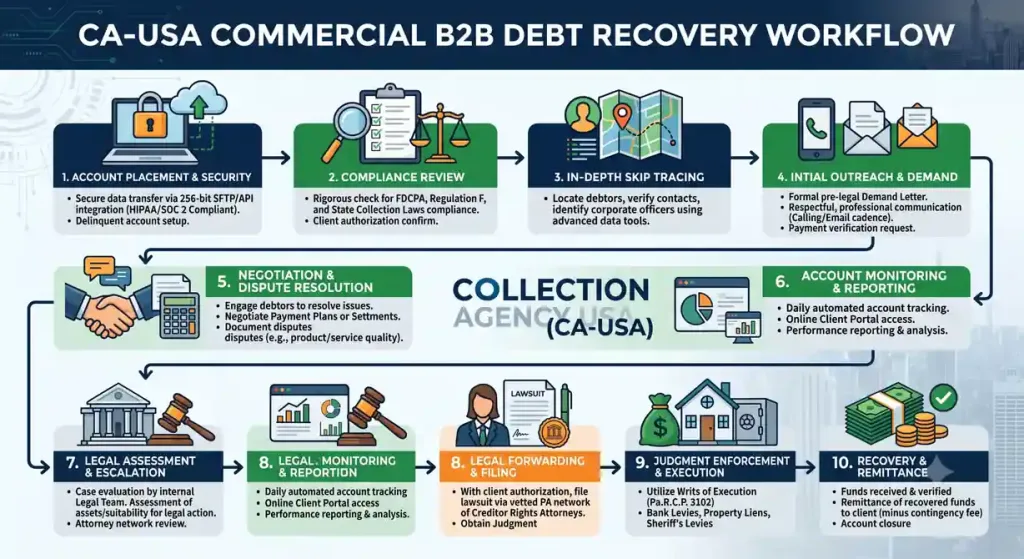
For our broader nationwide approach, see B2B Commercial Debt Recovery.
New Jersey Commercial Debt Often Travels Through a Chain
A New Jersey commercial receivable frequently involves more than one buyer and seller.
Consider a logistics transaction:
Importer → freight provider → warehouse → distributor → retailer
Or a life-sciences transaction:
Research company → laboratory → equipment supplier → manufacturer → distributor
When payment fails somewhere in that chain, simply sending another demand letter may not tell us enough.
We want to understand:
- Which legal entity contracted for the goods or services?
- Was delivery or performance completed?
- Is any portion of the invoice genuinely disputed?
- Has the debtor changed locations or entities?
- Is there a personal guarantee?
- Does a security interest exist?
- Has bankruptcy been filed?
- Is another creditor already ahead of you?
In New Jersey’s fast-moving commercial environment, documentation and debtor identification can be as important as persistence.
New Jersey Collection Agencies Have a Specific Bond Requirement
New Jersey requires businesses operating as collection agencies or collecting accounts for others to maintain applicable collection-agency bonding requirements.
The state’s current collection-agency bond filing process uses a $5,000 bond.
That makes state compliance more than a generic trust statement.
CA-USA maintains applicable licensing, registration and bonding coverage for the accounts it services.
There Is No Single New Jersey Deadline for Every B2B Invoice
Many Contractual Claims — Generally Six Years
New Jersey generally provides a six-year limitation period for many contractual claims and liabilities.
But that rule should not be applied automatically to every commercial invoice.
For more on how deadlines vary, see our Statute of Limitations for Debt Collection resource.
Sale of Goods — Generally Four Years
Contracts involving the sale of goods generally fall under New Jersey’s UCC four-year limitation period.
That distinction can matter to:
- Pharmaceutical suppliers
- Medical-device vendors
- Manufacturers
- Equipment companies
- Wholesalers
- Food distributors
- Packaging suppliers
- Industrial suppliers
A written invoice should therefore not automatically be treated as a six-year claim.
The transaction itself matters.
When a Debtor Says “We Dispute It,” Find the Actual Dispute
Commercial disputes are rarely all-or-nothing.
Suppose a New Jersey distributor owes $85,000 but claims $9,000 of the shipment was incorrect.
The question should not immediately become:
“Do we sue for $85,000?”
A better first question is:
“Why is the undisputed $76,000 still unpaid?”
We review available:
- Contracts
- Credit applications
- Purchase orders
- Invoices
- Statements
- Delivery confirmations
- Completion records
- Emails and correspondence
- Payment promises
- Credits
- Personal guarantees
- Security agreements
Separating a legitimate dispute from a payment excuse can unlock money without unnecessarily damaging a commercially valuable relationship.
New Jersey UCC Searches Start With the Correct Legal Entity
New Jersey’s UCC makes debtor identification especially important.
For a registered organization, a financing statement generally needs the company’s correct legal name from its organizational record.
Using only a debtor’s trade name may be insufficient.
That matters when a customer operates through:
- A DBA
- Trade name
- LLC
- Corporation
- Subsidiary
- Related operating company
In New Jersey, where businesses often operate through multiple corporate entities, invoicing the familiar business name is not always enough.
The correct legal entity can affect:
Contract enforcement → UCC searches → security interests → creditor priority → guarantees → attorney review
A UCC filing also does not mean the debtor has money available.
It may instead indicate that a bank or another creditor already has a security interest in equipment, inventory, receivables or other collateral.
A New Jersey LLC’s Debt Is Not Automatically the Owner’s Debt
New Jersey generally treats the debts and liabilities of an LLC as obligations of the company.
They do not automatically become the debts of an owner or manager merely because that person owns or manages the business.
A properly executed personal guarantee or another legally recognized basis for personal liability can change the analysis.
That is why finding the owner is not enough.
The real question is:
Did that person actually agree to guarantee the obligation?
New Jersey Construction Accounts Need Faster Attention
Commercial construction invoices run on a much faster timetable than ordinary contract claims.
For non-residential construction, eligible New Jersey contractors, subcontractors and suppliers generally have 90 days after the last qualifying work, services, materials or equipment to record a lien claim.
Separate enforcement deadlines also apply.
Sending an account to collections does not automatically preserve construction-lien rights.
For contractors and suppliers, a 90-day lien deadline can matter far more than the ordinary age of the invoice.
Commercial Credit Reporting Adds Non-Legal Leverage
Eligible delinquent commercial accounts may be reportable to participating commercial credit bureaus when applicable documentation and reporting requirements are satisfied.
Commercial payment history can affect how lenders, suppliers and other businesses evaluate a company when extending future credit.
That provides an additional commercial consequence for continued nonpayment without automatically turning every delinquent account into litigation.
The goal is not to threaten to destroy a company’s credit.
It is another professional recovery tool.
New Jersey Industries Where B2B Receivables Become Complex
Life Sciences, Pharma & Medical Technology
New Jersey has one of the country’s strongest pharmaceutical, biotechnology, medical-technology and life-sciences ecosystems.
Commercial balances can involve:
- Laboratory equipment
- Research services
- Medical devices
- Packaging
- Technology
- Staffing
- Manufacturing
- Distribution
- Specialized professional services
These accounts can be highly documented and contract-heavy, making careful review especially important.
Transportation, Warehousing & Logistics
New Jersey’s location between major Northeast markets makes logistics one of its defining commercial industries.
Receivables may involve:
- Freight
- Warehousing
- Distribution
- Trucking
- Import/export services
- Equipment
- Packaging
- Third-party logistics
Port Newark–Elizabeth further connects the state to international cargo, rail, warehousing and distribution networks.
Advanced Manufacturing
New Jersey’s manufacturers span pharmaceuticals, medical devices, aerospace components, electronics, food products and precision manufacturing.
Commercial claims may involve high-value equipment, components, tooling, purchase orders and UCC issues.
Technology & Professional Services
Software, IT, engineering, staffing, consulting and professional-service businesses often extend substantial unsecured credit simply by performing work before receiving payment.
Food & Beverage
New Jersey’s food manufacturers, distributors, packaging businesses, cold-storage operators and logistics providers create another substantial B2B network where delivery documentation and payment terms matter.
Performance-Based Value: Alignment of Interests
Our “Firm on Results, Fair on People” philosophy is backed by a transparent, contingency-only pricing model. At CA-USA, we are on the same team. Because our fee is tied directly to your success, we are fully invested in your recovery. To move things forward with maximum speed and seriousness, we ask that you share all contracts and communication proofs promptly; the more data we have, the faster we can pressure the debtor.
Our fees range from 10% to 45%, dictated by the balance size, the age of the debt, and the complexity of the case. By design, higher balances and younger debt receive our most competitive rates.
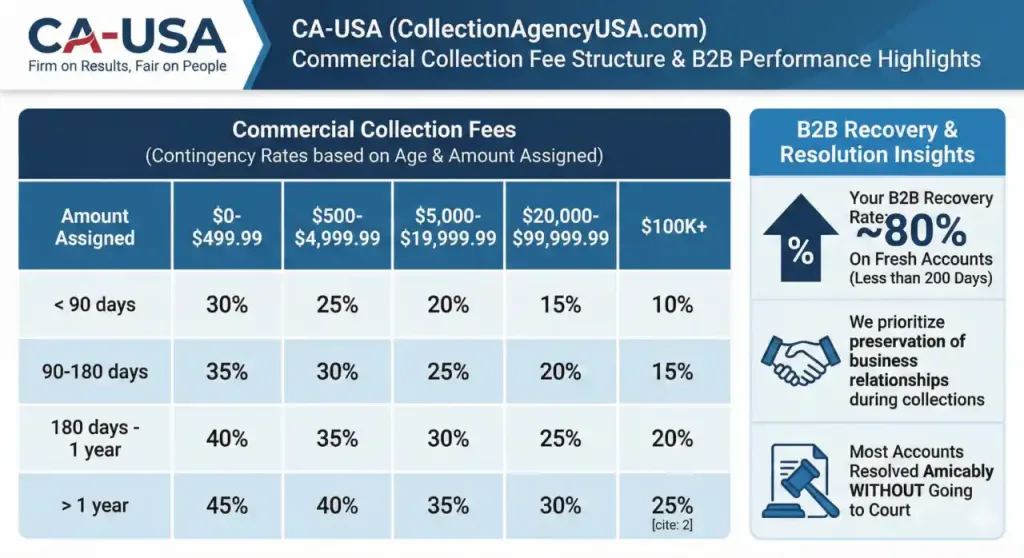
The 80% Performance Edge
Timing is the single greatest predictor of success in the commercial collection agency industry. CA-USA has achieved recovery rates around 80% on qualifying, well-documented commercial accounts placed less than 200 days past due. Actual recovery varies by account. By intervening before a debt “ages out,” we maximize the likelihood of a full recovery while minimizing the need for heavy-handed legal tactics.
For a deeper explanation of pricing, see What Should a B2B Commercial Collection Agency Charge?.
What We Do Before Recommending Legal Escalation
Contract & Invoice Review
We establish what was agreed, what was delivered and what remains unpaid.
Business Verification & Skip Tracing
We verify legal entities, operating status, updated addresses and relevant decision-makers.
Bankruptcy Screening
If bankruptcy protection applies, ordinary collection activity must change immediately.
Dispute Resolution
We identify the actual disputed amount rather than allowing an entire balance to remain unresolved indefinitely.
UCC-Aware Review
Security agreements and relevant financing information can materially affect creditor leverage.
Commercial Credit Reporting
Eligible accounts may receive additional non-legal leverage through participating commercial credit bureaus.
Negotiation & Payment Arrangements
A viable company experiencing temporary financial pressure may respond better to a structured payment solution than immediate litigation.
Attorney Referral — Last Resort
Attorney referral is considered only after reasonable collection and negotiation efforts fail, the account supports further escalation and the client approves the next step.
Trust, Security & New Jersey Compliance
CA-USA combines:
- More than 20 years of collection experience
- New Jersey collection-agency bond compliance where applicable
- Nationwide collection licensing coverage, including required state licenses, registrations and bonds
- SOC 2 Type II controls
- Bankruptcy screening
- Business skip tracing and verification
- Commercial credit reporting where eligible
- Dedicated support
- Reputation-conscious negotiation
- Attorney referral only as a final escalation
Firm on the balance does not have to mean reckless with the relationship.
FAQs About New Jersey Commercial Collections
Does New Jersey require a collection agency license or bond?
New Jersey requires businesses operating as collection agencies or collecting accounts for others to maintain applicable collection-agency bonding requirements. The state’s current collection-agency bond filing process uses a $5,000 bond.
How long can I collect an unpaid New Jersey business invoice?
Many New Jersey contractual claims generally have a six-year limitation period. Contracts involving the sale of goods generally fall under New Jersey’s UCC four-year limitation period. Other rules and exceptions may apply depending on the transaction, so the underlying agreement should be reviewed before assuming a deadline.
Why does the legal business name matter in New Jersey commercial collections?
The entity operating under a trade name may not be the entity legally responsible for the debt. Correct identification becomes especially important for contracts, guarantees and UCC financing statements. Using only a trade name can also create problems when determining secured-creditor rights.
Can I collect a New Jersey LLC’s debt from its owner?
Not merely because someone owns or manages the LLC. New Jersey generally treats an LLC’s debts and liabilities as obligations of the company. A valid personal guarantee or another legally recognized basis for personal liability may change the analysis.
What should New Jersey contractors know before sending an account to collections?
For non-residential construction, eligible New Jersey contractors, subcontractors and suppliers generally have 90 days after the last qualifying work, services, materials or equipment to record a lien claim. Separate enforcement deadlines apply. Sending an account to collections does not itself preserve lien rights.
Can an unpaid New Jersey B2B account be reported to a commercial credit bureau?
Eligible delinquent commercial accounts may be reportable to participating business credit bureaus when applicable documentation and reporting requirements are satisfied.
What documents should I provide with a New Jersey commercial collection account?
Useful documentation can include contracts, credit applications, purchase orders, invoices, statements, delivery records, correspondence, payment history, disputes, guarantees and relevant security agreements or UCC information. Better documentation generally makes it easier to identify the correct recovery strategy.
When does CA-USA refer a New Jersey commercial account to an attorney?
Attorney referral is a last resort. CA-USA first uses documentation review, business verification, professional outreach, dispute resolution, negotiation, commercial credit reporting where appropriate and other non-legal recovery tools.
Legal referral is considered only after reasonable collection efforts fail, escalation makes commercial sense and the client approves it.
Ready to Recover a New Jersey Business Account?
New Jersey commercial debt often moves through complicated relationships and multiple legal entities.
Before escalating, ask:
Who actually owes the money?
Is this a service obligation or a sale of goods?
What does the documentation prove?
Is a UCC or construction deadline running?
Why has payment stopped?
CA-USA combines commercial negotiation, documentation review, debtor intelligence, UCC-aware analysis, commercial credit reporting and measured escalation to help recover overdue B2B receivables.
For information on preparing your placement, see How to Assign Your Accounts to a Collection Agency.
Firm on the balance. Professional with the people. Legal only after reasonable recovery efforts have failed.
New Jersey B2B Debt Recovery: Securing Your Revenue
Need a New Jersey Commercial Collection Agency? Contact us