An unpaid invoice can create a different problem in Vermont than it does in a larger market. In a state where manufacturers, farms, food producers, resorts, professional firms and suppliers often work with the same customers for years, collecting too aggressively can cost more than the balance itself.
CA-USA helps Vermont businesses recover past-due commercial accounts across Burlington, South Burlington, Montpelier, Rutland, Bennington, Brattleboro and throughout Vermont using reputation-safe negotiation, contract review, bankruptcy screening, business verification, UCC-aware collection strategy and commercial credit reporting where eligible.
Our objective is not simply to apply maximum pressure.
It is to determine why the account remains unpaid, what leverage actually exists and how to recover the money without unnecessarily damaging a commercially valuable relationship.
Attorney referral is considered only after reasonable collection and negotiation efforts fail, the documentation and collectability support further escalation, and you approve the next step.
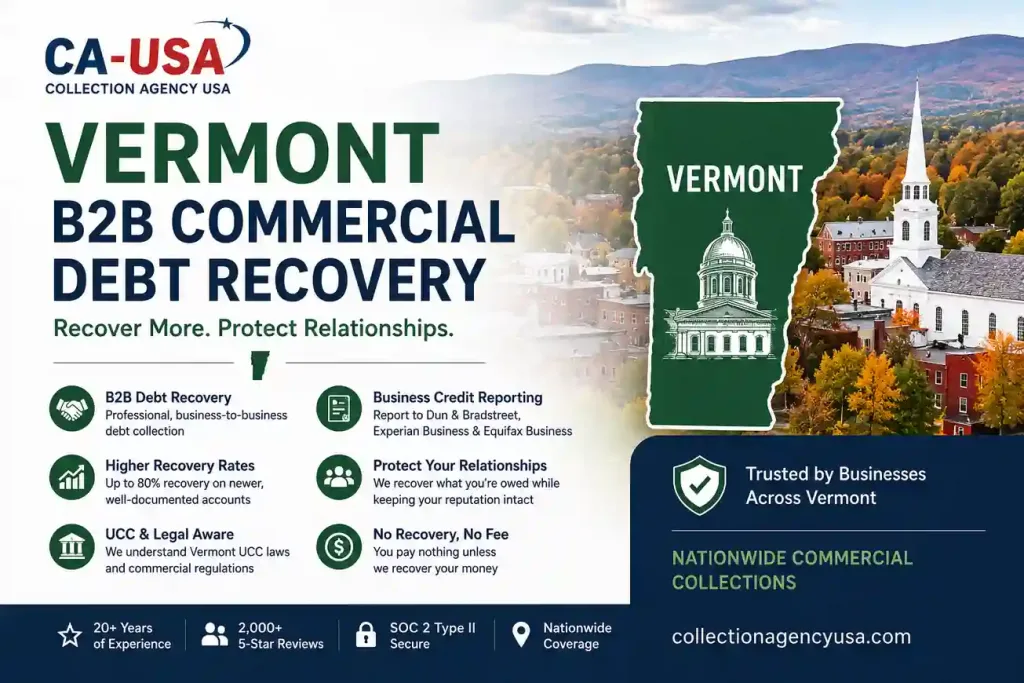
CA-USA provides a low cost, compliant, reputation-safe approach, equipped with all 50-state collections coverage, offering free credit reporting, free pre-litigation check, free bankruptcy scrubs, and zero onboarding fees. Secure – SOC 2 Type II compliant. Over 2,000 online reviews rate us 4.85 out of 5. Over 20 years experience , delivering excellent B2B collection results.
You’ll receive the direct mobile number of a dedicated representative, ensuring prompt support by call or text whenever you need assistance.
Need a Commercial Collection Agency? Contact us
Vermont Is a Small Market With Complex Commercial Relationships
Vermont’s economy is built around industries that often depend on long-term supplier and customer relationships.
A manufacturer may buy specialized components from the same regional supplier for years.
A ski resort may depend on dozens of local contractors, distributors and equipment vendors.
A dairy or specialty-food producer may have seasonal cash-flow cycles that look very different from those of a software or professional-services company.
A captive-insurance administrator in Burlington may be dealing with sophisticated consulting, accounting or technology agreements rather than ordinary trade invoices.
That matters when a balance becomes delinquent.
The correct collection strategy for a solvent long-term customer experiencing a temporary timing problem should not necessarily be the same as the strategy for a company that has broken three payment promises and stopped answering.
Vermont commercial collections require judgment, not just persistence.
Businesses with customers in multiple states can also review our B2B Commercial Debt Recovery guide for the broader nationwide commercial collection framework.
Before We Contact the Debtor, We Want Three Questions Answered
Who Actually Owes the Money?
A surprisingly common commercial collection problem is pursuing the wrong entity.
The customer may operate under:
- A trade name
- A DBA
- An LLC
- A corporation
- A subsidiary
- A related operating company
The name printed on the storefront may not be the legal entity that signed the agreement.
We compare available contracts, invoices, purchase orders, credit applications and business information so collection begins with the correct debtor.
That distinction can become particularly important when security interests, personal guarantees or attorney referral are later considered.
What Does the Documentation Actually Prove?
A strong commercial collection file should tell one consistent story:
What was agreed → what was delivered → what became due → what remains unpaid.
Useful documents may include:
- Contracts
- Credit applications
- Invoices
- Purchase orders
- Account statements
- Proof of delivery
- Completion records
- Emails and correspondence
- Payment history
- Credit memos
- Personal guarantees
- Security agreements
- Relevant UCC information
- Prior payment arrangements
When an account is disputed, documentation frequently creates more leverage than simply sending a stronger demand.
Why Has the Business Not Paid?
Not every delinquent Vermont business account represents the same problem.
The debtor may be:
- Temporarily short of cash
- Waiting for seasonal revenue
- Disputing only part of the invoice
- Missing documentation internally
- Operating from a new location
- Experiencing serious financial distress
- Deliberately delaying vendors
- Preparing for bankruptcy
- No longer operating
Understanding which situation exists helps determine how quickly the account should escalate.
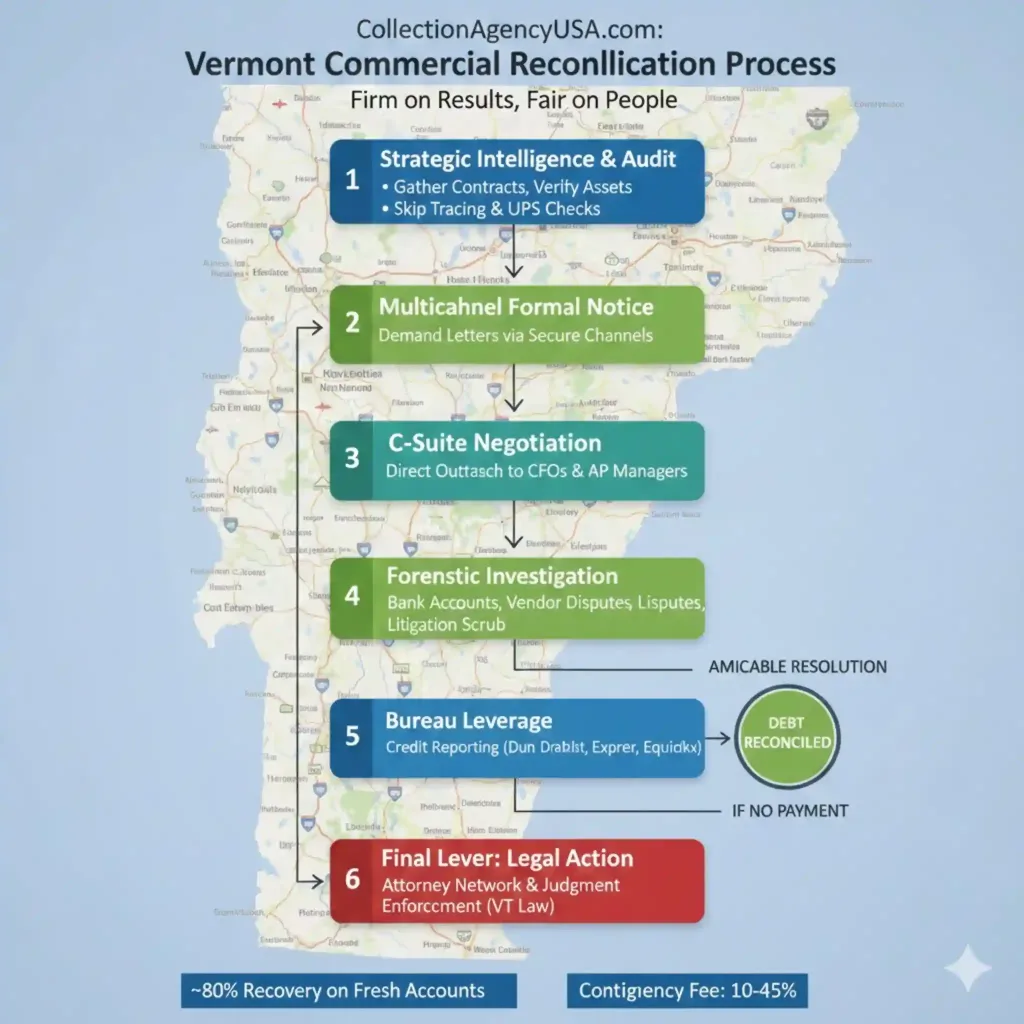
Our First Objective Is Resolution, Not Litigation
Commercial collection works best when the person contacted can actually authorize payment.
Depending on the debtor, that may be:
- Accounts payable
- Controller
- Finance manager
- CFO
- Owner
- Managing member
- Senior executive
Our initial communication is professional, factual and focused on resolution.
We want to understand:
Is the invoice acknowledged?
Is any portion genuinely disputed?
Does the business intend to pay?
What is preventing payment now?
If the debtor raises a legitimate issue involving pricing, delivery, quality, credits or performance, we isolate the actual dispute rather than allowing the entire account to remain frozen.
For example, a customer may dispute $8,000 of a $60,000 balance.
That does not automatically mean the remaining $52,000 should remain unpaid.
Separating disputed amounts from undisputed amounts can move a commercial account forward without immediately resorting to legal action.
Payment Arrangements Can Be Better Than Winning an Argument
A commercially sensible recovery is not always an immediate payment in full.
If a viable business is experiencing temporary cash-flow pressure, a structured payment plan may produce a better result than forcing the account toward legal escalation.
The important questions are whether the debtor can realistically perform, whether the proposed arrangement makes commercial sense and whether the business actually honors the agreement.
A missed payment under a negotiated arrangement tells us something very different from an account that has never been meaningfully engaged.
Commercial Credit Reporting Adds Non-Legal Leverage
Eligible delinquent business accounts may be reportable to participating commercial credit bureaus when applicable documentation and reporting requirements are satisfied.
Commercial credit reporting can be an important recovery tool because lenders, vendors and other businesses may consider payment behavior when making future credit decisions.
The purpose is not to threaten to “destroy” a company’s credit.
It creates a legitimate commercial consequence:
A company’s payment history can affect how other businesses evaluate its creditworthiness.
That can encourage a solvent debtor to address an unresolved balance before attorney referral becomes necessary.
UCC Review Is Especially Relevant to Vermont Suppliers and Manufacturers
For companies selling equipment, inventory, agricultural products, manufactured goods or other business assets, an unpaid invoice may involve more than ordinary contract rights.
Security agreements and UCC financing statements can affect whether a creditor has an interest in particular collateral and how that interest ranks against competing creditors.
A UCC filing does not tell us that a debtor has money available to pay.
It may, however, show that another creditor has already claimed a security interest in equipment, inventory, receivables or other assets.
That becomes especially important when the debtor is financially distressed.
Before assuming secured-creditor leverage exists, available contracts, guarantees, security agreements and relevant UCC information should be reviewed carefully.
A Vermont Case Shows Why the Debtor’s Legal Name Matters
In a Vermont commercial dispute involving restaurant equipment, a supplier attempted to perfect its security interest by filing under the restaurant’s trade name rather than the debtor’s actual legal name.
A competing lender had filed correctly.
The Vermont Supreme Court concluded that the trade-name filing was seriously misleading and ineffective for perfection, leaving the competing creditor with the stronger priority position.
What this teaches: A creditor can have a contract, collateral and even a UCC filing—and still discover that the expected leverage is not there.
That is why our commercial approach looks beyond the invoice to the legal entity, supporting agreements and relevant UCC information when those issues matter.
Personal Guarantees Need to Be Read, Not Assumed
A corporation or LLC normally has obligations separate from those of its owners.
Simply owning a Vermont LLC does not ordinarily make someone personally responsible for every company invoice.
A valid personal guarantee can change that.
But the actual language matters.
Another Vermont commercial case involved an individual who guaranteed a company’s original lease. The lease relationship later continued under subsequent agreements, but the guarantee did not clearly state that it would continue into later lease terms.
The Vermont Supreme Court held that the original guarantee did not automatically extend to the later arrangements.
What this teaches: Finding a signed personal guarantee is only the beginning.
We still need to understand what obligation the guarantee actually covers.
Bankruptcy Screening Comes Before Escalation
If a debtor files bankruptcy, ordinary collection activity against pre-bankruptcy debts may be restricted by the automatic stay.
That changes the recovery path immediately.
Instead of continuing ordinary collection demands, the creditor may need to participate in the bankruptcy process and file a proof of claim where appropriate.
That is why bankruptcy screening should happen before serious escalation, not after collection activity has already gone too far.
A company bankruptcy also does not necessarily answer every related question. Separate guarantors or other potentially liable parties may require individual review.
When Should a Vermont Business Send an Account to Collections?
There is no single magic day.
Account age matters, but debtor behavior can be even more revealing.
A commercial account deserves closer attention when:
- Payment promises repeatedly fail
- Accounts payable stops communicating
- An accepted invoice suddenly becomes disputed
- A payment plan defaults
- The debtor appears financially unstable
- A business closes or relocates
- The balance creates meaningful cash-flow pressure
- An important contractual or legal deadline is approaching
For many businesses, 60–90 days past due is a practical point for outside collection.
But a large customer that unexpectedly disappears may justify earlier intervention.
A long-term Vermont customer with a documented seasonal cash-flow problem may deserve a different approach.
The question should not simply be:
“How old is this invoice?”
It should also be:
“What is this debtor telling us through its behavior?”
Vermont Commercial Collection Deadlines
Many Civil Claims — Generally Six Years
Vermont generally provides a six-year limitation period for civil actions unless a more specific statute applies.
That can cover many contract-based commercial claims, but it should not be treated as a universal six-year deadline for every B2B transaction.
Sale of Goods — Generally Four Years
Vermont’s Uniform Commercial Code generally provides a four-year limitation period for breach of a contract for the sale of goods.
That distinction is particularly relevant to:
- Manufacturers
- Equipment suppliers
- Food producers
- Agricultural vendors
- Forest-product companies
- Wholesalers
- Distributors
A written commercial agreement does not automatically mean every creditor receives six years.
Judgments Have Their Own Time Limits
Vermont generally provides an eight-year period relating to execution and renewal of judgments.
The practical lesson is simple:
Do not allow a commercial receivable to age merely because the legal deadline appears distant.
Older accounts can become harder to document, locate and recover long before the statute of limitations actually expires.
The 80% Performance Advantage
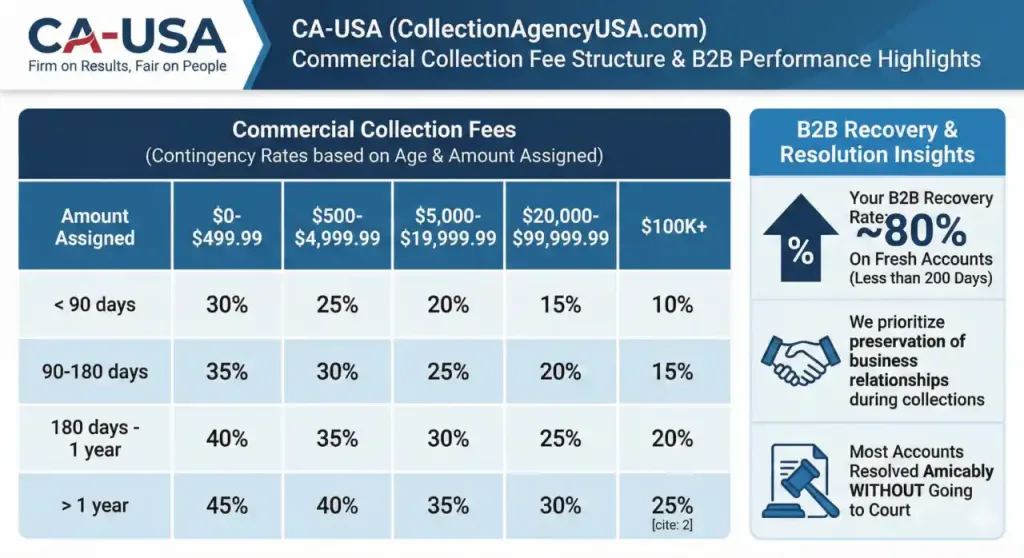
Speed is the ultimate arbiter of success in commercial recovery. For “fresh” accounts—those less than 200 days past due—CA-USA achieves an ~80% recovery rate. By engaging us early, Vermont enterprises can significantly increase the probability of a full reconciliation before the debt becomes toxic.
Vermont Industries Where B2B Receivables Can Become Complex
Captive Insurance & Professional Services
Vermont is internationally recognized for its captive-insurance sector, creating a sophisticated ecosystem of administrators, accountants, consultants, technology providers, attorneys and other professional-service companies.
These receivables can be contract-heavy and may depend more on clear documentation and executive-level negotiation than aggressive collection tactics.
Dairy, Maple, Agriculture & Specialty Food
Agriculture remains fundamental to Vermont’s economy, from dairy and maple to specialty foods and food manufacturing.
Commercial balances can involve:
- Feed
- Fertilizer
- Equipment
- Packaging
- Ingredients
- Transportation
- Maintenance
- Agricultural services
Businesses supplying farms, dairies and agricultural operations can also review our Collection Agency for Farm Supply & Agriculture Businesses resource for industry-specific recovery strategies.
Precision & Specialty Manufacturing
Vermont manufacturers produce specialized products across technology, wood, paper, printing, food and other sectors.
Commercial claims may involve purchase orders, delivery requirements, product disputes, equipment, secured transactions and long-standing supplier relationships.
Tourism, Ski Resorts & Outdoor Recreation
Resorts, lodging operators, restaurants and outdoor-recreation businesses often work with local contractors, food distributors, equipment companies and seasonal suppliers.
Seasonality does not make an invoice uncollectible—but it may affect how a practical payment strategy should be structured.
Forest Products & Wood Businesses
Logging, lumber, furniture, paper and other forest-product companies can create receivables involving equipment, materials, freight and wholesale transactions where UCC and sale-of-goods issues may become relevant.
Construction & Trades
Subcontractor, equipment-rental, contractor and material-supplier receivables often involve significant documentation and potentially time-sensitive legal rights.
These accounts should be reviewed promptly rather than allowed to sit indefinitely.
Technology & Professional Services
Software, IT, engineering, consulting, staffing, marketing and other contract-based service businesses frequently depend on recurring relationships where reputation-safe collection is particularly important.
Trust & Compliance
Contract, Invoice & UCC-Aware Review
We examine the documents that can materially affect collection strategy rather than treating every commercial account as an invoice-only problem.
Bankruptcy Screening
Accounts are checked for bankruptcy before escalation so ordinary collection does not continue blindly against a debtor subject to bankruptcy restrictions.
Business Skip Tracing & Verification
Lawful business-information resources help confirm legal entities, operating status, updated addresses and relevant decision-makers.
Commercial Credit Reporting
Eligible accounts may be reported to participating commercial credit bureaus where appropriate and permitted.
Reputation-Safe Collection Tactics
We prioritize professional communication and negotiation designed to recover the balance without unnecessarily damaging customer, vendor or referral relationships.
Secure Portal & SOC 2 Type II
Accounts and supporting documents are submitted through a secure environment backed by SOC 2 Type II controls.
Nationwide Collection Licensing Coverage
CA-USA maintains nationwide collection licensing coverage, including all required collection licenses, registrations and bonds.
Attorney Referral — Only as a Last Resort
Legal escalation is considered only after reasonable collection and negotiation efforts fail, the economics and documentation support further action, and the client approves the next step.
Commercial Collection Pricing
CA-USA primarily handles commercial collection accounts on a contingency basis.
Fees depend on factors such as:
- Account balance
- Age
- Complexity
- Documentation
- Location
- Whether additional legal work becomes necessary
The collection fee is earned when money is successfully recovered.
Businesses comparing contingency rates and collection costs can also review What Should a B2B Commercial Collection Agency Charge? before choosing a recovery partner.
FAQs About Vermont Commercial Collections
How long can we collect an unpaid business invoice in Vermont?
Many Vermont civil claims generally have a six-year limitation period, but contracts involving the sale of goods generally fall under Vermont’s UCC four-year limitation period.
Other rules may apply depending on the transaction.
The account should therefore be reviewed based on the underlying contract and facts rather than assuming every commercial invoice has the same deadline.
Does the FDCPA apply to B2B commercial debt in Vermont?
The federal FDCPA generally applies to debts incurred primarily for personal, family or household purposes and ordinarily does not cover business-to-business debts.
Commercial collection activity may still be subject to Vermont law, contract law, bankruptcy restrictions, UCC provisions and other applicable federal and state requirements.
Can we collect a Vermont LLC’s debt from its owner?
Usually not simply because someone owns or manages the LLC.
Vermont law generally treats company obligations as debts of the LLC rather than automatically those of its members or managers.
A personal guarantee or another legally recognized basis for individual liability may change the analysis.
What if our Vermont customer operates under a DBA or trade name?
The legal debtor should be identified carefully.
A trade name may not be the same as the individual, LLC or corporation legally responsible for the account.
This distinction can become especially important when contracts, UCC filings, personal guarantees or attorney referral are involved.
Does a personal guarantee automatically cover contract renewals or extensions?
Not necessarily.
The language of the guarantee and related agreement determines what obligations are covered.
A Vermont Supreme Court decision illustrates that a guarantee tied to a specific original lease did not automatically extend to later lease agreements when the documents did not clearly provide for continuing liability.
When does CA-USA refer a Vermont commercial account to an attorney?
Legal action is a last resort.
CA-USA first uses documentation review, business verification, professional outreach, dispute resolution, reputation-safe negotiation and other appropriate non-legal tools.
Attorney referral is considered only after reasonable collection efforts fail, the account supports further escalation and the client approves the next step.
Ready to Recover a Past-Due Vermont Business Account?
A strong commercial collection strategy does not begin with the loudest demand.
It begins by understanding the account.
Who owes the money?
What do the documents prove?
Why has payment stopped?
What leverage actually exists?
Can the balance be recovered without destroying the relationship?
CA-USA combines commercial collection experience with documentation, debtor intelligence, negotiation, commercial credit reporting and measured escalation to help Vermont businesses turn past-due receivables back into working capital.
If you are preparing accounts for placement, our How to Assign Your Accounts to a Collection Agency guide explains what documentation and account information helps us begin efficiently.
Firm on the balance. Professional with the people. Legal only when reasonable collection efforts have failed.
Strategic Capital Recovery: Navigating B2B Receivables in the Green Mountain State
Recover your Business Debts? Contact us