Texas commercial debt can become complicated fast.
A Houston energy supplier may be waiting on a seven-figure equipment invoice. A Dallas distributor may be dealing with a customer operating through several related LLCs. An Austin technology company may be facing a contract dispute after months of accepted services. A San Antonio contractor may have lien deadlines running while accounts payable keeps promising that “the check is coming.”
Those situations should not all receive the same collection strategy.
CA-USA helps businesses recover past-due commercial accounts across Houston, Dallas, Fort Worth, Austin, San Antonio, Plano, Irving, El Paso and throughout Texas using professional negotiation, contract and invoice review, bankruptcy screening, business verification, UCC-aware collection practices and commercial credit reporting where appropriate.
Our objective is simple:
Understand the debtor, preserve legitimate leverage, and recover the money without unnecessarily destroying a valuable commercial relationship.
Attorney referral is considered only after reasonable collection and negotiation efforts fail, the documentation and economics support escalation, and the client approves the next step.

CA-USA provides a low cost, compliant, reputation-safe approach, equipped with all 50-state collections coverage, offering free credit reporting, free pre-litigation checks, free bankruptcy scrubs, and zero onboarding fees. Secure – SOC 2 Type II compliant. Over 2,000 online reviews rate us 4.85 out of 5. Over 20 years experience , delivering excellent B2B collection results.
You’ll be assigned a direct representative who is available by cell phone whenever you need support.
Need a Commercial Collection Agency in Texas? Contact us
For our broader commercial recovery framework, see B2B Commercial Debt Recovery.
Texas B2B Recovery Starts With the Business Behind the Invoice
In a large commercial market like Texas, the company your salesperson knows may not be the company legally responsible for the debt.
A customer may operate through:
- Parent and subsidiary companies
- Multiple LLCs
- DBAs and trade names
- Separate operating companies
- Project-specific entities
- Related companies sharing personnel or addresses
Before increasing collection pressure, we want to establish:
Who signed the agreement?
Who received the goods or services?
Which company was invoiced?
Is another related entity being incorrectly treated as responsible?
Did an owner sign a personal guarantee?
Good debtor identification can completely change a recovery strategy.
Texas Gives Most Debt Claims a Four-Year Clock
Texas generally requires an action for debt to be brought within four years after the claim accrues.
Open or stated accounts and certain merchant accounts also generally operate under a four-year limitation period.
Texas therefore differs from states where ordinary contract claims may run six years or longer.
A four-year legal window does not mean a business should wait four years to place an account.
By then:
- Documentation may be harder to locate
- Employees may have left
- The debtor may have moved
- Other creditors may have priority
- The business may be insolvent or bankrupt
For more detail on how deadlines vary, see our Statute of Limitations for Debt Collection guide.
Texas UCC Sales Also Generally Run Four Years
For contracts involving the sale of goods, Texas UCC Section 2.725 generally provides a four-year limitation period.
That can matter substantially for:
- Oilfield suppliers
- Equipment companies
- Manufacturers
- Semiconductor vendors
- Aerospace suppliers
- Auto-parts companies
- Food distributors
- Wholesalers
- Industrial-material suppliers
The parties may originally agree to shorten the UCC period to no less than one year, but generally cannot extend it beyond four years.
So even when the invoice is written, the underlying contract and transaction still matter.
In Texas UCC Filings, a Trade Name Alone Is Not Enough
Texas law is especially clear on debtor naming.
A financing statement that provides only the debtor’s trade name does not sufficiently provide the debtor’s name.
That makes entity verification important when a customer is known commercially by a DBA or operating name.
For secured creditors, the difference can affect:
UCC searches → perfection → creditor priority → collateral analysis → recovery leverage
A UCC filing does not tell us that the debtor has cash available.
What it can tell us is whether banks or other creditors may already claim interests in inventory, equipment, receivables or other collateral.
That can influence whether negotiation, secured-creditor review or eventual legal escalation makes sense.
A Texas LLC’s Debt Is Not Automatically the Owner’s Debt
Texas provides strong liability protection to LLC members and managers.
An owner or manager is generally not personally liable for the company’s debt simply because of that role.
A valid personal guarantee or another legally recognized basis for personal responsibility may change that.
That is why locating an owner is not the same thing as proving owner liability.
The more useful question is:
What did the owner personally agree to?
Texas Construction Accounts Have Their Own Calendar
Construction receivables should be reviewed early because Texas mechanic’s-lien rules use specific month-based notice and filing deadlines.
For many non-residential projects, an original contractor generally must file the lien affidavit no later than the 15th day of the fourth month after the month in which the work was completed, terminated or abandoned.
Subcontractors and suppliers can have separate notice requirements. For example, certain non-residential claimants generally must send notice of unpaid labor or materials by the 15th day of the third month after the month in which the labor or materials were provided.
Separate lien-filing and foreclosure deadlines also apply.
Simply placing a construction account with a collection agency does not automatically preserve lien rights.
That makes early account review especially important for Texas:
- Contractors
- Subcontractors
- Material suppliers
- Equipment-rental businesses
- Fabricators
- Industrial contractors
When “We Dispute the Invoice” Does Not Mean the Entire Balance Is Disputed
Suppose a Texas manufacturer owes $140,000 but claims that $18,000 of delivered components failed inspection.
That does not automatically explain why the remaining $122,000 is unpaid.
We review:
- Contracts
- Purchase orders
- Invoices
- Delivery records
- Inspection or acceptance records
- Emails
- Payment promises
- Credits
- Dispute history
- Guarantees
- Relevant security documents
Breaking a balance into documented, undisputed and genuinely disputed amounts can create a much more effective negotiation than arguing over the entire account.
Commercial Credit Reporting Can Add Non-Legal Leverage
Eligible delinquent business accounts may be reportable to participating commercial credit bureaus when applicable documentation and reporting requirements are satisfied.
Commercial payment history can influence how lenders, vendors and other businesses evaluate future credit decisions.
That can create legitimate non-legal leverage without turning every unpaid invoice into litigation.
Where Texas B2B Receivables Get Complicated
Energy, Oil & Gas
Texas remains a global energy center.
Commercial balances can involve:
- Oilfield equipment
- Industrial services
- Fabrication
- Transportation
- Engineering
- Maintenance
- Chemicals
- Energy technology
- Renewable-energy supply chains
Large balances, multiple subcontractors and sophisticated corporate structures can make correct entity identification especially important.
Advanced Manufacturing & Semiconductors
Texas has major manufacturing clusters in electronics, semiconductors, machinery, automotive production and advanced technology.
These transactions frequently involve purchase orders, goods, equipment, warranties, UCC issues and high-dollar B2B credit.
Aerospace & Defense
Texas supports extensive aerospace, aviation and defense activity involving engineering firms, manufacturers, parts suppliers, tooling businesses and specialized contractors.
Freight, Warehousing & Distribution
Dallas–Fort Worth and Houston are major national logistics markets.
Receivables can involve:
- Trucking
- Freight brokerage
- Warehousing
- Distribution
- Equipment
- Import/export services
- Third-party logistics
Technology & Professional Services
Austin, Dallas and other major Texas markets support software, engineering, consulting, staffing and technology businesses that often perform substantial work before payment is received.
Construction & Trades
Texas’s enormous construction sector creates high volumes of contractor, subcontractor, material-supplier and equipment-rental receivables where lien timing may matter.
Smart Recovery Examples
Industrial Equipment Account — 79% Recovery
A customer disputed a large equipment balance while payments were being redirected among several related Texas entities.
Instead of pursuing every entity, the file was narrowed to the company that actually signed the purchase documents and accepted delivery. The undisputed invoices were separated from a smaller warranty issue, and negotiations were moved from accounts payable to the finance decision-maker.
Result: 79% of the placed balance recovered without litigation.
Freight & Distribution Account — 68% Recovery
A debtor claimed a broad setoff against multiple freight invoices.
The account review showed that the alleged offset related to one shipment rather than the entire receivable. Supporting delivery and billing records were reconciled, the undisputed invoices were isolated, and a structured resolution was negotiated with management.
Result: 68% recovery of the placed balance.
Alignment of Interests: Performance-Based Value
For Texas commercial accounts, CA-USA works primarily on a pure contingency basis.
You pay when money is successfully recovered.
Rates typically range from 10% to 45%, depending on:
- Account balance
- Age
- Documentation
- Complexity
- Debtor condition
- Legal status
Higher balances and younger accounts generally receive the lowest rates, with pricing confirmed upfront.
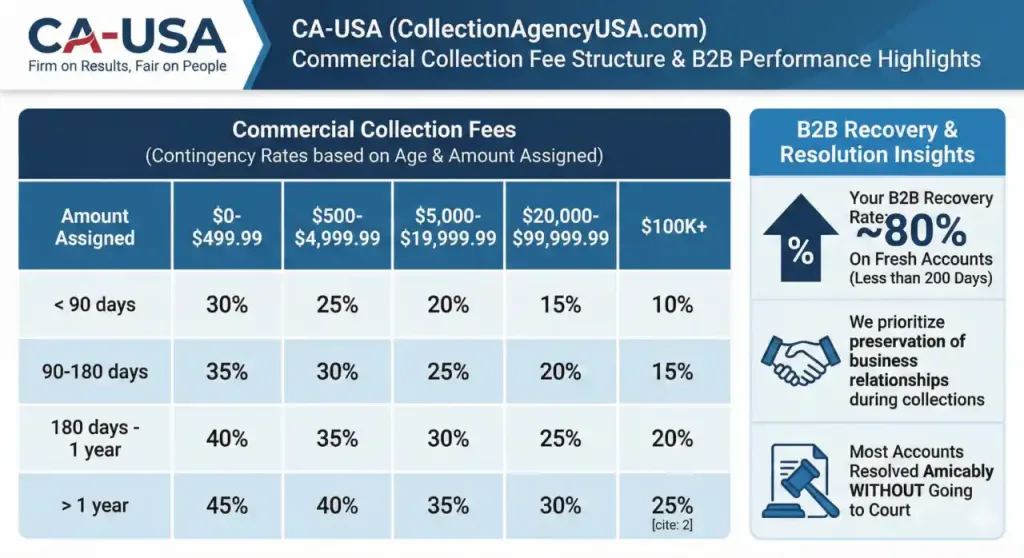
For qualifying fresh commercial accounts under approximately 200 days old and supported by adequate documentation, CA-USA’s internal results can approach ~80% recovery.
Results vary based on debtor condition, account age, disputes, documentation and other factors.
For more detail, see What Should a B2B Commercial Collection Agency Charge?.
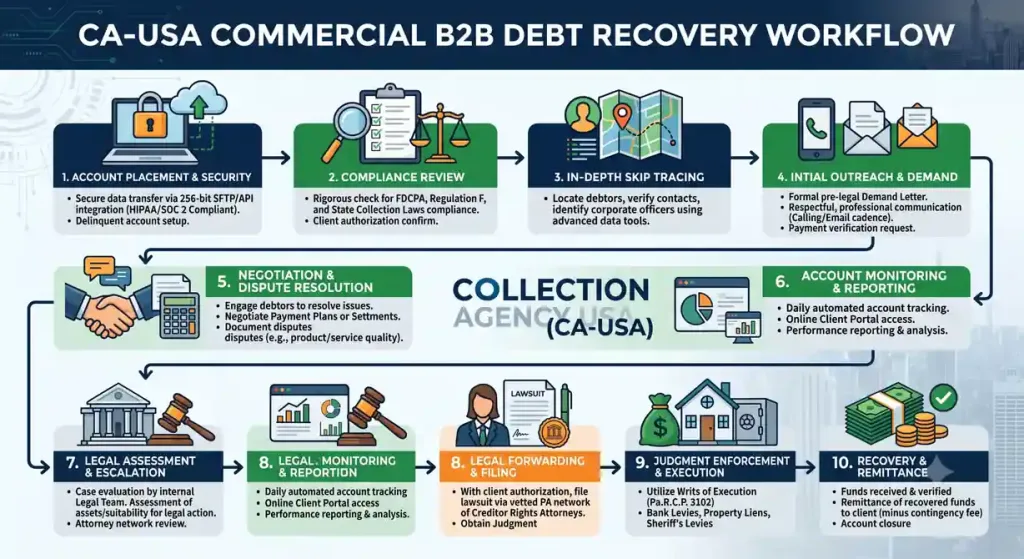
What Happens Before Attorney Referral
Contract & Invoice Review
We determine what was agreed, what was delivered and what remains unpaid.
Business Verification & Skip Tracing
We identify legal entities, current operating status, addresses and decision-makers.
Bankruptcy Screening
A bankruptcy filing can immediately change the permissible recovery path.
Dispute Analysis
We isolate legitimate disputes instead of allowing them to freeze an entire account unnecessarily.
UCC-Aware Review
Security agreements, financing statements and competing creditor claims can affect leverage.
Commercial Credit Reporting
Eligible commercial accounts may receive additional non-legal leverage through participating business credit bureaus.
Negotiation & Payment Arrangements
A structured solution with a viable company may generate a better economic result than immediate litigation.
Attorney Referral — Last Resort
Attorney referral is considered only after reasonable non-legal recovery efforts fail, the documentation and economics support escalation, and the client approves the next step.
Texas Legal Guardrails
-
TRCP Rule 185 (Suit on Sworn Account): Cite this powerful Texas rule that allows summary judgment on open accounts if the debtor fails to file a sworn denial.
-
Texas Property Code Chapter 28: Mention the 18% annual interest penalty under the Texas Prompt Payment Act for commercial construction and contractor defaults.
-
Statutory Pre-Judgment Interest: Reference Texas Finance Code § 302.002 (6% statutory default interest starting 30 days past due) as leverage against stalling debtors.
FAQs About Texas Commercial Collections
How long can a business debt be collected in Texas?
Texas generally provides a four-year limitation period for actions involving debt. Open or stated accounts and certain merchant accounts also generally carry a four-year period. Other rules can apply depending on the transaction, so the underlying contract and account history should be reviewed rather than assuming every debt has the same accrual date.
Does the FDCPA apply to B2B commercial debt in Texas?
The federal FDCPA generally applies to debts incurred primarily for personal, family or household purposes and does not ordinarily cover corporate or business debt. Texas businesses should still use professional, accurate and non-deceptive collection practices, and other laws or contractual rules may apply.
Can I collect a Texas LLC’s debt from its owner?
Usually not merely because the person owns or manages the LLC. Texas law generally protects members and managers from personal liability for company obligations. A personal guarantee or another legally recognized basis for individual liability can change the analysis.
How does a Texas UCC filing affect commercial debt collection?
A properly perfected security interest may give a creditor rights in specified collateral and affect priority against competing creditors. Texas requires accurate debtor identification, and a financing statement using only a debtor’s trade name is insufficient. UCC records should therefore be reviewed before assuming secured-creditor leverage exists.
What are the Texas mechanic’s-lien deadlines for commercial construction?
Texas uses specific month-based notice and filing deadlines. On many non-residential projects, an original contractor generally files the lien affidavit by the 15th day of the fourth month after the month work was completed, terminated or abandoned. Certain subcontractors and suppliers also have earlier notice deadlines, including the 15th day of the third month after qualifying labor or materials were provided. Exact requirements depend on the claimant and project.
When should a Texas business send an unpaid invoice to collections?
There is no single mandatory age. Accounts deserve earlier attention when payment promises repeatedly fail, a previously accepted invoice is suddenly disputed, accounts payable stops responding, the debtor changes entities or locations, or financial distress appears. For many businesses, 60–90 days past due is a practical review point, but debtor behavior can justify earlier placement.
What documents should I send with a Texas B2B collection account?
Useful records include contracts, credit applications, purchase orders, invoices, account statements, delivery or completion records, correspondence, payment history, dispute information, personal guarantees, security agreements and relevant UCC documents. Strong documentation makes it easier to determine who owes the money and which recovery strategy is appropriate.
Can an unpaid Texas business account be reported to a commercial credit bureau?
Eligible delinquent B2B accounts may be reportable to participating commercial credit bureaus when documentation and reporting requirements are satisfied. Commercial credit reporting can create additional non-legal leverage because future lenders and vendors may consider a company’s payment history.
Ready to Recover a Texas Business Account?
Texas commercial collection should begin with the facts, not the threat of a lawsuit.
Ask:
Who legally owes the money?
What does the documentation prove?
Is the debt secured or unsecured?
Is a Texas lien or limitation deadline running?
Why has payment stopped?
CA-USA combines professional negotiation, debtor intelligence, contract review, UCC-aware analysis, commercial credit reporting and measured escalation to recover overdue Texas B2B receivables.
If you are preparing accounts for placement, review How to Assign Your Accounts to a Collection Agency for the documentation and account information that helps us begin efficiently.
Firm on the balance. Professional with the people.
| Need a Commercial Collection Agency? Contact Us Serving Hundreds of Businesses !Easy to use • Fully Compliant with Federal and State Laws • USA Citizens-Only Team • 24×7 Secure Portal • High Recovery Rates • Over 20 years Experience • Free Commercial Credit Bureau reporting • Low fee • Highly Rated ! |
