Connecticut may be geographically small, but its B2B invoices can be anything but small.
Insurance and financial-services firms in Hartford and Stamford, aerospace suppliers across central Connecticut, life-sciences businesses around New Haven, manufacturers along the I-91 corridor and professional-service companies throughout Fairfield County routinely extend substantial commercial credit.
When one of those customers stops paying, the smartest recovery strategy is usually not the most aggressive one.
It starts with three questions:
Who legally owes the money?
What do the contract and supporting documents actually prove?
What has changed since the invoice became overdue?
CA-USA helps recover past-due commercial accounts across Hartford, Stamford, New Haven, Bridgeport, Norwalk, Danbury, Waterbury and throughout Connecticut using professional negotiation, documentation review, bankruptcy screening, business verification, UCC-aware collection practices and commercial credit reporting where appropriate.
Our objective is to recover the balance without unnecessarily damaging a commercially valuable relationship.
Attorney referral is considered only after reasonable collection efforts fail, the documentation and economics support further escalation, and the client approves the next step.
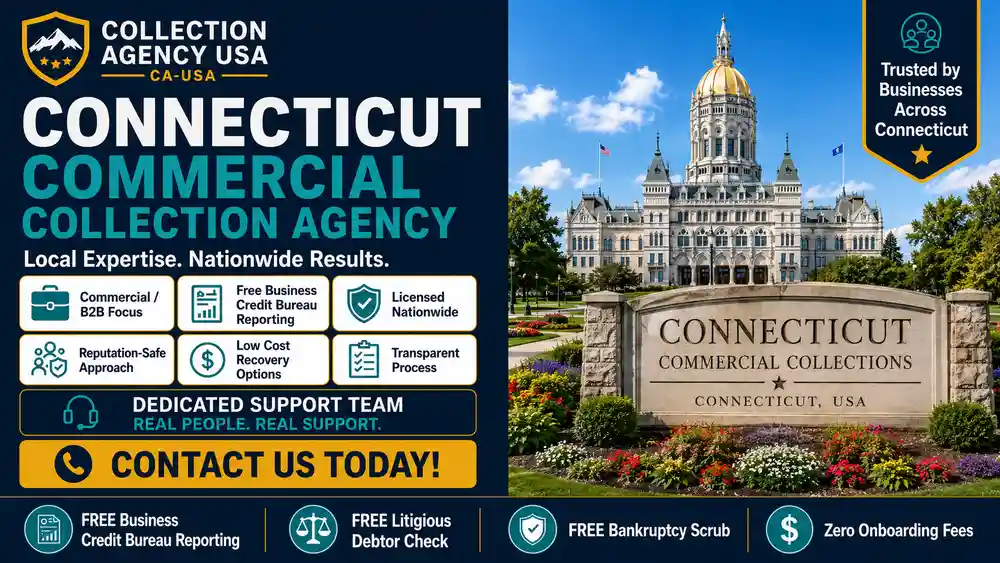
CA-USA provides a low cost, compliant, reputation-safe approach, equipped with all 50-state collections coverage, offering free credit reporting, free per-litigation checks, free bankruptcy scrubs, and zero onboarding fees. Secure – SOC 2 Type II compliant. Over 2,000 online reviews rate us 4.85 out of 5. Over 20 years experience , delivering excellent B2B collection results.
We’ll provide you with the direct mobile number of a dedicated representative, so support is always just a call or text away whenever you need it.
Need a Connecticut Commercial Collection Agency? Contact us
For nationwide commercial recovery strategy, see our B2B Commercial Debt Recovery guide.
Connecticut Commercial Recovery Is Mostly About Diagnosing the Account Correctly
An overdue balance can represent very different problems.
A buyer may acknowledge the invoice but be experiencing temporary liquidity pressure.
Another business may suddenly dispute work it accepted months earlier.
A third may have changed legal entities, moved its accounts-payable operation out of state or begun showing signs of serious financial distress.
We review available:
- Contracts and credit applications
- Purchase orders
- Invoices and statements
- Delivery or completion records
- Email correspondence
- Payment promises
- Dispute history
- Personal guarantees
- Security agreements
- Relevant UCC information
That allows the strategy to respond to the actual problem instead of simply increasing the volume of collection calls.
Connecticut Has Two Important Commercial Collection Clocks
Many Contract and Account Claims — Generally Six Years
Connecticut generally provides a six-year limitation period for actions involving an account, simple or implied contract, or written contract.
That does not mean a business should wait anywhere near six years.
Documentation weakens, personnel change and debtor condition can deteriorate long before the legal deadline arrives.
Sales of Goods — Generally Four Years
Connecticut’s UCC generally provides a four-year limitation period for breach of a contract for sale.
That distinction can matter significantly to:
- Aerospace suppliers
- Manufacturers
- Equipment vendors
- Medical-device companies
- Distributors
- Wholesalers
- Industrial suppliers
A written invoice does not automatically mean every Connecticut commercial claim gets six years.
The nature of the transaction matters.
For a broader discussion of collection deadlines, see our Statute of Limitations for Debt Collection resource.
Connecticut UCC Searches Begin With the Correct Legal Name
Connecticut’s UCC requires particular care when identifying a registered business debtor.
A financing statement generally needs the organization’s correct legal name from its public organizational record.
A financing statement providing only the debtor’s trade name is not sufficient.
That matters when customers operate through:
- DBAs
- Trade names
- LLCs
- Corporations
- Subsidiaries
- Related companies
A salesperson may know the customer by one name while the agreement was actually signed by another legal entity.
That difference can affect contract recovery, UCC searches, security interests, creditor priority and eventual legal review.
A Connecticut LLC’s Debt Is Not Automatically the Owner’s Debt
Connecticut law generally treats an LLC’s debt as an obligation of the company.
A member or manager is not personally liable merely because that person owns or manages the LLC.
A properly executed personal guarantee or another legally recognized basis for liability may change the result.
So finding the owner is only part of the investigation.
The more important question is:
Did that person actually agree to be personally responsible?
Construction Receivables Move Much Faster
Connecticut contractors, subcontractors and material suppliers should not treat lien rights like an ordinary six-year contract claim.
A Connecticut mechanic’s lien generally must be recorded within 90 days after the claimant stops furnishing qualifying services or materials.
A copy generally must then be served on the owner within 30 days after the lien certificate is recorded.
And a perfected mechanic’s lien generally must be foreclosed within one year or it expires.
Sending an invoice to collections does not automatically preserve lien rights.
Construction accounts therefore deserve early review.
Professional Negotiation Before Legal Pressure
A good commercial collector tries to reach the person who can actually authorize payment:
- Owner
- CFO
- Controller
- Finance director
- Accounts-payable manager
- Senior executive
We want to determine:
Is the balance acknowledged?
Is part of it genuinely disputed?
Is this temporary cash-flow pressure or something more serious?
What realistic resolution can be completed now?
If a Connecticut customer disputes $8,000 of a $60,000 account, the entire balance should not automatically remain frozen.
The first question becomes:
Why is the undisputed $52,000 still unpaid?
Separating the real dispute from the rest of the receivable can often move an account forward without immediate legal escalation.
Commercial Credit Reporting Provides Non-Legal Leverage
Eligible delinquent commercial accounts may be reportable to participating business credit bureaus when applicable documentation and reporting requirements are satisfied.
Commercial payment history may influence how lenders and suppliers evaluate a business.
That creates a legitimate non-legal consequence for continued nonpayment without turning every overdue invoice into litigation.
Connecticut Industries Where B2B Debt Gets Complicated
Insurance & Financial Services
Hartford remains synonymous with insurance, while Stamford and Fairfield County support major financial-services and corporate operations.
These receivables can involve consulting, technology, staffing, data services, professional fees and sophisticated contract disputes.
Aerospace, Defense & Precision Manufacturing
Connecticut has a deep aerospace and defense supply chain supported by precision manufacturers, engineering companies, tooling businesses and specialized vendors.
High-value component and equipment invoices make documentation and UCC considerations particularly important.
Life Sciences & Medical Technology
New Haven and surrounding markets support biotechnology, research, medical technology and laboratory businesses where receivables can involve equipment, research services, staffing and specialized suppliers.
Technology & Professional Services
Software, IT, engineering, consulting and staffing firms frequently extend unsecured commercial credit simply by completing work before payment arrives.
Construction & Trades
Contractors, subcontractors, material suppliers and equipment companies face both ordinary collection issues and much shorter lien deadlines.
Recent Recovery Snapshots
Equipment Supplier — 74% Recovery
A debtor disputed part of a large equipment invoice after months of silence. Instead of treating the whole balance as contested, the file was broken into documented, undisputed and genuinely disputed amounts. Delivery records supported most of the balance, executive-level contact restarted negotiations, and the undisputed portion was prioritized first.
Recovery: 74% of the placed balance without legal escalation.
Professional Services Account — 88% Recovery
The debtor operated under multiple related business names and accounts payable kept redirecting responsibility. The recovery strategy began by identifying the actual contracting entity, confirming there was no active bankruptcy and locating the finance decision-maker rather than continuing generic AP follow-up. A structured resolution followed.
Recovery: 88% of the placed balance.
Performance-Based Value (Pure Contingency, Aligned Incentives)
Our commercial collections model in Connecticut is 100% contingency-based. You pay only when we recover.
Fees typically range 10%–45%, based on balance size, account age, documentation strength and complexity.
Higher balances and younger debts generally receive the lowest rates, and pricing is confirmed in advance.
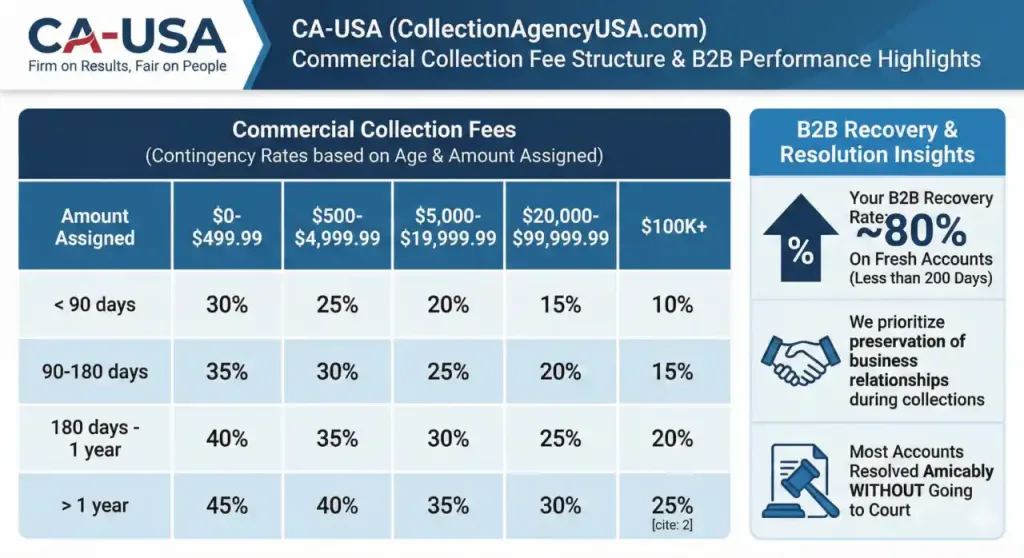
For qualifying fresh commercial accounts under approximately 200 days old and supported by adequate documentation, CA-USA’s internal results can approach ~80% recovery.
Results vary according to account age, debtor condition, documentation, disputes and other factors.
For more detail, see What Should a B2B Commercial Collection Agency Charge?
Trust, Security & Measured Escalation
CA-USA combines:
- More than 20 years of collection experience
- Nationwide collection licensing coverage where required
- SOC 2 Type II controls
- Contract and invoice review
- Business verification and skip tracing
- Bankruptcy screening
- UCC-aware review
- Commercial credit reporting where eligible
- Dedicated support
- Reputation-conscious negotiation
Connecticut separately licenses consumer collection agencies through its Department of Banking. Pure commercial B2B accounts are different from consumer debt, so we avoid implying that Connecticut’s consumer licensing statute automatically governs every business-to-business receivable.
Attorney Referral — Last Resort
Legal escalation is considered only after reasonable collection and negotiation efforts fail, the economics and documentation support further action, and the client approves the next step.
FAQs About Connecticut Commercial Collections
How long can I collect an unpaid business invoice in Connecticut?
Many Connecticut account and contract claims generally have a six-year limitation period. Contracts involving the sale of goods generally fall under Connecticut’s UCC four-year limitation period. The underlying transaction should be reviewed before assuming which deadline applies.
Does Connecticut require a collection agency license for B2B commercial debt?
Connecticut’s Department of Banking licenses “consumer collection agencies,” and the statute focuses on collection from consumer debtors. Pure B2B commercial receivables are therefore different from consumer collection activity. CA-USA maintains nationwide licensing and registration coverage for accounts and jurisdictions where those requirements apply.
How quickly must a Connecticut mechanic’s lien be filed?
A Connecticut mechanic’s lien generally must be recorded within 90 days after the claimant stops furnishing qualifying services or materials. A copy generally must be served on the property owner within 30 days after recording, and the lien generally must be foreclosed within one year to remain effective.
Can I collect a Connecticut LLC’s business debt from its owner?
Not simply because someone owns or manages the LLC. Connecticut law generally treats the debt as an obligation of the company. A personal guarantee or another legally recognized basis for personal liability can change the analysis.
Does a DBA or trade name matter in a Connecticut UCC filing?
Yes. For a registered organization, Connecticut’s UCC generally requires the correct legal organizational name. A financing statement using only the debtor’s trade name does not sufficiently provide the debtor’s name.
What documents should I send with a Connecticut commercial collection account?
Useful records include contracts, credit applications, purchase orders, invoices, statements, delivery or completion records, correspondence, payment history, dispute information, personal guarantees and relevant security agreements or UCC documentation. Stronger documentation usually makes it easier to determine the right recovery strategy.
Ready to Recover a Connecticut Business Account?
Effective commercial recovery starts by understanding the account before escalating it.
Who actually owes the money?
Which Connecticut deadline applies?
What does the documentation prove?
Why has payment stopped?
CA-USA combines commercial negotiation, debtor intelligence, documentation review, UCC-aware analysis, commercial credit reporting and measured escalation to help recover overdue B2B receivables.
Firm on the balance. Professional with the people. Legal only after reasonable recovery efforts have failed.
| Need a Connecticut Commercial Collection Agency? Contact Us Serving Hundreds of Businesses !Easy to use • Fully Compliant with Federal and State Laws • USA Citizens-Only Team • 24×7 Secure Portal • High Recovery Rates • Over 20 years Experience • Free Commercial Credit Bureau reporting • Low fee • Highly Rated ! |