• Skip to main content
  • Skip to primary sidebar

Collection Agency USA

collections

by

Utah B2B Collections | Salt Lake City, Provo & St. George

Utah’s economy moves faster than its population growth suggests it should: Silicon Slopes startups scaling out of Lehi and Provo, freight rolling through the Salt Lake City rail hub, ski resorts restocking before the first snow. When a B2B customer goes quiet on a net-30 invoice in the middle of that, it doesn’t just cost you money, it costs you the working capital you needed for the next order. We collect past-due commercial accounts across Utah the way we’d want a vendor to treat us: professionally, firmly, and without turning a slow payer into a lost one. Licensed and bonded in all 50 states, rated 4.8 stars across more than 2,000 Google reviews, and backed by a support team that actually answers the phone, submitting an account through our secure portal is simple enough that you won’t need a manual to do it.


CA-USA provides a low cost, compliant, reputation-safe approach, equipped with all 50-state collections license, offering free credit reporting, free litigation, free bankruptcy scrubs, and zero onboarding fees. Secure – SOC 2 Type II compliant. Over 2,000 online reviews rate us 4.85 out of 5.  Over 20 years experience , delivering excellent B2B collection results.

You’ll receive the direct mobile number of a dedicated representative, ensuring prompt support by call or text whenever you need assistance.

Need a Commercial Collection Agency? Contact us


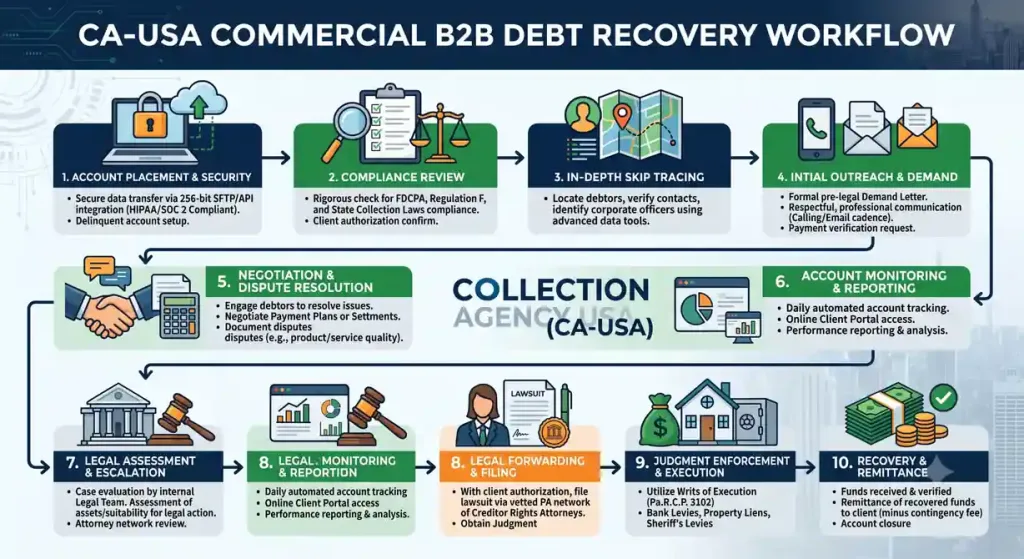
A 10-step flowchart infographic titled CA-USA Commercial B2B Debt Recovery Workflow detailing the debt collection process. Steps move sequentially from Account Placement & Security using 256-bit SFTP/API and SOC 2 compliance, through In-Depth Skip Tracing, Initial Outreach, and Negotiation. The process includes Legal Assessment, Legal Forwarding & Filing to obtain a judgment, and Judgment Enforcement using Writs of Execution and bank levies. The workflow concludes with Recovery & Remittance of funds. Each step has modern icons, process summaries, and regulatory references. The central logo shows Collection Agency USA (CA-USA)

Why Utah’s B2B Accounts Need a Different Approach

Utah’s commercial landscape doesn’t fit a single mold, and neither should how a past-due account gets handled.

Silicon Slopes’ Fast-Moving Contracts

Tech and SaaS companies clustered along the Lehi-to-Provo corridor tend to run on subscription and enterprise-contract billing, where a stalled payment can sit quietly for a full billing cycle before anyone notices. Speed matters here more than in most industries; the longer a subscription account goes unaddressed, the more it looks like it was never going to get paid at all.

Logistics, Mining, and the I-15 Corridor

Freight moving through the Salt Lake City rail and trucking hub, alongside the state’s mining and heavy-industry base, runs on net-30 and net-60 vendor terms that can get quietly stretched without a word to the supplier. These accounts often respond well to early, documented contact before a slow payer becomes a habitual one.

Utah’s Statute of Limitations

Written contracts generally have six years to be enforced in court in Utah, oral agreements four (Utah Code §§ 78B-2-309, 78B-2-307). A judgment can be renewed for up to eight years, and its interest rate locks in at whatever the federal rate was on January 1st of that year plus 2%, for the life of the judgment. None of that is a reason to wait; older accounts get harder to collect long before any legal deadline arrives.


How We Recover Your Utah Commercial Debt

  1. Intake & Documentation Review — Contracts, invoices, purchase orders, and prior communication are reviewed before any outreach begins, so the file is built on facts rather than assumptions.
  2. Verification & Formal Notice — Debtor identity and current address are confirmed, then a documented, multi-channel demand goes out that establishes a clear paper trail.
  3. Direct Negotiation — Outreach goes to the people who can actually approve payment: owners, controllers, and accounts payable managers, not a front desk.
  4. Dispute Review — Genuine disputes (short-pays, quality claims, delivery questions) get investigated on their merits rather than dismissed, since collecting on a real dispute usually costs more in goodwill than it recovers.
  5. Credit Bureau Reporting — Where appropriate, delinquencies can be reported to commercial credit bureaus, adding a non-legal incentive to resolve the account.
  6. Legal Referral — If mediation doesn’t resolve the account and the numbers support it, the file can be referred to our attorney network for judgment and enforcement, only with your authorization.

What This Actually Costs

  • Fixed-Fee Recovery ($15/account): Ideal for early-stage receivables. Debtors pay 100% directly to you. No commissions.
  • Contingency Service (40%): Performance-based recovery. No Recovery, No Fee.
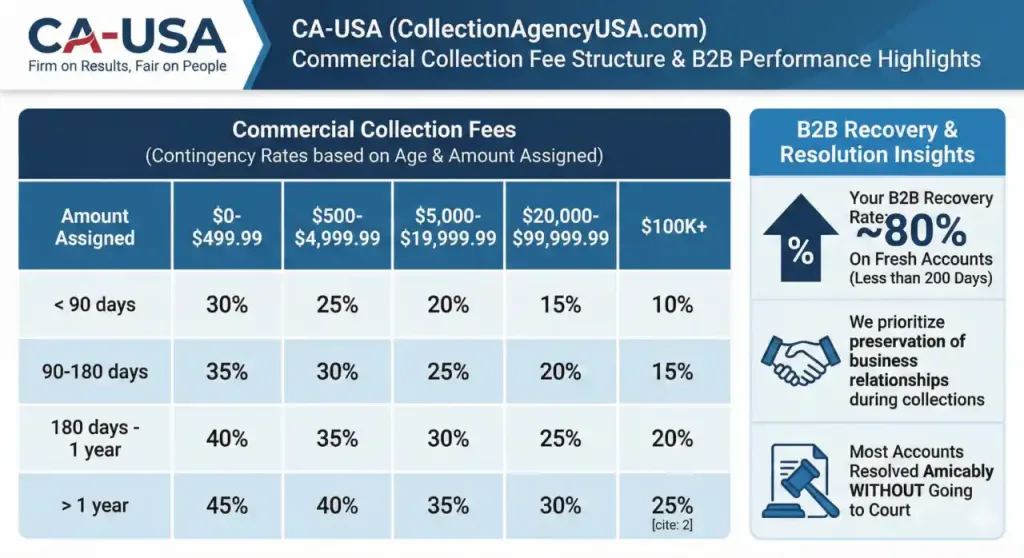
A chart showing B2B commercial collection agency fee, that varies by balance and age of debt.


Trust & Compliance, In Plain Terms

  • HIPAA & BAA: For medical and dental accounts, a Business Associate Agreement (BAA) is signed before any patient data changes hands, and account handling stays inside a HIPAA-compliant environment throughout.
  • FDCPA: Consumer-facing communication follows the federal Fair Debt Collection Practices Act and applicable Utah requirements, so an assigned account doesn’t create liability exposure of its own.
  • Secure Client Portal: Every account and every update runs through an encrypted portal rather than email threads or phone messages that are easy to lose track of.
  • Licensed & Bonded: Licensed and bonded across all 50 states, so the process holds up whether a debtor is in Ogden or out of state entirely.

How we approached a recent commercial account

A logistics company running freight through the Salt Lake City rail corridor had three shipping clients quietly extend their own payment terms from 30 to 75 days without ever renegotiating the underlying contract. Rather than escalating all three the same way, the accounts were split by responsiveness: two resumed normal payment after a single documented notice referencing the original contract terms, while the third required commercial credit bureau reporting before clearing its balance. Treating the three accounts differently, instead of applying one uniform escalation, preserved two ongoing customer relationships while still resolving the full amount owed.

Success Stories

A Lehi-based software company had an enterprise client stop paying mid-contract term, citing an internal “budget review.” A documented review of the signed agreement’s payment terms, paired with a single executive-level call, led to the outstanding balance being paid within three weeks, without ever needing to suspend the client’s platform access.

An outdoor equipment supplier to several Wasatch Front ski resorts had accounts pile up heading into a slow summer season. Rather than treating the lull as nonpayment, the accounts were monitored through a light-touch reminder cycle; all but one resolved naturally once the resorts’ own revenue picked back up for the season, and the one that didn’t was escalated separately.

Industries We Serve

  • Technology & SaaS — subscription billing and enterprise contract disputes across the Silicon Slopes corridor
  • Logistics & Freight — vendor and shipping-client accounts tied to the I-15 and rail corridors
  • Outdoor Recreation & Hospitality — ski resort, lodging, and equipment-supplier accounts with seasonal cash-flow patterns
  • Mining & Heavy Industry — equipment and materials suppliers to Utah’s mining and manufacturing base
  • Healthcare & Medical Groups — patient and payer balances handled inside a HIPAA-compliant process
  • Construction & Trades — subcontractor and material-supplier accounts tied to project timelines

Frequently Asked Questions

Does Utah’s Consumer Sales Practices Act give our B2B customer any special protections?

No. The Act is written around consumer transactions, purchases made primarily for personal, family, or household use, and Utah courts have been clear that even a sole proprietor buying supplies for their business doesn’t count as a “consumer” under it. A genuine business-to-business account sits outside its reach entirely, which gives more room to negotiate directly on the terms of the underlying contract.

How long do we actually have to collect on an unpaid Utah invoice?

Six years from the breach for a written contract, four for an oral one. Once a judgment is entered, it’s good for renewal up to eight years, and its interest rate locks in at whatever the federal rate was on January 1st of that year plus 2%, for the entire life of the judgment. None of that is a reason to wait, since older accounts get harder to collect well before any deadline arrives.

We run a SaaS or software business in the Silicon Slopes corridor. Can we just cut off access instead of going through collections?

Often, yes, if the subscription agreement says so, and it’s usually the fastest lever available. Most SaaS contracts include a suspension-for-nonpayment clause, and cutting access is generally simpler and faster than a formal collection process for smaller accounts. The catch is documentation: suspending access without a clear contractual right to do so can turn a nonpayment issue into a breach-of-contract dispute running the other direction.

Our business supplies Utah’s ski resorts and outdoor recreation industry, and payments slow down every off-season. Is that a real pattern we should plan around?

It’s a genuine, predictable rhythm rather than a red flag on its own. Resort and hospitality vendors in Utah’s mountain economy often see payments slow between seasons, when a property’s own cash flow contracts, and treating every slow summer or shoulder-season account as a crisis can create friction with a customer who fully intends to catch up once the season turns over. The accounts worth watching closely are the ones that don’t rebound when the season changes.

The company that owes us is a Utah LLC with seemingly no assets. Can we go after the owners personally?

Only in limited circumstances. Utah treats an LLC’s separate legal existence seriously, and reaching an owner’s personal assets generally requires something like a signed personal guarantee, commingled funds, or the entity being used as a shell to avoid an obligation, not simply that the company itself is short on cash. That makes documentation obtained at signing, like a personal guarantee, considerably more valuable than trying to pierce the veil after the fact.

Filed Under: collections

by

Virginia Commercial Collection Agency | B2B Debt Recovery

Virginia Corporate Revenue Guard: Smart Account Reconciliation for the Old Dominion

Cash flow isn’t just a metric on a balance sheet—it is the lifeblood that keeps a technology firm in the Dulles corridor scaling, a maritime logistics provider at the Port of Virginia moving, or a manufacturing plant in Roanoke operating at full capacity. When a corporate partner ignores a net-30 billing milestone or stops responding to past-due notices, it puts a sudden brakes on your business growth.

At Collection Agency USA, we abandon the scripted, aggressive phone-bashing of consumer agencies. Instead, we deploy an agile Account Reconciliation Team focused strictly on high-leverage business-to-business debt recovery.


CA-USA provides a low cost, compliant, reputation-safe approach, equipped with all 50-state collections license, offering free credit reporting, free litigation, free bankruptcy scrubs, and zero onboarding fees. Secure – SOC 2 Type II compliant. Over 2,000 online reviews rate us 4.85 out of 5.  Over 20 years experience, delivering excellent B2B collection results.

You’ll receive the direct mobile number of a dedicated representative, so help is always just a call or text away.

Need a Commercial Collection Agency? Contact us


The 7-Step Commercial Debt Recovery Framework in Virginia

Seven-step Virginia commercial debt recovery framework, from pre-analysis and address verification through legal action and judgment enforcement.

Recovering delinquent business-to-business debt in the Old Dominion requires a systematic, escalating framework. Whether you are dealing with an overdue procurement invoice in Norfolk or a stalled milestone payment in Fairfax, a standardized timeline protects your cash flow while ensuring full legal compliance.

Our Account Reconciliation Team utilizes a structured 7-step recovery cycle engineered specifically for the commercial marketplace

Step 1: Pre-Analysis and Pre-Litigation Underwriting

Before initiating contact with the debtor, the file undergoes an intensive data audit. We execute a comprehensive litigation scrub to determine if the business is a habitual countersuit filer, alongside a proactive bankruptcy scan to verify operational standing. This phase establishes the baseline solvency of the debtor corporation before any corporate communication begins.

Step 2: Localized Data and Address Verification

To ensure notifications reach the correct corporate officers, we deploy advanced skip tracing and verify operational footprints against the USPS database. This step is critical in Virginia, where businesses frequently shift physical operations between regional tech parks or change corporate filings with the State Corporation Commission.

Step 3: Multifaceted Diplomatic Outreach

Once data integrity is confirmed, we launch a strategic communication campaign via secure digital channels, including email and SMS networks, alongside structured telephonic contact. Our specialists utilize bilingual Spanish capabilities to handle accounts seamlessly across diverse market sectors, ensuring zero communication barriers.

Step 4: Executive Disputes Mediation

When a debtor raises operational objections—such as cargo disputes near the Port of Virginia or compliance delays on government subcontracts—the file escalates to executive mediation. We handle these barriers with an objective, firm tone. This focused dialogue cuts through administrative stalls to position your invoice at the top of their immediate accounts payable schedule.

Step 5: Commercial Credit Risk Escalation

If a solvent debtor remains uncooperative after direct mediation, we escalate the economic leverage. Where contractually authorized and legally permitted, we initiate formal commercial credit bureau reporting. This directly impacts their corporate credit rating, creating an immediate operational incentive for them to clear the liability to restore their vendor terms and lending power.

Step 6: Internal Quality and Compliance Review

Prior to recommending formal external escalation, management conducts a comprehensive file audit. Because all inbound and outbound calls are recorded and reviewed, we verify that the collection history is bulletproof. This safeguards your enterprise against retaliatory public review-bombing or regulatory compliance vulnerability.

Step 7: Legal Action and Judgment Enforcement

When all amicable remediation paths are exhausted and financial assets are confirmed, the account transitions to our last-resort phase: referral to our local Virginia counsel network. If authorized by your team, independent counsel initiates a formal civil lawsuit for breach of contract. Upon securing a final court order, our partner legal teams deploy aggressive post-judgment collection mechanisms permitted under Virginia law, including bank account garnishments, debtor interrogatories, and writs of fieri facias to seize non-exempt corporate property.

Pricing:

CA-USA commercial collection fee table showing contingency rates by account balance and debt age, with B2B recovery highlights.

Money-Saver Tip: Virginia enterprises can routinely offset the operational cost of our flat-fee stage by registering it as a deductible Business Expense on corporate tax filings, following validation by their CPA.

Strategic Advantages for Virginia Industries

  • Healthcare & Medical: Compliant, professional revenue management optimized for hospital supply vendors, contract laboratories, and multi-facility healthcare groups.

  • Colleges & Universities: Resolving overdue corporate sponsorships, vendor balances, and institutional accounts while strictly protecting university community prestige.

  • Dental: Tailored recovery processes for orthodontic networks, dental lab suppliers, and regional practice groups.

  • Construction & Trades: Strategic debt liquidation built around mechanics’ lien deadlines, complex retainage structures, and material vendor contract cycles.

  • K-12 Private & Charter Schools: Managing institutional billing discrepancies and corporate enrollment balances with absolute diplomatic care.

  • Accountants & CPA Firms: Direct professional mediation for overdue corporate consulting fees, preserving your corporate networking goodwill.

  • Banks & Credit Unions: Managing high-exposure corporate line-of-credit defaults, vehicle fleet lease deficiencies, and overdrawn business portfolios.

  • B2B Commercial & Waste Management: High-velocity recovery workflows built specifically for bulk transport companies, industrial manufacturing outfits, and regional waste management operators.

Frequently Asked Commercial Questions

Why should we assign an account to an agency rather than keeping it internal?

Allowing your staff to manage prolonged delinquencies takes their focus away from revenue-generating business operations. Our specialized team handles the tedious, firm negotiations required to recover funds, allowing your employees to focus entirely on the core functions they enjoy and excel at.

What happens if the debtor business files for bankruptcy during the process?

Our continuous monitoring systems identify active bankruptcy filings immediately. If an automatic stay is issued, we pause direct outreach instantly to remain perfectly compliant, transitioning your file to court-monitored proof-of-claim filing to protect your remaining financial exposure.

How long does it take to move from Step 1 to Step 7?

The timeline depends heavily on debtor responsiveness. Soft mediation and credit escalation steps typically occur within a 60-to-90-day window. If the debtor remains completely non-compliant despite verified liquidity, the file is promptly reviewed for legal escalation options.

Does Virginia’s Consumer Protection Act only cover individual consumers, or could a small business customer invoke it against us?

Traditionally, the VCPA stayed limited to true personal, family, or household transactions, and Virginia courts specifically held that one business buying from another for business purposes isn’t a “consumer transaction” at all. That changed with a recent amendment: the VCPA’s definition of “consumer” now also covers small businesses, generally independently owned with 250 or fewer employees or under $10 million in annual receipts, for certain transaction types, including automatic-renewal and continuous-service agreements. If your Virginia contracts include auto-renewal terms and the customer qualifies as a small business, that account may now carry consumer-style protections it wouldn’t have had a few years ago.

If a Virginia judgment debtor has property in multiple counties, does one writ of fieri facias cover all of it?

Not automatically. A writ of fieri facias is directed to the sheriff of the specific jurisdiction where it will be executed, so property scattered across multiple Virginia counties or cities generally requires coordinating execution through each relevant sheriff’s office rather than relying on a single writ statewide. That’s part of why the pre-litigation asset-mapping work matters as much as it does: knowing where a debtor’s property actually sits changes how enforcement gets structured after judgment, not just whether it’s worth pursuing.

Recover your Business Debts? Contact us

Filed Under: collections

by

What Collection Agencies Do That Restoration Companies Can’t Handle In-House

You restored the property. You documented everything, managed the crew, coordinated with the adjuster, and delivered the work. The invoice went out. And now — silence.

Restoration companies are built to respond fast and work clean. Chasing payments is neither. What a professional collection agency brings to the table isn’t just persistence — it’s a set of capabilities your internal team structurally cannot replicate.

CA-USA provides a low cost, compliant, reputation-safe approach, equipped with all 50-state collections license, offering free credit reporting, free litigation, free bankruptcy scrubs, and zero onboarding fees. Secure – SOC 2 Type II compliant. Over 2,000 online reviews rate us 4.85 out of 5.  Over 20 years experience , delivering excellent collection results.

Need a Collection Agency? Contact us

Omnichannel Outreach at the Right Cadence

Phone calls alone don’t move accounts anymore. Agencies run a legally compliant mix of mail, phone, email, and text — timed to maximize response without crossing into harassment under the CFPB’s seven-call rule. Every contact is logged. Your receptionist making follow-up calls between scheduling jobs isn’t a system. It’s improvisation — and the recovery rates reflect the difference.

Credit Reporting as a Recovery Lever

When permitted by law and account type, reporting a delinquent account to Experian, Equifax, or TransUnion changes debtor behavior faster than repeated calls. For homeowners and property managers who care about their credit standing, a collection entry creates real urgency. Restoration companies cannot report to credit bureaus directly. Only licensed agencies with established reporting agreements can.

Neutral Third-Party Distance

There’s something no software solves: the discomfort of a restoration owner calling a longtime customer to collect a disputed invoice. The conversation is loaded — it risks the relationship, the referral, the online review. A collection agency removes that friction entirely. The debtor is no longer saying no to you personally. They’re navigating a professional process with a neutral party who has no emotional stake — and debtors who stalled for months with internal follow-up often resolve within weeks once that dynamic shifts.

Documentation That Holds Up

Every contact attempt, payment promise, and dispute is logged and timestamped by a collection agency. That paper trail matters if an account escalates to litigation. A call log in a spreadsheet — or in someone’s memory — doesn’t hold up the same way.

The Point Most Companies Miss: Time Is the Enemy

Recovery rates drop significantly after 90 days. Most restoration companies wait far longer than that before referring accounts, often because internal staff is already stretched. Every week an account sits unworked is a week the debtor grows more comfortable not paying. Earlier assignment isn’t just better strategy — it’s what the data consistently shows.

Your People Were Hired to Restore Properties

Every hour your project coordinator spends chasing an invoice is an hour not spent estimating new work or retaining the customers who do pay. Collections is a specialized function — treating it as something existing staff can absorb quietly is how restoration companies end up with six figures in aging receivables and no clear path to recovery.

Skip Tracing: Finding People Who Don’t Want to Be Found

Property owners move. Contact information goes stale. A homeowner who signed a work authorization after a flood may have a disconnected number and a new address by the time the dispute drags on. Your staff can Google someone — that’s not skip tracing. Licensed agencies access credit header data, utility records, and proprietary address history databases unavailable to the general public. When a debtor goes quiet, professionals find them. Your team cannot.

Bankruptcy and Litigation Screening

Before investing resources in an account, you need to know if it’s worth pursuing. A debtor who has filed Chapter 7 is legally shielded by an automatic stay — contacting them anyway, even unknowingly, exposes your business to liability. Agencies run bankruptcy checks and litigation screening as standard before any outreach begins, separating productive collection from accounts that carry more legal risk than dollar value.

One More Thing: FDCPA and State Law Compliance Across All 50 States

Federal FDCPA rules govern third-party collectors nationwide — but layered on top are state-specific statutes, contact restrictions, and licensing requirements that shift market to market. A restoration company working across multiple states faces a compliance patchwork that most office administrators simply aren’t equipped to navigate. Agencies handle this daily. Missteps don’t just mean failed collections — they can mean regulatory complaints, consumer protection lawsuits, and review-bomb damage from debtors who know how to weaponize the process.

Involving a collection agency significantly improves recovery rates. The earlier an account is assigned, the more recoverable it becomes.

Cost-Effectiveness: The CA-USA Advantage

blank

  • Fixed-Fee Recovery ($15/account): Ideal for early-stage accounts. Debtors pay 100% directly to you.

  • Contingency Service (20%–40%): Performance-based recovery. If we don’t recover your money, you owe us nothing.

Contact us

Filed Under: collections

by

Georgia Commercial Debt Recovery: Delivering Exceptional Recovery

Georgia state flag with seven steps in commercial debt collection, from initial contact and analysis through legal enforcement.
Georgia’s B2B Revenue Guard: Elite Account Reconciliation for the Empire State

In Georgia’s high-stakes commercial landscape, cash flow is the difference between scaling a Midtown fintech firm and stalling out on the I-75 industrial corridor. From the heavy-lift logistics surrounding the Port of Savannah to the precision manufacturing hubs of Dalton, an unpaid invoice isn’t just a number—it’s a disruption to your supply chain. At CA-USA, we don’t “collect debt.” We deploy an elite Account Reconciliation Team to protect your professional reputation while securing the capital you’ve already earned.

CA-USA provides a low cost, compliant, reputation-safe approach, equipped with all 50-state collections license, offering free credit reporting, free litigation, free bankruptcy scrubs, and zero onboarding fees. Secure – SOC 2 Type II compliant. Over 2,000 online reviews rate us 4.85 out of 5.  Over 20 years experience, delivering excellent B2B collection results.

Need a Commercial Collection Agency? Contact us

Performance-Based Precision

We operate on a strictly Contingency-Only Model. Our interests are locked to yours: if we don’t recover your funds, you don’t pay a dime. Fees range from 10% to 45%, meticulously calculated based on the balance age, volume, and case complexity. We provide this transparent pricing in advance, ensuring that younger, high-value accounts receive our most aggressive, low-friction rates.

CA-USA commercial collection fee table showing contingency rates from 10% to 45% based on account balance and debt age, with B2B recovery highlights.

The “Firm on Results, Fair on People” Edge

Hard-line tactics often trigger defensive litigation or “review-bombing” that stains your brand. We prioritize Amicable Mediation. By engaging debtors as human beings rather than file numbers, we resolve most accounts without the expense of a courtroom. However, we back our empathy with an 80% recovery rate on fresh commercial accounts (under 200 days). We don’t just ask for payment; we negotiate a resolution that often keeps the vendor relationship intact for future Georgia business.

Commercial Reconciliation Workflow

  1. Contractual Audit & Asset Intel: We verify corporate assets and audit UCC filings to ensure the debtor has the liquidity to pay before we even make the first call.

  2. Executive-Level Outreach: We bypass the “check is in the mail” gatekeepers. Our team negotiates directly with CFOs and Controllers who have the authority to release funds.

  3. Digital Multi-Channel Demands: We utilize high-velocity email and text strategies to establish an immediate, undeniable paper trail.

  4. Forensic Investigation: Our Litigation Scrub filters out high-risk accounts, while our deep-dive skip tracing locates hidden corporate assets across the state.

  5. The Credit Reporting Lever: As a powerful non-legal motivator, we report delinquencies to Dun & Bradstreet, Experian Business, and Equifax Commercial, effectively freezing the debtor’s ability to secure new credit or favorable vendor terms.

  6. Judgment Enforcement: When mediation hits a wall, we activate our nationwide network of attorneys to pursue legal action and asset seizure.

Georgia Legal & Compliance Guardrails

Georgia’s B2B landscape is governed by specific statutes—from the six-year statute of limitations on written contracts (O.C.G.A. § 9-3-24) to the nuances of the Georgia Fair Business Practices Act. We handle the complexity for you. Every call is recorded and reviewed to ensure 100% compliance, insulating your company from the liability of “rogue” collection tactics. We provide USPS address verification, Bankruptcy checks, and Spanish-speaking bilingual support to ensure no account slips through the cracks of the Peach State’s diverse economy.

The Strategic B2B “Red Flags” in Georgia

  • The Seasonal Stalling: In Georgia’s agricultural and tourism sectors, debtors often try to “float” their debt until the next peak season. We intervene early to ensure your invoice is top-of-pile.

  • The Logistics Loophole: Near the Savannah or Brunswick ports, firms often blame “customs delays” for non-payment. Our forensic team verifies these claims in real-time.

  • The Ghosting Startup: Atlanta’s tech scene moves fast. If a firm stops communicating, we deploy immediate skip tracing to protect your interest before they dissolve or rebrand.

Commercial Strategy FAQ

Can we collect from a business owner personally?

In Georgia, if an owner signed a Personal Guarantee, they are personally on the hook. Furthermore, in Sole Proprietorships or Partnerships, there is no legal “shield” between business debt and personal assets. We also look for Fraudulent Transfers—where owners move money to avoid creditors—which can be challenged in court.

Why shouldn’t my internal team handle this?

Every hour your team spends playing “debt detective” is an hour they aren’t closing new Georgia business. Our reconciliation team acts as a professional buffer, allowing your employees to maintain a positive, sales-focused relationship while we handle the “tough talk” of reconciliation.

Does Georgia’s Fair Business Practices Act reach our B2B disputes, or is it limited to consumer complaints?

It’s limited to consumer transactions, specifically goods, services, or property purchased mainly for personal, family, or household purposes. A genuine business-to-business dispute generally falls outside the FBPA’s reach entirely, which is different from a handful of other states where similar consumer-protection statutes have been stretched to cover commercial disputes too. That gives Georgia commercial creditors a bit more room to negotiate firmly without that particular statute hanging over the conversation, though ordinary contract law still governs everything else.

The page mentions auditing UCC filings before pursuing a debtor. What does that actually tell you?

It tells us whether we’d actually be first in line if things go badly. A UCC-1 filing search reveals whether a bank or other secured lender already holds a blanket lien on the debtor’s equipment, inventory, or receivables, and if so, that secured creditor generally gets paid ahead of an ordinary unsecured trade creditor in a liquidation or bankruptcy. Finding a heavily encumbered debtor doesn’t mean collection is pointless, but it does change the calculus: a debtor with no existing liens is a much stronger candidate for aggressive pursuit of assets than one whose equipment and inventory are already pledged elsewhere.

Recover your Business Debts? Contact us

Filed Under: collections

by

Vermont B2B Collections: Recover Your Commercial Debt Fast

Strategic Capital Recovery: Navigating B2B Receivables in the Green Mountain State

In Vermont’s specialized B2B landscape—stretching from the advanced manufacturing hubs in Chittenden County to the agricultural tech corridors along I-89—maintaining liquidity is as vital as the state’s rugged reputation for integrity. Whether your enterprise is anchored in Burlington’s tech scene or the industrial parks of Rutland, past-due invoices represent more than lost revenue; they represent stalled growth. At CollectionAgencyUSA.com, we specialize in high-stakes account reconciliation that honors the “Firm on Results, Fair on People” ethos.


CA-USA provides a low cost, compliant, reputation-safe approach, equipped with all 50-state collections license, offering free credit reporting, free litigation, free bankruptcy scrubs, and zero onboarding fees. Secure – SOC 2 Type II compliant. Over 2,000 online reviews rate us 4.85 out of 5.  Over 20 years experience , delivering excellent B2B collection results.

You’ll receive the direct mobile number of a dedicated representative, ensuring prompt support by call or text whenever you need assistance.

Need a Commercial Collection Agency? Contact us


The Vermont Commercial Reconciliation Workflow

Vermont Commercial Collections process

Our methodology is designed for the sophisticated B2B environment, where precision outweighs volume. We don’t just “collect”—we reconcile through a rigorous, multi-stage process:

  1. Strategic Intelligence & Audit: We begin by verifying assets and auditing existing contracts. Our team utilizes advanced Skip Tracing and USPS address checks to ensure your debtor hasn’t vanished into the rural Northeast.

  2. Multichannel Formal Notice: We move immediately with professional demand letters sent via multiple secure channels, establishing a clear paper trail and legal standing.

  3. C-Suite Negotiation: Our senior adjusters engage directly with CFOs and AP Managers. We eschew robo-calls in favor of human-to-human dialogue, recognizing that a polite yet firm conversation is the fastest route to a wire transfer.

  4. Forensic Investigation: We perform a deep-dive into bank accounts and vendor disputes. This includes a Litigation Scrub to identify high-risk debtors who make a habit of non-payment.

  5. Bureau Leverage: Where permitted, we report delinquencies to Dun & Bradstreet, Experian Business, and Equifax Commercial. This non-legal lever often prompts payment from Vermont businesses looking to protect their credit standing for future expansion.

Performance-Based Alignment of Interests

Our fee structure is built on a pure Contingency Model. We only succeed when you do. Our rates range from 10% to 45%, dictated by the balance size, the age of the debt, and the complexity of the file. To maximize your ROI, we offer our lowest rates to younger debt and higher balances. This ensures our interests are perfectly aligned with your bottom line.

The 80% Performance Advantage

Speed is the ultimate arbiter of success in commercial recovery. For “fresh” accounts—those less than 200 days past due—CA-USA achieves an ~80% recovery rate. By engaging us early, Vermont enterprises can significantly increase the probability of a full reconciliation before the debt becomes toxic.

Table of B2B Commercial Collections cost in Oregon State. Recovery of 80% on viable debts.

The Red Flag Section: 3 Common B2B Mistakes in Vermont

  • Waiting for the “Check in the Mail”: In the close-knit Vermont business community, many owners wait too long out of politeness. Every day an invoice sits past 90 days, its value depreciates.

  • Incomplete Documentation: Failing to secure a signed personal guarantee or updated credit application limits your leverage when a business entity dissolves.

  • Ignoring the “Corporate Veil”: Many assume a “Closed” sign means the end. However, if the owner signed a personal guarantee or is operating as a sole proprietorship, they remain personally liable.

Legal Sophistication and Personal Assets

When mediation reaches its limit, we pivot to our national network of specialized attorneys to initiate legal action and judgment enforcement. Under Vermont law (Title 9, Chapter 63), commercial collections are distinct from consumer debt, allowing for more aggressive pursuit of business assets.

FAQ: Can we go after personal assets?

Yes, under specific conditions. If a Personal Guarantee was signed, or if the entity is a Sole Proprietorship/Partnership, the owners are personally liable. Furthermore, if we detect “fraudulent transfers”—where an owner moves money to dodge creditors—we can challenge those actions in court.

Strategic FAQs

Will this ruin my relationship with my vendor?

Rarely. We prioritize relationship preservation, acting as a third-party mediator to resolve disputes amicably. Most accounts are settled through professional negotiation without ever seeing a courtroom.

Do you handle out-of-state debtors for VT companies?

Absolutely. While you are based in Vermont, our reach is national. We track debtors across state lines using bilingual (Spanish) teams and recorded calls for total compliance and quality assurance.

Does Vermont’s Consumer Protection Act only cover individual consumers, or could our B2B customer count as a “consumer” too?

It can, and Vermont is unusually direct about it. The Vermont Consumer Protection Act’s own definition of “consumer” explicitly includes a business buying goods or services for its own use, as opposed to buying for resale. That means a business customer disputing a purchase made to run its own operations, equipment, software, services, can potentially bring a claim under the same statute meant to protect individual shoppers, with remedies that include attorney’s fees and treble damages. It’s worth keeping in mind on the selling side of a Vermont transaction, not just as leverage against a debtor.

For a smaller unpaid invoice, would Vermont’s small claims court actually be a realistic option instead of full litigation?

Often, yes, more so than in a lot of states. Vermont’s small claims court handles disputes up to $10,000, and a genuine commercial invoice dispute, as opposed to a true consumer credit transaction or medical debt, which are capped lower, can generally use the full limit. It’s simple enough that many people represent themselves, though a corporation typically still needs an attorney to appear. For a lot of the smaller B2B accounts common among Vermont’s close-knit business community, that’s a faster, cheaper path to a judgment than the full civil litigation track.

Recover your Business Debts? Contact us

Filed Under: collections

by

Commercial Collections in WA | Seattle, Everett, Bellevue & Redmond

Reclaiming Capital in the Innovation State: A Washington B2B Masterclass

From the precision-engineered aerospace clusters in Evergreen and Snohomish County to the automated sorting lines of Kent Valley logistics, Washington’s B2B economy is built on high-velocity contracts. In a landscape where “Net-30” often stretches into “Net-Never,” a stalled invoice is more than a delay—it’s a disruption to the very innovation that defines the Pacific Northwest. At CA-USA, we don’t just “collect”; our Account Reconciliation Team acts as a sophisticated extension of your accounts receivable, ensuring your cash flow is as steady as the current in the Columbia River.

Washington commercial collection agency graphic featuring the state map and its aerospace, shipping, and agriculture industries.


CA-USA provides a low cost, compliant, reputation-safe approach, equipped with all 50-state collections license, offering free credit reporting, free litigation, free bankruptcy scrubs, and zero onboarding fees. Secure – SOC 2 Type II compliant. Over 2,000 online reviews rate us 4.85 out of 5.  Over 20 years experience , delivering excellent B2B collection results.

You’ll receive the direct mobile number of a dedicated representative, so help is always just a call or text away.

Need a Commercial Collection Agency? Contact us


Performance-Based Value: Our Alignment of Interests

We operate on a pure Contingency Model. Our fee ranges between 10% to 45% depending on the balance, age, and complexity of the case. We prioritize transparency: higher balances and younger debt receive our lowest rates, incentivizing early assignment. If we don’t recover your funds, you owe us nothing. This model ensures our team is as invested in your bottom line as you are.

B2B collection agency rates in WA state. Table format showing rates of up to 10% for newer and high balance accounts and up to 45% for low balance and older accounts.

The 80% Performance Stat

In Washington’s competitive tech and maritime sectors, speed is the ultimate lever. We achieve an ~80% recovery rate on fresh commercial accounts (those less than 200 days old). Once a debt crosses the 200-day threshold, the probability of recovery in the B2B world begins to plummet. Early intervention by our specialists is the difference between a reinvested profit and a tax write-off.

Three Red Flags in Washington B2B Debt

  • The “Silent” Vendor: In the tight-knit supply chains of Bothell’s Life Science corridor, a sudden silence from a long-term partner often signals a liquidity crisis.

  • The Dispute as a Delay Tactic: Debtors often cite “Quality of Service” issues only after a payment is late. We identify these fabrications early through deep-dive contract verification.

  • Missing the “Evergreen” Deadline: Washington’s Statute of Limitations on written contracts is 6 years (RCW 4.16.040). Waiting until the final year makes skip-tracing and asset location significantly more difficult.

The Commercial Reconciliation Workflow

We replace aggressive “street-level” tactics with corporate-grade mediation.

  1. Consultation & Intel: We analyze your contracts, purchase orders, and proof of delivery to build an unshakeable case.

  2. Verification & Formal Notice: We issue multi-channel notices that command attention without damaging your professional reputation.

  3. Human-to-Human Negotiation: We bypass front-desk gatekeepers and engage directly with CFOs and AP Managers. No robo-calls; only professional, bilingual (Spanish/English) mediation.

  4. Deep-Dive Investigation: We leverage USPS address checks, Skip tracing, and Bankruptcy scrubs to find hidden assets or shell company maneuvers.

  5. The Credit Lever: When permitted, we report delinquencies to Dun & Bradstreet, Experian Business, and Equifax Commercial, impacting the debtor’s ability to secure future credit.

  6. The Final Lever: If mediation fails, we utilize our nationwide network of attorneys for Judgment Enforcement, ensuring no stone is left unturned.

Strategic Relationship Preservation

In a state home to giants like Amazon, PACCAR, and Microsoft, burning bridges is bad for business. Most accounts are resolved amicably through our mediation. By acting as a third-party “Account Reconciliation Team,” we remove the friction from the transaction, allowing you to maintain your client relationship while we secure your capital.

Washington Legal & Quality Guardrails

We strictly adhere to the Washington Collection Agency Act (RCW 19.16). Our operations include rigorous litigation scrubs to identify high-risk accounts and protect you from “review-bomb” risks. All calls are recorded and reviewed for quality assurance, ensuring our “Firm on Results, Fair on People” brand identity is maintained in every interaction.

FAQs

Can you collect from a company that has closed its doors?
If there was a Personal Guarantee or if assets were illegally transferred, we can often pursue the principals directly through our legal network.

How does this affect my relationship with a key vendor?
Professional reconciliation often clears the air. Many “unpaid” invoices are actually administrative errors; we solve the puzzle so the relationship can continue.

Does the Washington Collection Agency Act (RCW 19.16) apply to us if we collect our own commercial accounts in-house, or only to outside agencies like CA-USA?

Mainly the latter. RCW 19.16 is built around licensing third-party collection agencies, requiring a state license and a $5,000 surety bond, and a business collecting its own debt in-house is generally exempt from that specific licensing requirement, whether the debt is consumer or commercial. What that means practically: the Act matters most when vetting who to hire, since operating as an unlicensed collection agency in Washington is itself treated as a violation of the state’s Consumer Protection Act. It’s less a constraint on an internal AR team and more a checklist item for the agency being brought in.

Does Washington’s Consumer Protection Act only cover consumer complaints, or could a commercial dispute trigger it too?

It reaches commercial disputes routinely, not just consumer complaints. Washington’s CPA (RCW 19.86) prohibits “unfair or deceptive acts or practices in the conduct of any trade or commerce,” language courts have read broadly enough that it has become a frequent cause of action in ordinary business litigation, not just product liability or retail consumer cases. Operating as an unlicensed collection agency in Washington is itself treated as a CPA violation, which is part of why using a properly licensed agency matters here specifically, not just as a formality.

Recover your Business Debts? Contact us

Filed Under: collections

  • Page 1
  • Page 2
  • Page 3
  • Interim pages omitted …
  • Page 6
  • Go to Next Page »

Primary Sidebar

CA-USA: A 4.87 Rated Agency!

Collection Agency Good Reviews

Need a Collection Agency?

Kindly fill this form.
We’ll get in touch with you

    Please prove you are human by selecting the car.

    Recent Posts

    • Utah B2B Collections | Salt Lake City, Provo & St. George
    • Virginia Commercial Collection Agency | B2B Debt Recovery
    • What Collection Agencies Do That Restoration Companies Can’t Handle In-House
    • Georgia Commercial Debt Recovery: Delivering Exceptional Recovery
    • Vermont B2B Collections: Recover Your Commercial Debt Fast

    Featured Posts

    • Handling the 6 Biggest Collection Agency Sales Objection
    • Top Sectors Relying on B2B Commercial Debt Recovery
    • Professional Debt Collection Services in California
    • What Collection Agencies Do That Restoration Companies Can’t Handle In-House
    • Recover Business Debt in SC: Firm Results, Fair on People

    Copyright © 2026 ·Copyright: CollectionAgencyUSA.com (CA-USA) | This content is provided for general informational purposes only and should not be considered legal advice. Collection laws and requirements may vary by state, account type, documentation, debtor status, and specific facts. Please consult qualified legal counsel for guidance regarding your particular situation. CA-USA and its authorized collection partners service accounts in accordance with applicable federal and state collection requirements.. Visit our home page to know more about us.

    X
    Need a Collection Agency?
    Contact Us