South Carolina moves a lot more than tourists and freight.
It moves vehicles, aircraft components, machinery, tires, raw materials, manufactured products and millions of dollars in B2B invoices through some of the country’s most important supply chains.
When one company in that chain stops paying, the problem can quickly move upstream.
CA-USA helps businesses recover past-due commercial accounts across Charleston, Greenville, Spartanburg, Columbia, Rock Hill, Myrtle Beach and throughout South Carolina using professional negotiation, documentation review, bankruptcy screening, business verification, UCC-aware collection practices and commercial credit reporting where appropriate.
The objective is straightforward:
Recover the balance without unnecessarily destroying a commercially valuable relationship.
Legal referral is considered only after reasonable collection and negotiation efforts fail, the documentation and economics justify further escalation, and the client approves the next step.
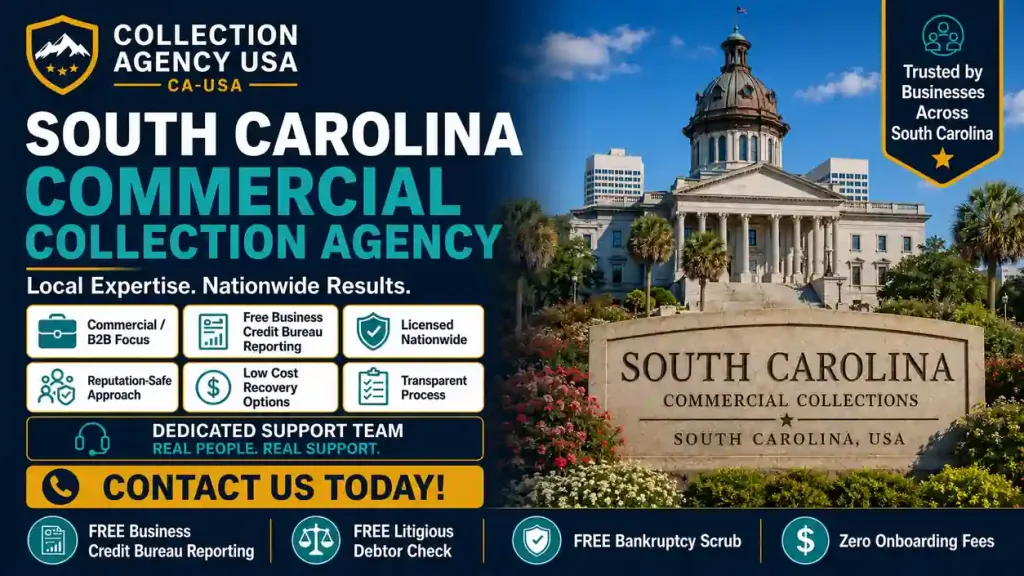
CA-USA provides a low cost, compliant, reputation-safe approach, equipped with all 50-state collections coverage, offering free credit reporting, free pre-litigation check, free bankruptcy scrubs, and zero onboarding fees. Secure – SOC 2 Type II compliant. Over 2,000 online reviews rate us 4.85 out of 5. Over 20 years experience , delivering excellent B2B collection results.
We’ll provide you with the direct mobile number of a dedicated representative, so support is always just a call or text away whenever you need it.
Need a South Carolina Commercial Collection Agency? Contact us
South Carolina Is a Supply-Chain Collection Market
South Carolina’s commercial economy is unusually interconnected.
An automotive supplier in Spartanburg may depend on a manufacturer, logistics provider, toolmaker and engineering company.
A Charleston importer may owe freight, warehousing and distribution vendors.
An aerospace supplier may have high-dollar invoices tied to components, tooling or specialized services.
A construction company may depend on several tiers of subcontractors and material suppliers.
When payment stops, we do not want to know only how much is owed.
We want to know:
Where does this invoice sit in the commercial relationship?
That often tells us more about recovery strategy than the balance alone.
Four South Carolina Rules Can Change the Recovery Strategy
1. Many Contract Claims Run on a Three-Year Clock
South Carolina generally provides a three-year limitation period for actions based on contracts, obligations and liabilities unless another specific rule applies.
That is shorter than many businesses expect.
An old invoice should therefore not sit indefinitely simply because communication with the debtor continues.
For a broader explanation of how deadlines vary, see our Statute of Limitations for Debt Collection resource.
2. Sales of Goods Are Different — South Carolina Generally Gives Six Years
This is where South Carolina becomes particularly interesting for B2B suppliers.
South Carolina’s UCC generally provides six years to bring an action for breach of a contract for sale.
That can matter to businesses selling:
- Automotive components
- Aerospace parts
- Machinery
- Equipment
- Tires
- Plastics
- Building materials
- Agricultural products
- Wholesale inventory
In other words:
A service contract and a sale-of-goods transaction may operate on very different clocks.
The underlying transaction needs to be identified before assuming the deadline.
3. The Legal Debtor Name Matters Under South Carolina’s UCC
A financing statement covering a registered organization generally needs the debtor’s correct legal name from its public organizational record.
South Carolina law specifically says that providing only a debtor’s trade name is not sufficient.
That becomes important when customers operate through:
- DBAs
- Trade names
- LLCs
- Corporations
- Subsidiaries
- Related operating companies
A salesperson may know the customer by one name while the actual contracting—and potentially secured—entity has another.
That distinction can affect UCC searches, security interests, creditor priority and eventual legal strategy.
4. Construction Accounts Have a Much Faster Deadline
South Carolina construction receivables deserve immediate attention.
Certain mechanics’ lien claimants generally must serve and file the required lien statement within 90 days after they stop providing qualifying labor or materials.
A lien generally also requires an enforcement action and notice of pendency within six months after the claimant ceases providing labor or materials.
Collection activity does not automatically preserve lien rights.
Contractors, subcontractors, equipment companies and material suppliers should therefore review lien deadlines separately from ordinary debt collection.
Not Every Unpaid Invoice Is the Same Problem
Before deciding how hard an account should be pushed, we want to understand which problem we are actually dealing with.
The Customer Acknowledges the Debt but Is Slow
This may be a cash-flow or prioritization issue.
Professional persistence, executive-level contact and a realistic payment arrangement can sometimes solve the problem without destroying the relationship.
Part of the Invoice Is Disputed
If $10,000 of a $70,000 balance is legitimately disputed, we do not automatically accept the idea that the entire $70,000 should remain unpaid.
The undisputed amount may still be collectible while the smaller disagreement is resolved.
The Company Has Gone Quiet
Silence can signal something more serious:
- Address changes
- Ownership changes
- Business closure
- Financial stress
- Multiple creditors
- Bankruptcy
- Deliberate avoidance
Business verification and skip tracing become more important at this stage.
The Wrong Entity Was Invoiced or Identified
This happens more often than many creditors realize.
The storefront name, email signature or DBA may not be the entity that signed the contract.
Correct debtor identification becomes particularly important when UCC rights, guarantees or legal referral are involved.
Professional Pressure Without Unnecessary Damage
Commercial recovery is not about making the loudest demand.
It is about getting the right person to make a decision.
Depending on the debtor, that can mean:
- Owner
- CFO
- Controller
- Finance director
- Accounts payable manager
- Managing member
- Senior executive
Our initial objective is to establish:
Is the balance acknowledged?
What, if anything, is genuinely disputed?
Why has payment stopped?
What resolution can actually be completed?
That can lead to payment in full, resolution of a disputed portion or a structured payment arrangement.
If those efforts repeatedly fail, stronger options can be evaluated.
Commercial Credit Reporting Can Add Non-Legal Leverage
Eligible delinquent commercial accounts may be reportable to participating commercial credit bureaus when applicable documentation and reporting requirements are satisfied.
Payment history matters because other businesses and lenders may use commercial credit information when deciding whether to extend future credit.
That creates a meaningful consequence for unresolved business debt without automatically turning the account into litigation.
For our nationwide commercial recovery approach, see B2B Commercial Debt Recovery.
An LLC’s Debt Is Not Automatically the Owner’s Debt
South Carolina law generally treats the debts and obligations of an LLC as obligations of the company.
A member or manager is not personally liable merely because that person owns or manages the LLC.
A valid personal guarantee or another legally recognized basis for personal liability can change the analysis.
That means finding the owner is not enough.
The important question is:
Did the owner actually agree to be personally responsible?
Where South Carolina B2B Receivables Get Complex
Automotive, EV & Supplier Networks
South Carolina has one of the country’s strongest automotive manufacturing ecosystems.
Receivables can involve components, tooling, engineering, transportation, maintenance, materials and tiered supplier relationships.
Aerospace & Aviation
Charleston and Greenville support a large aerospace ecosystem involving manufacturers, engineering companies, parts suppliers, tooling businesses and technical-service providers.
South Carolina Commerce reports more than 400 private-sector aerospace firms in the state’s cluster.
Port, Freight & Distribution
The Charleston region connects importers, exporters, freight companies, warehouses, manufacturers, distributors and third-party logistics providers.
These receivables often move across multiple companies and multiple states, making accurate entity identification particularly important.
Advanced Manufacturing
Machinery, plastics, tires, metal products, advanced materials and industrial suppliers all commonly operate on commercial credit terms.
Large invoice balances can accumulate quickly when a customer begins delaying payment.
Agribusiness
Producers, processors, packaging companies, equipment vendors, distributors and agricultural suppliers face seasonal and supply-chain payment risks.
Construction & Building Materials
Contractors, subcontractors, equipment-rental companies and material suppliers face both ordinary invoice collection issues and separate mechanics’ lien deadlines.
Technology & Professional Services
Software, engineering, staffing, consulting, marketing and business-service firms frequently extend unsecured credit simply by completing work before payment arrives.
Performance-Based Value — Our Incentives Stay Aligned
For South Carolina commercial accounts, CA-USA uses contingency-only pricing, typically 10% to 45%, depending on balance size, account age and complexity—quoted upfront.
Higher balances and younger accounts generally receive lower rates.
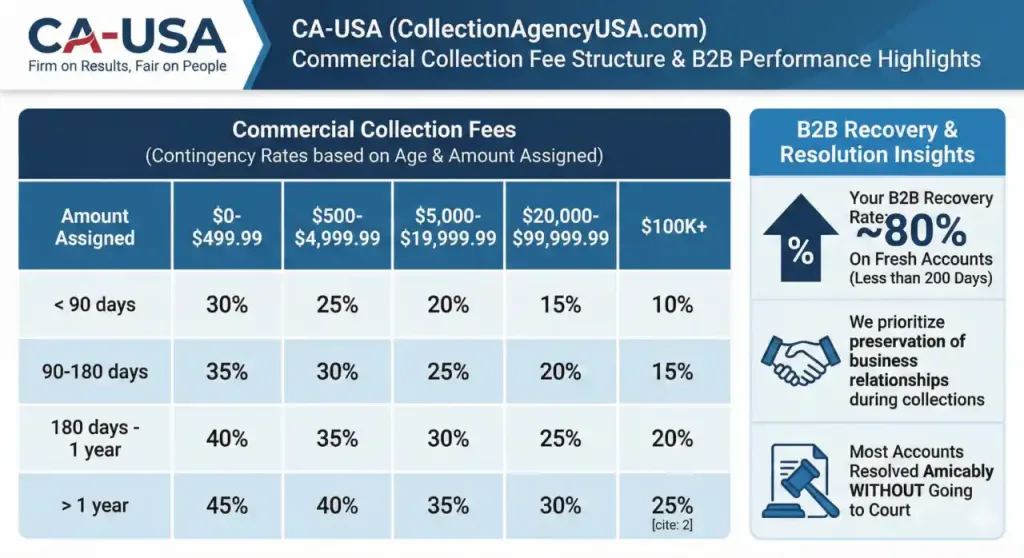
On qualifying fresh commercial accounts under approximately 200 days old and supported by adequate documentation, CA-USA’s internal results can approach ~80% recovery.
Results naturally vary by debtor condition, age, documentation, disputes and other factors.
For pricing details, see What Should a B2B Commercial Collection Agency Charge?.
What Happens Before an Account Ever Reaches an Attorney?
Most accounts should not begin with legal action.
Before attorney referral, CA-USA may use:
Contract & Invoice Review
We examine what was agreed, what was delivered and what remains unpaid.
Business Verification & Skip Tracing
We confirm legal entities, locations, operating status and relevant decision-makers.
Bankruptcy Screening
Collection strategy changes immediately when bankruptcy protection applies.
UCC-Aware Review
Security agreements and relevant filings can materially affect creditor leverage.
Dispute Resolution
A legitimate dispute should be isolated rather than allowing an entire account to remain unpaid indefinitely.
Commercial Credit Reporting
Eligible accounts may receive additional non-legal leverage through participating commercial credit bureaus.
Negotiation & Payment Arrangements
A realistic agreement with a viable business can sometimes recover more efficiently than litigation.
Attorney Referral — Last Resort
Legal escalation is considered only after reasonable collection efforts fail, the account supports further escalation and the client authorizes the next step.
Trust, Security & Nationwide Coverage
CA-USA combines commercial collection experience with:
- More than 20 years of collection experience
- Nationwide collection licensing coverage, including required licenses, registrations and bonds where applicable
- SOC 2 Type II controls
- Secure client account submission
- Bankruptcy screening
- Business skip tracing
- Commercial credit reporting where eligible
- Dedicated support
- Reputation-conscious collection tactics
Our collectors do this work every day.
That experience matters when an account needs persistence without unnecessary escalation.
FAQs About South Carolina Commercial Collections
What is different about B2B debt collection in South Carolina?
South Carolina has several rules that can materially affect commercial recovery. Many ordinary contract claims generally have a three-year limitation period, while contracts for the sale of goods generally receive a six-year period under South Carolina’s UCC. Construction lien rights can involve much shorter 90-day and six-month deadlines.
How long can I collect an unpaid South Carolina business invoice?
Many South Carolina contract claims generally have a three-year limitation period. However, contracts for the sale of goods generally fall under South Carolina’s UCC six-year limitation period. Other rules may apply depending on the obligation, so the transaction and documentation should be reviewed before assuming a deadline.
Why does South Carolina give six years for the sale of goods?
South Carolina’s version of UCC Section 2-725 provides a six-year limitation period for breach of a contract for sale. This can be particularly important for manufacturers, wholesalers, automotive suppliers, machinery vendors and other businesses selling goods rather than services.
Can I collect a South Carolina LLC’s debt from its owner?
Not simply because someone owns or manages the LLC. South Carolina generally treats the company’s debts and obligations as those of the LLC. A personal guarantee or another legally recognized basis for personal liability may change the analysis.
Does using a DBA or trade name matter when collecting South Carolina B2B debt?
Yes. The trade name used in everyday business may not identify the actual legal debtor. This becomes especially important for contracts and UCC financing statements. South Carolina’s UCC specifically provides that a financing statement using only a debtor’s trade name does not sufficiently provide the debtor’s name.
What should South Carolina contractors know before sending an invoice to collections?
Certain mechanics’ lien rights generally require a lien statement to be served and filed within 90 days after qualifying labor or materials stop being provided. A separate enforcement deadline also applies. Sending an account to collections does not automatically preserve those lien rights.
Can a South Carolina commercial debt be reported to a business credit bureau?
Eligible delinquent commercial accounts may be reportable to participating commercial credit bureaus when applicable documentation and reporting requirements are satisfied.
When does CA-USA refer a South Carolina commercial account to an attorney?
Attorney referral is a last resort. CA-USA first uses documentation review, business verification, professional outreach, dispute resolution, negotiation, commercial credit reporting where appropriate and other non-legal recovery tools. Legal referral is considered only after reasonable collection efforts fail, escalation makes commercial sense and the client approves it.
Ready to Recover a South Carolina Business Account?
Commercial recovery works best when the strategy matches the transaction.
Before escalating, ask:
Is this a service contract or sale of goods?
Who is the actual legal debtor?
What does the documentation prove?
Is a shorter lien or limitation deadline running?
Why has payment stopped?
CA-USA combines professional negotiation, debtor intelligence, documentation review, UCC-aware analysis, commercial credit reporting and measured escalation to help South Carolina businesses recover overdue B2B receivables.
If you’re ready to place accounts, see How to Assign Your Accounts to a Collection Agency for the documentation and information that help us begin efficiently.
Firm on the balance. Professional with the people. Legal only after reasonable recovery efforts have failed.
Recover your South Carolina B2B debts? Contact us