Why Modern Debt Recovery Requires a Specialized Partner
-
Regulatory & Compliance Pressure: Strict enforcement of Regulation F, GLBA data security standards, and ever-changing state licensing laws.
-
Evolving Credit Bureau Policies: Major credit bureaus (Equifax, Experian, TransUnion) no longer report paid medical debt or unpaid medical collections under $500.
-
Diminishing Scoring Impact: Newer scoring models like FICO 9 and VantageScore give significantly less weight to medical defaults, reducing consumer urgency to pay.
-
Digital & Consumer Obstacles: High call-blocking rates, rising cybersecurity costs, and viral online content misleading debtors into ignoring valid obligations.
Most people associate hospitals and clinics with healing, not invoices. Yet unpaid medical bills are a fast‑growing line item on the balance sheet of nearly every provider. Collecting those balances brings its own set of hurdles—many of which simply don’t exist in typical consumer or B2B collections.
1. Strict Privacy & Compliance Rules
- HIPAA restrictions prevent agencies from seeing—or even discussing—certain patient details unless airtight Business Associate Agreements are in place.
- State surprise‑billing laws and No Surprises Act protections create extra disclosure requirements at every step of the revenue cycle.
Example: A regional imaging center had to redact diagnostic codes from every past‑due statement before forwarding accounts, adding weeks to its internal workflow.
2. Emotion‑Driven Payment Decisions
Healthcare debt often follows illness, trauma, or job loss, so patients can be anxious—or angry—when collectors call. A hard‑sell script that works fine for retail cards can tank response rates here.
- Patient trust and brand reputation matter; an overly aggressive call could trigger a social‑media backlash that costs far more than the balance owed.
- Medical credit scores (e.g., VantageScore 4.0) weigh medical debt differently, meaning consumers may not feel the same urgency to pay.
Example: A children’s hospital replaced its robo‑dialer with SMS reminders that include a “Need help? Click to set a payment plan” button. Roll‑to‑agent escalations dropped 38 %, and monthly recoveries climbed.
3. Insurance and Coding Complexities
Disputes rarely hinge on willingness; they hinge on EOB confusion, denials, and miscoded CPTs.
- Coordination‑of‑benefits delays keep charges in limbo.
- Patients often assume insurers will eventually pay—and ignore collection letters in the meantime.
4. High‑Dollar, Low‑Frequency Balances
A hospital may carry fewer accounts than a utility company, but each bill is larger. That makes recovery cycles lumpy and forecasting tricky.
5. Fragmented Account Ownership
One emergency room visit can generate four separate bills (facility, physician group, lab, radiology). Patients see “one hospital” and get frustrated by multiple collectors.
Five Field‑Tested Strategies to Overcome These Obstacles
| Strategy | Why It Works |
|---|---|
| Compassion‑First Scripting | Acknowledges hardship, keeps net‑promoter scores intact, and satisfies CFPB expectations of “consumer‑focused” communication. |
| Omnichannel Self‑Service | Mobile‑friendly portals let patients verify insurance, upload documents, and choose a payment plan without human friction. |
| Insurance Follow‑Up Teams | Specialized reps chase down payors, correct coding errors, and resubmit claims—often converting a “bad debt” into reimbursed revenue. |
| Consolidated Billing | Rolling multiple provider invoices into one statement reduces patient confusion and call volume, boosting first‑touch resolutions. |
| Data‑Driven Segmentation | Machine‑learning models flag charity‑care candidates vs. high‑propensity payers, ensuring the right account hits the right workflow. |
Quick Wins You Can Implement This Quarter
- Add QR codes to paper statements that launch a mobile wallet checkout.
- Sync with patient‑engagement apps (MyChart®, Healow®, etc.) so balances appear alongside test results.
- Create a micro‑video for first‑notice emails explaining insurance vs. patient responsibility.
Why us
- Patient Education on Billing
We provide clear explanations of charges and insurance adjustments, reducing confusion that often delays payment. - Flexible Installment Plans
Offering structured payment plans aligned with patient budgets helps increase recovery while maintaining goodwill. - Early-Out Programs
Our team can step in right after billing to handle reminder calls and letters—preventing accounts from ever becoming delinquent. - Compliance with State-Specific Rules
Beyond HIPAA, we stay current on evolving state healthcare debt laws, ensuring providers remain fully compliant.
CA-USA provides a low cost, compliant, reputation-safe approach, equipped with all 50-state collections coverage, offering free skip tracing, free pre-litigation checks, free bankruptcy scrubs, and zero onboarding fees. Secure – SOC 2 Type II and HIPAA compliant. Over 2,000 online reviews rate us 4.85 out of 5. Over 20 years experience , delivering excellent medical collection results.
Need a Medical Collection Agency? Contact us
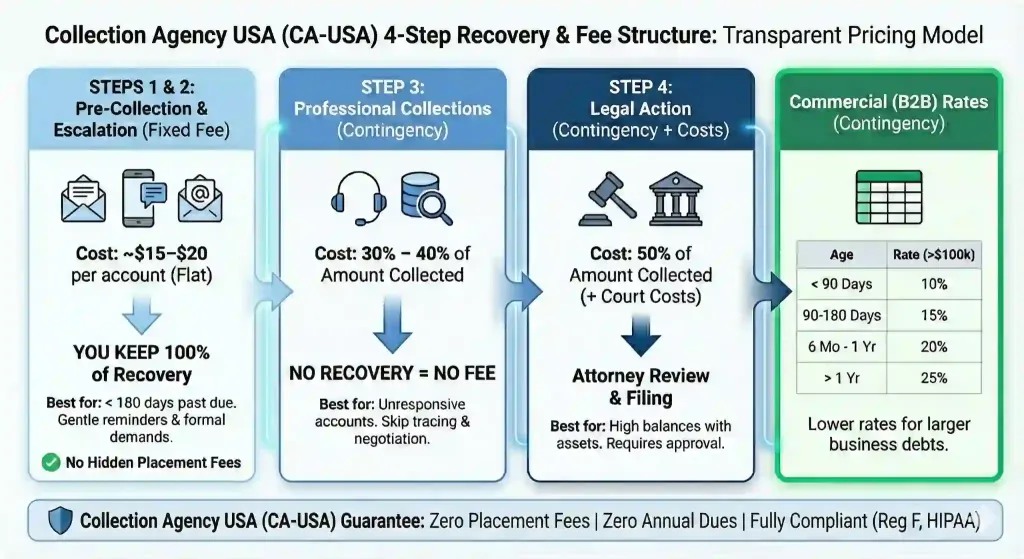
Our Simple Pricing:
$15 for fixed fee collections, 40% for Contingency Collections
Frequently Asked Questions
Does the CFPB’s rule banning medical debt from credit reports still apply?
No, not anymore, at least at the federal level. The CFPB finalized that rule in January 2025, but a federal court in Texas vacated it in its entirety in July 2025, ruling that the CFPB had exceeded its authority under the Fair Credit Reporting Act. What’s left standing are the credit bureaus’ own 2023 voluntary policies (already reflected in reduced reporting of paid debt and small balances) rather than a binding federal ban. The court also suggested that the FCRA may preempt similar state-level bans, which is worth watching if you operate in a state that’s passed its own version.
The page mentions strict Regulation F enforcement. What does that actually restrict day to day?
The most practical piece is the “7-in-7” call cap: no more than seven calls about a specific debt within any rolling seven-day period, and once a collector connects with the consumer, a mandatory seven-day pause before calling about that same debt again. Reg F also requires clear opt-out language for email and text contact and a detailed validation notice itemizing the debt. Most of the friction providers feel isn’t the rule itself, it’s that a single ER visit can generate several separate accounts, each technically its own “debt” under the cap, which legacy call-heavy workflows weren’t built to handle.
Are there federal rules that limit how aggressively a nonprofit hospital can pursue unpaid balances?
Yes, for tax-exempt hospitals specifically. Section 501(r) of the Internal Revenue Code requires nonprofit hospitals to maintain a written financial assistance policy, make reasonable efforts to determine charity-care eligibility, and avoid “extraordinary collection actions” (lawsuits, liens, credit reporting) until at least 120 days after the first bill and a documented eligibility determination. Falling short doesn’t just create bad press, it can jeopardize the hospital’s tax-exempt status itself, which raises the stakes well beyond any single account.
Final Thoughts
Healthcare collections demand empathy, airtight compliance, and surgical‑level precision in handling insurance data. Providers who blend patient‑friendly communication with tech‑powered workflows recover more revenue—and preserve the goodwill that keeps communities trusting their care.