You restored the property. You documented the damage, managed the crew, coordinated with the adjuster, completed the work, and sent the invoice.
Then the payment stopped moving.
For restoration companies, however, an unpaid invoice does not always mean the customer simply refuses to pay. The balance may be stuck with an insurance carrier, waiting on a supplement, tied up with a mortgage company, disputed over scope or pricing, or genuinely delinquent after the responsible party has already received the funds.
A professional collection agency does more than make additional phone calls. It helps determine what is actually collectible, who is responsible for payment, and which recovery strategy makes sense before escalating the account.
| CA-USA provides a low cost, compliant, reputation-safe approach, equipped with all 50-state collections coverage, offering free credit reporting, free pre-litigation check, free bankruptcy scrubs, and zero onboarding fees. Secure – SOC 2 Type II compliant. Over 2,000 online reviews rate us 4.85 out of 5. Over 20 years experience , delivering excellent collection results. Need a Collection Agency? Contact us |
First: Why Has the Restoration Invoice Not Been Paid?
One of the biggest mistakes in restoration collections is treating every old balance the same way.
A 90-day-old receivable could represent several completely different situations.
Insurance Payment Still Processing
The insurance carrier may still be reviewing the claim, requesting documentation, or processing payment. That is different from a homeowner who has received the insurance proceeds but has not paid the restoration company.
Supplement Still Under Review
Additional labor, equipment, materials, or scope changes may have produced a supplement that has not yet been approved. The undisputed portion of the invoice should be separated from amounts that remain under review.
Recoverable Depreciation Has Not Been Released
On replacement-cost claims, part of the payment may depend on completion of the work and submission of supporting documents before recoverable depreciation is released.
Mortgage Company Is Holding the Insurance Check
When a property has a mortgage, the lender may be named on the insurance payment and require inspections, endorsements, or additional paperwork before releasing funds.
Customer Deductible Is Still Outstanding
Insurance coverage does not normally eliminate the customer’s contractual responsibility for a deductible. That portion of the restoration bill may need to be pursued separately.
The Account Is Actually Delinquent
Sometimes the work is complete, the payment responsibility is clear, insurance funds have been released, and the customer or business simply has not paid.
That is when professional collections become especially valuable.
A good restoration collection process first separates insurance-processing delays from actual collectible debt.
Restoration Collections Start With the Job File
Restoration receivables are documentation-heavy.
When an account is disputed, simply showing an invoice may not be enough. The strength of the collection effort often depends on the underlying job file.
Useful documentation may include:
- Signed work authorization or service agreement
- Final invoices
- Xactimate or other estimates
- Photographs of the loss and completed work
- Drying and equipment logs
- Moisture readings
- Certificate of completion
- Change orders
- Supplements
- Payment history
- Insurance correspondence
- Direction-to-Pay documents
- Assignment of Benefits documents, where applicable
- Deductible information
- Previous emails, calls, and payment promises
The better the documentation, the easier it is to distinguish a legitimate billing dispute from a customer simply delaying payment.
If you are preparing accounts for outside collection for the first time, see our guide on how to assign accounts to a collection agency.
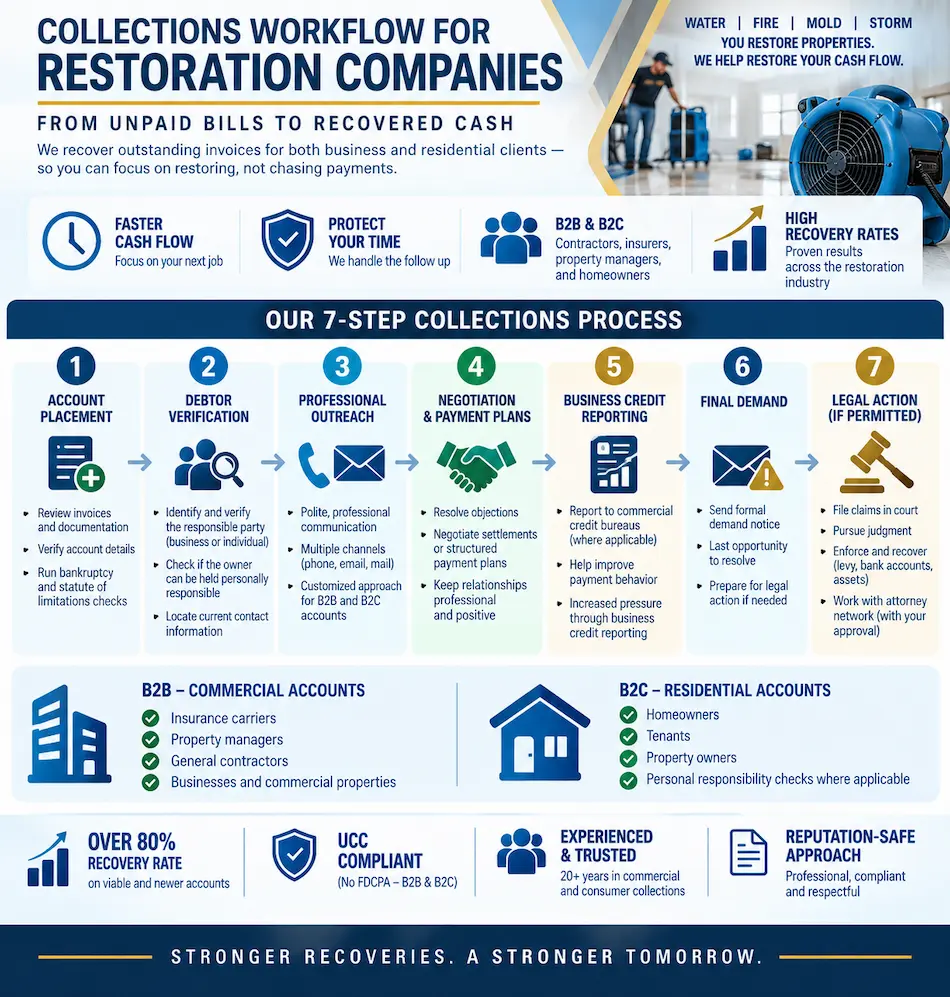
Omnichannel Outreach Without Turning It Into Harassment
Having an office employee repeatedly call a customer is not the same as having a structured collection process.
Professional collection agencies can use an appropriate combination of:
- Phone
- Text
- Documented payment reminders
- Formal collection notices
Every interaction can be logged, including disputes, promises to pay, returned communications, and payment arrangements.
For consumer restoration debts, third-party collectors must structure communication around applicable FDCPA, Regulation F, and state requirements. Regulation F includes specific presumptions regarding telephone-call frequency; those telephone-call provisions should not simply be applied as a universal “seven-contact rule” to every form of communication or every commercial account.
Commercial restoration accounts involving businesses, landlords, property-management companies, hotels, or other entities may be subject to a different collection framework.
Residential and Commercial Restoration Debts Are Different
This distinction matters.
A restoration bill owed by an individual homeowner for work on a personal residence may be a consumer debt.
An invoice owed by a:
- Property-management company
- Commercial landlord
- Hotel
- Office building
- Apartment business entity
- Retail operation
- Industrial property owner
- General contractor
- Other business
may instead be a commercial B2B debt.
Business debt is not simply a larger version of consumer debt. Contracts, payment terms, corporate structure, UCC considerations, commercial credit reporting, and business relationships can all change the recovery strategy.
For larger commercial restoration balances, see our guide to B2B commercial debt recovery.
Credit Reporting Can Add Another Recovery Lever
Repeated reminders eventually lose their impact.
Eligible delinquent accounts may, where appropriate, be reportable to participating consumer or commercial credit bureaus depending on the type of debt, available documentation, reporting relationship, and applicable requirements.
Credit reporting should never be treated casually. Businesses that furnish consumer information to credit reporting agencies have responsibilities concerning accuracy, documentation, updating information, and handling disputes under the FCRA.
For a restoration company that is not set up as a regular credit-data furnisher, working with an established collection agency can provide access to recovery tools that are difficult to operate properly in-house.
A Neutral Third Party Protects the Relationship
Some collection conversations are difficult precisely because your company already has a relationship with the customer.
Maybe the homeowner gave you referrals.
Maybe the property manager sends several jobs every year.
Maybe an adjuster or commercial client is disputing only part of the invoice.
When your own project manager repeatedly asks for payment, the conversation can become personal very quickly.
A professional collection agency creates distance.
The discussion becomes:
What does the contract say? What amount is undisputed? What documentation is missing? What payment arrangement can resolve this?
That allows the restoration company to step away from the emotional part of the collection process while the agency works toward a professional resolution.
Reputation-Safe Collection Tactics Matter
Restoration companies depend heavily on:
- Referrals
- Online reviews
- Insurance relationships
- Property managers
- Contractors
- Local reputation
Recovering one invoice is not worth unnecessarily damaging a valuable source of future business.
That is why our approach emphasizes firm but professional communication, negotiation, documentation, and resolution before legal escalation.
Legal action should be considered only when reasonable collection efforts and negotiations have failed and when the amount, documentation, debtor status, and potential recovery justify taking the next step.
Assignment of Benefits and Direction to Pay Are Not the Same Thing
Restoration companies frequently deal with insurance-payment documents, but the exact document matters.
A Direction to Pay generally instructs an insurer to direct payment in a particular way.
An Assignment of Benefits (AOB) may transfer certain insurance rights from the policyholder to the restoration contractor.
The Restoration Industry Association has specifically noted that restorers sometimes assume they have an assignment when the document is actually only a Direction to Pay. State laws governing assignments also vary significantly.
If an unpaid job includes an AOB, Direction to Pay, or similar document, include it when placing the collection account.
It may materially affect how the payment dispute should be evaluated.
Collections Do Not Replace Mechanics’ Lien Deadlines
Restoration contractors may also have mechanics’ lien or preliminary-notice rights depending on the state, property, work performed, and contractual relationship.
Those deadlines can continue running while the contractor waits for an adjuster, homeowner, or mortgage company to resolve payment.
Sending an account to collections does not automatically preserve mechanics’ lien rights.
Restoration-payment guidance specifically warns contractors to monitor lien and preliminary-notice deadlines rather than waiting indefinitely for an insurance payment.
If lien rights may exist, they should be evaluated separately and promptly.
Skip Tracing Finds Customers Your Staff Cannot Easily Locate
Restoration work often happens after a disruptive event.
A property owner may relocate after a fire or flood. Phone numbers change. Mail is returned. Businesses move. Corporate contacts leave.
Ordinary internet searches do not always provide reliable current information.
Professional agencies can use lawful skip-tracing and business or consumer data sources, where permitted, to locate updated:
- Addresses
- Telephone numbers
- Business information
- Ownership information
- Other contact data
That becomes particularly valuable when a customer stops responding after the work is completed.
Bankruptcy Screening Prevents the Wrong Kind of Collection Activity
Before escalating an account, it is important to know whether the debtor has filed bankruptcy.
A bankruptcy filing may create an automatic stay restricting ordinary collection activity.
Continuing to pursue payment without recognizing that restriction can create unnecessary legal exposure.
Bankruptcy screening allows collection activity to be stopped or redirected when appropriate instead of treating every delinquent account as though it remains collectible through the normal process.
Documentation Creates a Defensible Collection Record
Professional collections create a consistent record of:
- Calls
- Letters
- Emails
- Disputes
- Supporting documents
- Payment promises
- Negotiated arrangements
- Returned communications
- Account status
That documentation becomes increasingly important if an account later requires management review, attorney assessment, or another form of escalation.
A spreadsheet note saying “called customer again” is not the same thing as a structured account history.
Your Employees Were Hired to Restore Properties
Your estimator should be estimating jobs.
Your project coordinator should be coordinating projects.
Your office manager should be managing operations.
Every hour those employees spend chasing an old invoice is an hour they are not spending on activities that produce new revenue.
Collection agencies specialize in:
- Account follow-up
- Difficult conversations
- Payment negotiation
- Dispute handling
- Skip tracing
- Bankruptcy screening
- Documentation
- Credit-reporting procedures
- Escalation decisions
Outsourcing collection activity lets your restoration team return its attention to restoration.
When Should a Restoration Account Be Sent to Collections?
There is no universal day when every restoration invoice should automatically be assigned.
First determine:
- Is the contractual payment actually due?
- Is insurance still processing an undisputed payment?
- Is a supplement still legitimately under review?
- Is a mortgage company holding the payment?
- Has the homeowner or business already received funds?
- Is there a genuine dispute?
- Have reasonable internal follow-ups failed?
Once the balance is clearly due and internal efforts are no longer moving the account forward, continuing to wait usually provides little advantage.
Older debts may also face state-specific statutes of limitation. Our overview of debt collection statutes of limitation explains why account age and state law should be considered before delaying collection indefinitely.
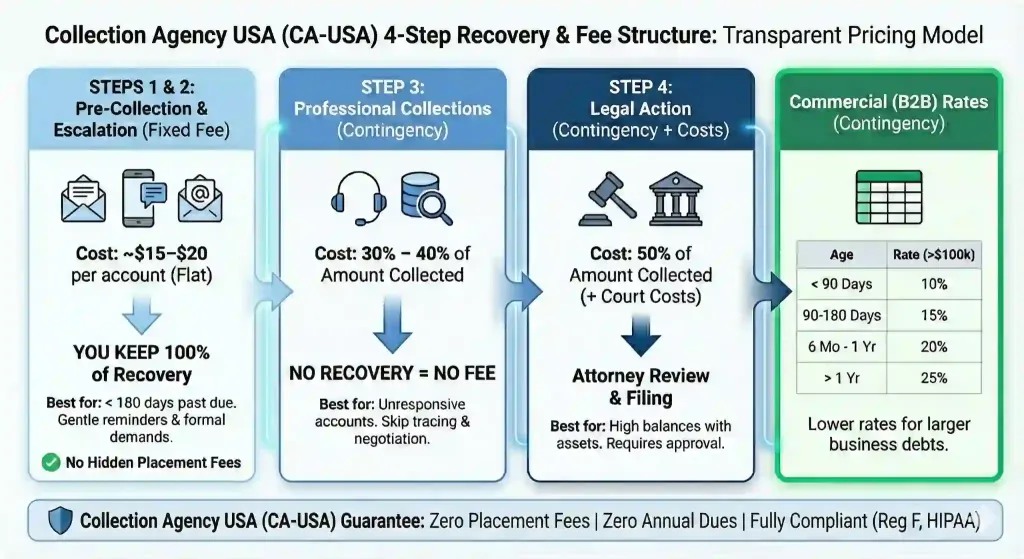
Cost-Effectiveness: The CA-USA Approach
CA-USA offers two primary approaches depending on the age and circumstances of the account:
Fixed-Fee Recovery — $15 Per Account
Designed primarily for earlier-stage accounts.
You pay a small fixed placement fee, and payments are made directly to you. You keep 100% of the recovered amount.
Contingency Collection
For accounts requiring full collection activity, contingency rates generally range from 20% to 40%, depending on factors such as balance, age, and account circumstances.
If we do not recover money under the contingency service, there is no collection commission.
Businesses comparing collection costs can also review our guide on what a B2B commercial collection agency should charge.
Frequently Asked Questions
Can a restoration company send a homeowner to collections while the insurance claim is still open?
Potentially, but an open insurance claim alone does not establish whether the homeowner’s balance is ready for collection. First determine what amount is contractually due, what the insurer has paid or approved, whether supplements or depreciation remain outstanding, and whether the customer is responsible for the unpaid portion. Collections should pursue a documented debt rather than money that is simply still moving through the insurance process.
Who owes the restoration invoice if insurance pays less than expected?
The answer depends on the restoration contract, insurance policy, applicable state law, AOB or Direction-to-Pay documents, and the reason the insurer paid less. Insurance coverage does not automatically determine the customer’s contractual obligations to the restoration company. Disputed balances should be reviewed before collection begins.
Can an unpaid restoration account be reported to a credit bureau?
Eligible delinquent accounts may be reportable where applicable requirements are satisfied. Consumer credit reporting carries FCRA duties involving accuracy and dispute handling, while commercial accounts may involve business credit reporting instead. The appropriate reporting option depends on the account type and available documentation.
What documents should we provide when sending a restoration invoice to collections?
Provide as much of the job file as possible, including the signed authorization or contract, invoices, estimates, completion documents, photographs, equipment or drying logs, supplements, payment history, insurance correspondence, and any AOB or Direction-to-Pay documents that apply.
Does an Assignment of Benefits change how the debt is collected?
It can. An AOB may transfer certain insurance-related rights, while a Direction to Pay may simply instruct the insurer regarding payment. The legal effect varies by state and by the language of the document, so it should be reviewed as part of the collection file rather than assumed to provide a particular right.
Should we protect mechanics’ lien rights before sending an account to collections?
If lien rights may apply, review them promptly. State deadlines for preliminary notices and mechanics’ liens can expire while a payment dispute remains unresolved. Collection placement does not automatically extend or preserve those deadlines.
Stop Letting Old Restoration Invoices Become Permanent Write-Offs
The goal is not to send every slow-paying restoration customer to collections.
The goal is to recognize when an insurance-processing issue has become a real unpaid debt—and then move the account into a professional recovery process before more time is lost.
CA-USA helps restoration companies identify the right collection path, document the account, locate difficult-to-reach debtors, negotiate professionally, and escalate only when necessary.
Recover the invoice without turning every payment problem into a fight. Contact us