Need a commercial collection agency in Virginia for unpaid B2B invoices? CA-USA helps businesses recover past-due commercial accounts across Richmond, Norfolk, Virginia Beach, Arlington, Fairfax, Roanoke, and throughout Virginia. Our approach combines reputation-safe negotiation, contract and invoice review, UCC-aware commercial collection practices, bankruptcy screening, business skip tracing, and commercial credit reporting—without unnecessarily damaging valuable customer relationships.
We focus first on professional communication and negotiated resolution. Attorney referral is considered only when reasonable collection efforts have failed, the documentation and balance support further action, and you approve the escalation. Accounts are placed through a secure SOC 2 Type II environment, with dedicated support and zero onboarding fees. We are local, our office is located in Virginia Beach.
CA-USA provides a low cost, compliant, reputation-safe approach, equipped with all 50-state collections coverage, offering free credit reporting, free pre-litigation review, free bankruptcy scrubs, and zero onboarding fees. Secure – SOC 2 Type II compliant. Over 2,000 online reviews rate us 4.85 out of 5. Over 20 years experience, delivering excellent B2B collection results.
You’ll receive the direct mobile number of a dedicated representative, so help is always just a call or text away.
Need a Commercial Collection Agency? Contact us
Why Virginia B2B Collections Require a Commercial Approach
Virginia’s commercial economy is unusually diverse. Northern Virginia is a global center for data centers, software, cybersecurity, and federal contracting; Hampton Roads is anchored by the Port of Virginia, maritime trade, logistics, and defense; and advanced manufacturing, aerospace, life sciences, and professional services extend across the Commonwealth. A past-due commercial account in these sectors may involve purchase orders, subscription agreements, milestone billing, security interests, retainage, personal guarantees, or disputed performance terms.
That is why commercial collections should not be handled like ordinary consumer debt. We review the business relationship, supporting documentation, debtor status, and available non-legal leverage before choosing the appropriate recovery strategy.
The 7-Step Commercial Debt Recovery Framework in Virginia
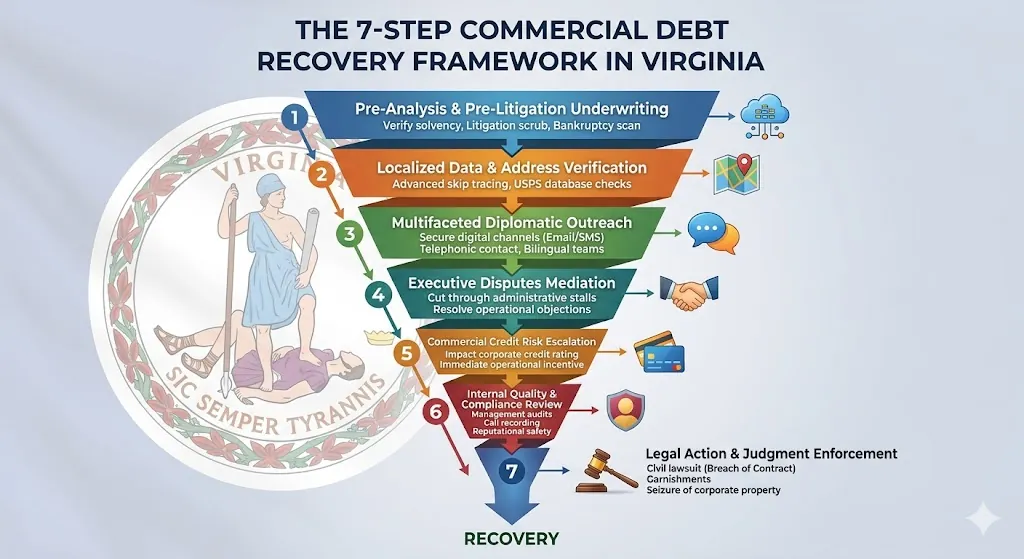
Step 1: Contract, Invoice & Account Review
We begin by reviewing the signed agreement, invoices, purchase orders, credit applications, payment terms, guarantees, account statements, and dispute history. Where relevant, we also look for UCC-related issues that may affect the creditor’s position. The goal is to understand what is actually documented before contacting the debtor.
Step 2: Bankruptcy, Business & Address Verification
Before escalation, we screen for bankruptcy and verify the debtor’s business identity, current operating status, addresses, and available corporate information. Virginia State Corporation Commission records can be particularly useful when confirming legal entities, registered offices, and UCC-related filings.
Step 3: Reputation-Safe Business Outreach
Our first collection contacts are professional, firm, and businesslike. We communicate with the appropriate accounts-payable, finance, ownership, or executive contacts and focus on resolving the balance without unnecessarily damaging an ongoing customer, vendor, or referral relationship.
Step 4: Dispute Resolution & Negotiation
If the debtor disputes the invoice, contract performance, delivery, pricing, or payment terms, we identify the specific issue and work toward a documented resolution. When appropriate, negotiated payment arrangements can recover the account while preserving a commercially valuable relationship.
Step 5: Commercial Credit Reporting — Where Appropriate
Eligible delinquent business accounts may be reportable to participating commercial credit bureaus, subject to applicable reporting requirements and supporting documentation. When appropriate, commercial credit reporting can provide an additional non-legal incentive for a solvent business to resolve the balance.
Step 6: Management & Documentation Review
Before any legal recommendation, the account is reviewed again for documentation quality, debtor status, dispute history, collectability, and prior negotiation efforts. We want legal escalation to be a reasoned business decision—not an automatic next step.
Step 7: Attorney Referral — Only as a Last Resort
If reasonable collection efforts and negotiations fail, and the account supports further action, attorney referral may be considered with your approval. Virginia law specifically allows a collection agency to refer a debt to an attorney with the creditor’s approval of both the referral and the fee arrangement. Legal action is therefore treated as a final escalation, not the starting strategy.
Virginia Commercial Collection Deadlines
Virginia commercial collection deadlines depend on the underlying transaction. A contract that is in writing and signed by the party to be charged is generally subject to a five-year limitation period. Certain unsigned written agreements and unwritten contracts generally have a three-year period. For contracts involving the sale of goods, Virginia’s UCC generally provides a four-year limitation period, subject to the terms and facts of the transaction.
Construction receivables may also involve separate Virginia mechanics’ lien deadlines, so subcontractor and material-supplier balances should be reviewed promptly rather than treated like ordinary invoices. Because limitation periods and accrual dates can vary by account type, older commercial balances should be reviewed individually.
Trust & Compliance
Commercial Credit Reporting
Eligible delinquent business accounts may be reported to participating commercial credit bureaus where appropriate, creating a non-legal incentive for resolution while supporting responsible commercial credit practices.
Contract, Invoice & UCC Review
We review available contracts, invoices, purchase orders, guarantees, security interests, and relevant UCC information before choosing a recovery strategy. This helps identify documentation strengths, disputes, and potential secured-creditor issues early.
Bankruptcy Screening
Accounts are screened for bankruptcy before escalation. If an automatic stay or other bankruptcy restriction applies, collection activity is handled accordingly rather than continuing ordinary recovery efforts.
Business Skip Tracing & SCC Verification
We use business skip-tracing tools and available Virginia State Corporation Commission information to help confirm legal entities, current addresses, registered offices, and other business details needed to reach difficult-to-locate debtors.
Secure Portal & SOC 2 Type II
Accounts and supporting documents are submitted through a secure online environment backed by SOC 2 Type II controls designed to protect sensitive business and account information.
Nationwide Licensing & Compliance
CA-USA maintains required collection licenses, registrations, and bonds where applicable nationwide and handles accounts in accordance with applicable federal and state requirements.
Attorney Referral — Only as a Last Resort
Our first priority is reputation-safe communication, dispute resolution, and negotiation. Attorney referral is considered only after reasonable collection efforts fail, the documentation and balance support escalation, and the client approves both the referral and applicable fee arrangement.
Industries We Serve in Virginia
Technology, SaaS & Data Centers
Enterprise software, hosting, cloud infrastructure, subscription, licensing, implementation, and technology-vendor receivables across Northern Virginia’s data-center and technology ecosystem.
Cybersecurity & Government Contractors
Subcontractor, consulting, technology, staffing, and vendor balances connected with Virginia’s cybersecurity, defense, and federal contracting marketplace.
Port, Logistics & Distribution
Freight, carrier, warehouse, drayage, shipping-client, and supply-chain accounts tied to Hampton Roads, Norfolk, and the Port of Virginia.
Aerospace, Defense & Unmanned Systems
Engineering, component, tooling, supplier, maintenance, and subcontractor balances across Virginia’s aerospace, defense, and unmanned-systems sectors.
Advanced Manufacturing & Semiconductors
Equipment, materials, components, tooling, industrial-service, and commercial supplier receivables across Virginia’s manufacturing base.
Life Sciences & Healthcare Vendors
B2B balances involving laboratories, pharmaceutical and medical-device companies, healthcare suppliers, practices, facilities, and other business-to-business service relationships.
Construction & Trades
Subcontractor, equipment-rental, material-supplier, retainage, and commercial project balances where documentation and time-sensitive remedies may matter.
Professional & Business Services
Unpaid invoices involving consulting, staffing, IT services, accounting, marketing, legal support, and other contract-based business services.
Why Our Commercial Collection Process Matters in Virginia
Real Virginia Scenario: UCC Priority Changed Who Had the Stronger Claim
In a Virginia Supreme Court commercial dispute, competing creditors claimed rights to funds held in a company’s deposit accounts. One creditor had a perfected security interest through control of the accounts, while the competing interest was not perfected in the same way. The court held that the perfected interest had priority.
Our approach: We do not assume that a contract, security agreement, or UCC reference automatically creates the leverage a creditor expects. Available contracts, guarantees, security interests, and filing information should be reviewed before relying on secured-creditor rights during collection.
Real Virginia Scenario: Collection Continued After Bankruptcy Notice
In a Virginia bankruptcy case, a creditor continued efforts to collect a pre-bankruptcy balance after receiving notice of the bankruptcy filing. The court found that the continued collection activity violated the automatic stay and awarded damages and attorney’s fees.
Our approach: Bankruptcy screening happens before escalation. If a stay or other bankruptcy restriction applies, ordinary collection activity should stop and the account should be handled through the appropriate bankruptcy process rather than pushed forward as a normal delinquency.
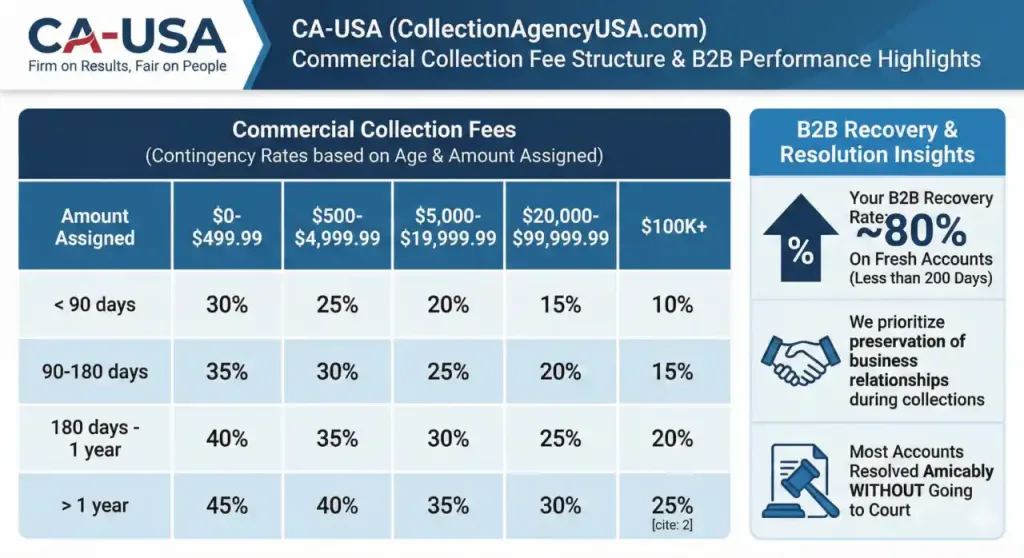
Commercial Collection Pricing
CA-USA offers commercial collection options based on account balance, debt age, documentation and the level of recovery work required. There are no onboarding fees, and our tiered commercial pricing provides lower contingency rates for larger qualifying balances.
Frequently Asked Questions
Does the FDCPA apply to commercial B2B debt collection in Virginia?
The FDCPA generally applies to debts incurred primarily for personal, family, or household purposes—not ordinary business-to-business debts. Commercial collections still require attention to the underlying contract, applicable Virginia law, bankruptcy restrictions, UCC issues where relevant, and professional collection practices. CA-USA uses reputation-safe communication designed to recover the balance without unnecessarily damaging an ongoing business relationship.
How long can we pursue an unpaid business invoice in Virginia?
Virginia generally provides five years for a contract that is in writing and signed by the party to be charged, while certain unsigned written agreements and unwritten contracts generally have a three-year period. Contracts for the sale of goods generally fall under Virginia’s UCC four-year limitation period. The correct deadline and accrual date depend on the transaction, so older B2B accounts should be reviewed individually.
How does Virginia’s UCC affect a commercial collection?
Virginia’s Uniform Commercial Code can affect transactions involving the sale of goods, security interests, financing statements, deposit accounts, and other secured commercial rights. We review available contracts, invoices, guarantees, security interests, and relevant UCC information because filing and perfection details can materially affect the options available on a commercial account.
Can an unpaid Virginia B2B account be reported to a commercial credit bureau?
Eligible delinquent commercial accounts may be reportable to participating business credit bureaus, subject to reporting requirements, documentation, and the circumstances of the account. When appropriate, commercial credit reporting can create an additional non-legal incentive for a business to resolve an outstanding balance before attorney referral is considered.
Can we pursue the owner of a Virginia LLC personally for the company’s unpaid debt?
Usually not simply because someone owns or manages the LLC. Virginia law generally provides that members and managers are not personally liable for the company’s obligations solely because of that role. A signed personal guarantee or another legally recognized basis for personal liability can materially change the analysis, which is why guarantees and supporting agreements should be reviewed.
When does CA-USA refer a Virginia commercial account to an attorney?
Legal action is a last resort. CA-USA first uses documented outreach, dispute review, reputation-safe negotiation, and other appropriate non-legal recovery options. If those efforts fail and the documentation and balance justify further action, an attorney referral may be considered. Virginia law requires creditor approval of both the referral and the fee arrangement, so legal escalation proceeds only with client authorization.
Ready to Recover a Past-Due Virginia Business Account?
If a customer, vendor, contractor, or commercial client has stopped paying, early professional intervention can preserve more recovery options. Submit the account securely or contact CA-USA to discuss the documentation, balance, and appropriate next step.
Recover your Business Debts? Contact us