Need a commercial collection agency in Utah for unpaid B2B invoices? CA-USA helps businesses recover past-due commercial accounts across Salt Lake City, Lehi, Provo, Ogden, St. George, and throughout Utah. Our commercial collection process follows professional B2B recovery practices aligned with applicable Uniform Commercial Code (UCC) requirements, with free Business Credit Bureau reporting, bankruptcy screening, secure SOC 2 Type II account handling, and experienced negotiation. We use reputation-safe tactics designed to recover past-due invoices without unnecessarily damaging valuable customer relationships.
Our goal is to recover the money while preserving valuable business relationships. Legal action is considered only when collection efforts and negotiations have been exhausted, and only when appropriate for the account. With 20+ years of experience, zero onboarding fees, a dedicated representative, and more than 2,000 online reviews averaging approximately 4.85 out of 5, placing a Utah commercial account is simple and secure.
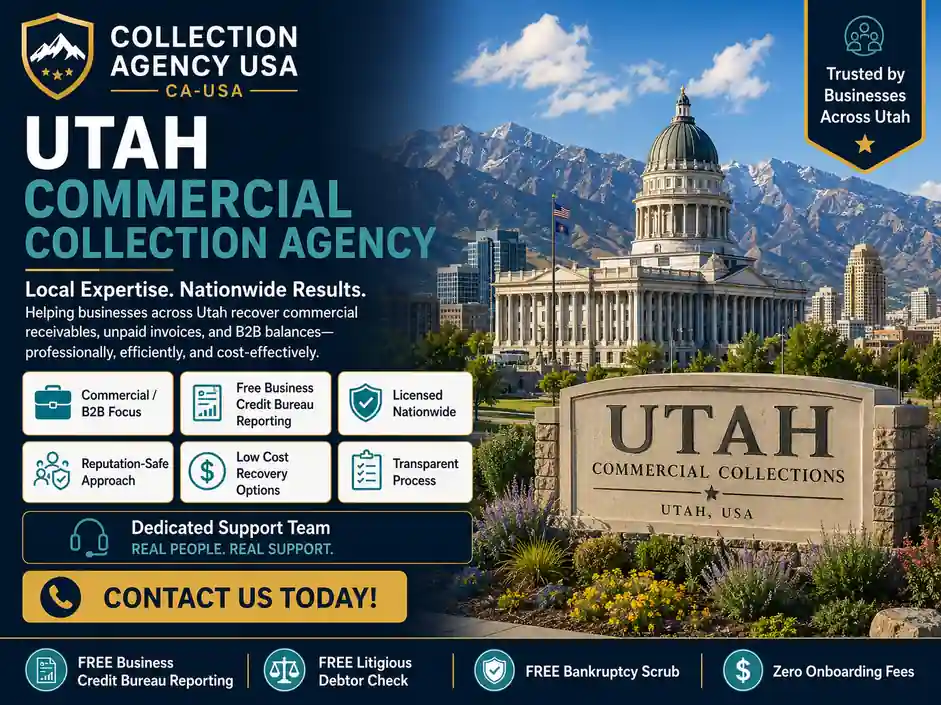
CA-USA provides a low cost, compliant, reputation-safe approach, equipped with all 50-state collections coverage, offering free credit reporting, free pre-litigation checks, free bankruptcy scrubs, and zero onboarding fees. Secure – SOC 2 Type II compliant. Over 2,000 online reviews rate us 4.85 out of 5. Over 20 years experience , delivering excellent B2B collection results.
You’ll receive the direct mobile number of a dedicated representative, ensuring prompt support by call or text whenever you need assistance.
Need a Commercial Collection Agency in Utah? Contact us
Why Utah’s B2B Accounts Need a Different Approach
Utah’s commercial landscape doesn’t fit a single mold, and neither should how a past-due account gets handled.
Silicon Slopes’ Fast-Moving Contracts
Tech and SaaS companies clustered along the Lehi-to-Provo corridor tend to run on subscription and enterprise-contract billing, where a stalled payment can sit quietly for a full billing cycle before anyone notices. Speed matters here more than in most industries; the longer a subscription account goes unaddressed, the more it looks like it was never going to get paid at all.
Logistics, Mining, and the I-15 Corridor
Freight moving through the Salt Lake City rail and trucking hub, alongside the state’s mining and heavy-industry base, runs on net-30 and net-60 vendor terms that can get quietly stretched without a word to the supplier. These accounts often respond well to early, documented contact before a slow payer becomes a habitual one.
Utah’s Statute of Limitations
Written contracts in Utah are generally subject to a six-year statute of limitations, while certain oral contracts and open accounts generally have a four-year period. Specific accrual rules can vary by account type, including credit agreements. Utah judgments generally continue for eight years and may be renewed under applicable law. Because limitation periods and judgment interest can depend on the underlying contract and facts, older commercial accounts should be reviewed rather than allowed to sit until a deadline approaches.
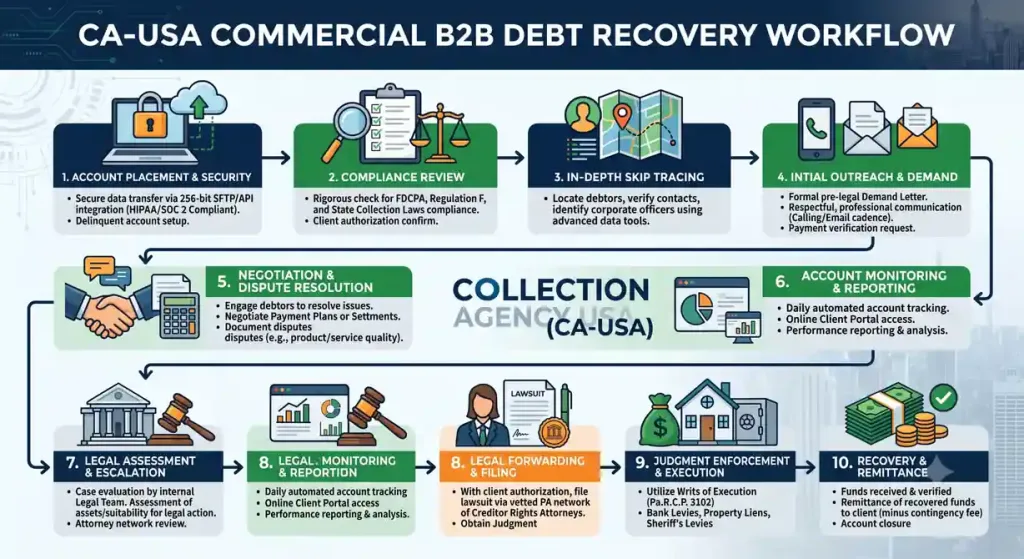
How We Recover Your Utah Commercial Debt
- Intake & Documentation Review — Contracts, invoices, purchase orders, and prior communication are reviewed before any outreach begins, so the file is built on facts rather than assumptions.
- Verification & Formal Notice — Debtor identity and current address are confirmed, then a documented, multi-channel demand goes out that establishes a clear paper trail.
- Direct Negotiation — Outreach goes to the people who can actually approve payment: owners, controllers, and accounts payable managers, not a front desk.
- Dispute Review — Genuine disputes (short-pays, quality claims, delivery questions) get investigated on their merits rather than dismissed, since collecting on a real dispute usually costs more in goodwill than it recovers.
- Credit Bureau Reporting — Where eligible and appropriate, delinquent commercial accounts may be reported to business credit bureaus (Dun & Bradstreet, Experian Business, Equifax Commercial and Credit Safe), creating an additional non-legal incentive for the debtor to resolve the balance.
- Legal Referral — If reasonable collection efforts and negotiations fail, and the balance and documentation support further action, the account may be referred to an attorney. Legal referral is considered only as a final escalation and with client authorization.
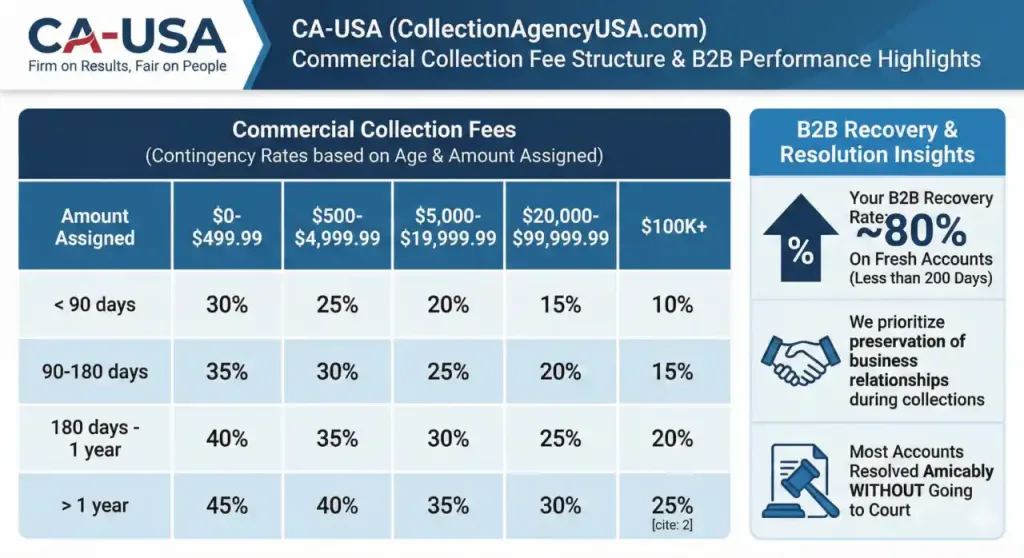
What This Actually Costs
- Fixed-Fee Recovery ($15/account): Ideal for early-stage receivables. Debtors pay 100% directly to you. No commissions.
- Contingency Service (40%): Performance-based recovery. No Recovery, No Fee.
Trust & Compliance, In Plain Terms
Commercial Credit Reporting
Eligible delinquent business accounts may be reported to commercial credit bureaus, adding another incentive for businesses to resolve outstanding balances.
Contract & Invoice Review
We review contracts, purchase orders, invoices, payment terms, and supporting documentation to strengthen collection efforts and identify relevant UCC considerations.
Bankruptcy Screening
Accounts are screened for bankruptcy so collection activity can be handled appropriately and unnecessary recovery efforts are avoided.
Business Skip Tracing
Our business skip-tracing tools help locate companies, owners, updated addresses, phone numbers, and other information needed to reconnect with hard-to-reach debtors.
Secure Portal & SOC 2 Type II
Accounts and documents are submitted through a secure online portal backed by SOC 2 Type II security controls to help protect sensitive business information.
Nationwide Licensing & Bonding
We maintain required collection licenses, registrations, and bonds where applicable, allowing us to pursue commercial accounts across the United States.
Attorney Referral — Only as a Last Resort
Our first priority is reputation-safe communication and negotiation. Attorney referral is considered only when reasonable collection and negotiation efforts have failed and legal escalation is appropriate.
Why Our Commercial Collection Process Matters in Utah
A UCC Filing in the Wrong State
In a Utah bankruptcy case, a creditor filed a UCC financing statement in Utah because the debtor conducted business there. However, the debtor was legally organized in another state, and the court determined that the filing had been made in the wrong jurisdiction. As a result, the creditor could not rely on the secured position it expected.
Our approach: Before using secured-creditor leverage, we review available contracts, invoices, guarantees, and relevant UCC information. Commercial collection strategy should be based on the actual documentation—not assumptions.
Bankruptcy Status Missed Before Escalation
In another Utah case, collection activity continued after bankruptcy notices had been issued, and the account was eventually escalated for legal action. The court found that the continued collection activity violated the bankruptcy automatic stay.
Our approach: We use bankruptcy screening before escalation, focus first on reputation-safe communication and negotiation, and consider attorney referral only after reasonable collection efforts have failed and legal action is appropriate.
Industries We Serve
- Technology & SaaS — subscription, licensing, implementation, and enterprise contract balances across the Silicon Slopes corridor
- Financial Services & Fintech — unpaid vendor, technology, consulting, and other B2B receivables across Utah’s growing financial sector
- Aerospace, Defense & Advanced Manufacturing — supplier, component, tooling, engineering, and commercial contractor balances
- Life Sciences & Healthcare Vendors — B2B balances involving laboratories, medical-device companies, healthcare suppliers, practices, and service providers
- Logistics, Freight & Distribution — vendor, carrier, warehouse, and shipping-client accounts tied to Utah’s I-15, rail, and distribution corridors
- Mining, Energy & Heavy Industry — equipment, materials, maintenance, and supplier receivables supporting Utah’s industrial economy
- Construction & Trades — subcontractor, restoration, equipment-rental, material-supplier, and commercial project balances
- Outdoor Recreation & Hospitality — resort, lodging, equipment-supplier, distributor, and seasonal commercial accounts
- Professional Services — unpaid invoices involving consulting, staffing, IT services, marketing, accounting, and other contract-based B2B work
Need a Utah Commercial Collection Agency? Contact us
Frequently Asked Questions
Does the FDCPA apply to commercial B2B debt collection in Utah?
The FDCPA generally covers debts incurred primarily for personal, family, or household purposes—not ordinary business-to-business debts. Commercial collections still require careful attention to the underlying contract, applicable Utah law, bankruptcy restrictions, UCC issues where relevant, and professional collection practices. CA-USA uses reputation-safe communication designed to recover the balance without unnecessarily damaging an ongoing business relationship.
How long can we pursue an unpaid business invoice in Utah?
Utah generally allows six years for claims based on a written contract and four years for certain oral contracts and open accounts, although the starting date and applicable limitation period can depend on the agreement and type of account. Waiting is rarely advantageous: documentation becomes harder to locate and recovery rates generally become more challenging as accounts age.
How can the UCC affect a commercial collection in Utah?
Utah’s Uniform Commercial Code can be important when a commercial debt involves the sale of goods, secured transactions, security interests, or UCC filings. Before relying on secured-creditor leverage, we review available contracts, invoices, purchase orders, guarantees, and relevant UCC information. Our approach is UCC-aware because the strength of a commercial collection strategy often depends on the creditor’s actual documentation and legal position.
Can an unpaid Utah B2B account be reported to a commercial credit bureau?
Eligible delinquent commercial accounts may be reportable to business credit bureaus, subject to the bureau’s requirements, supporting documentation, and the circumstances of the account. When appropriate, commercial credit reporting can create an additional non-legal incentive for a business to resolve an outstanding balance before attorney referral becomes necessary.
Can we pursue the owners of a Utah LLC personally for the company’s unpaid debt?
Generally, an LLC owner or manager is not personally responsible for a company debt solely because of their ownership or management role. A signed personal guarantee or another legally recognized basis for personal liability can materially change the situation. That is why we review guarantees, contracts, credit applications, and other supporting documents before determining the appropriate recovery strategy.
When does CA-USA refer a Utah commercial account to an attorney?
Legal action is a last resort. We first use documented outreach, direct negotiation, dispute review, reputation-safe collection tactics, and other appropriate non-legal recovery options. Attorney referral is considered only when reasonable collection and negotiation efforts have failed, the documentation and balance justify further action, and the client authorizes the escalation.