• Skip to main content
  • Skip to primary sidebar

Collection Agency USA

collections

by

Top Sectors Relying on B2B Commercial Debt Recovery

Here are the top industries specifically for B2B Commercial Debt Collections where delinquent accounts frequently occur and professional collection services are highly valued:

1. Manufacturing & Wholesale Distribution

  • Delayed or unpaid invoices from retailers, distributors, and supply-chain partners.

  • Significant reliance on credit terms, making consistent cash flow vital.

2. Construction & Building Materials

  • Frequent payment disputes, delayed payments from contractors, subcontractors, and developers.

  • High dollar-value contracts increase the importance of debt recovery.

3. Commercial Real Estate & Property Management

  • Outstanding rent payments, maintenance charges, lease defaults, or broken contracts from commercial tenants.

  • Critical to sustain operating budgets and property upkeep.

4. Professional Services Firms

  • Accounting, legal, advertising, consulting, IT and software services facing unpaid invoices from business clients.

  • Work often performed upfront, creating increased exposure to collection risks.

5. Transportation, Freight & Logistics

  • Non-payment or disputed invoices from shippers, brokers, or corporate customers.

  • Collections ensure working capital for operational expenses.

6. Business Lending & Equipment Financing

  • Unpaid or overdue commercial loans, leases, credit lines, and financed equipment.

  • Collections crucial due to high financial exposure and lending risks.

7. Healthcare Equipment & Medical Suppliers

  • Hospitals, clinics, and medical offices frequently delay payments to equipment or supply providers.

  • Collection services become necessary to maintain operational capital.

8. Energy, Utilities & Telecom Providers

  • Non-payment or delayed payments from corporate accounts for electricity, gas, internet, phone, and network services.

  • High transaction volumes increase importance of timely collections.

9. Technology & SaaS Providers

  • Subscription-based business software, cloud services, or IT solutions companies experiencing payment delays or cancellations.

  • High reliance on recurring revenue, making debt recovery essential.

10. Agricultural & Food Supply Chains

  • Distributors, processors, and suppliers regularly face delayed payments from wholesale buyers or retail chains.

  • Collections crucial for tight-margin operations.


Ready to assign your overdue accounts? Connect with us now 

Commercial Collection Process

  • ✅ Account Review – Verify debt, contract terms, and payment history.

  • 📞 Initial Contact – Call, email, or mail to request payment.

  • ⚠️ Reminder Notices – Send formal demand letters or payment reminders.

  • 🤝 Negotiation – Offer payment plans or settlements, if needed.

  • 👔 Escalation – Transfer to a professional collection agency.

  • ⚖️ Legal Action – File a lawsuit if recovery efforts fail.

  • 💰 Debt Recovery – Collect full/partial payment or enforce judgment.

Filed Under: collections

by

Why Medical Collections Are Harder Than Ever: Regulations, FICO & Bureau Changes

Why Modern Debt Recovery Requires a Specialized Partner

  • Regulatory & Compliance Pressure: Strict enforcement of Regulation F, GLBA data security standards, and ever-changing state licensing laws.

  • Evolving Credit Bureau Policies: Major credit bureaus (Equifax, Experian, TransUnion) no longer report paid medical debt or unpaid medical collections under $500.

  • Diminishing Scoring Impact: Newer scoring models like FICO 9 and VantageScore give significantly less weight to medical defaults, reducing consumer urgency to pay.

  • Digital & Consumer Obstacles: High call-blocking rates, rising cybersecurity costs, and viral online content misleading debtors into ignoring valid obligations.


Most people associate hospitals and clinics with healing, not invoices. Yet unpaid medical bills are a fast‑growing line item on the balance sheet of nearly every provider. Collecting those balances brings its own set of hurdles—many of which simply don’t exist in typical consumer or B2B collections.

1. Strict Privacy & Compliance Rules

  • HIPAA restrictions prevent agencies from seeing—or even discussing—certain patient details unless airtight Business Associate Agreements are in place.
  • State surprise‑billing laws and No Surprises Act protections create extra disclosure requirements at every step of the revenue cycle.

Example: A regional imaging center had to redact diagnostic codes from every past‑due statement before forwarding accounts, adding weeks to its internal workflow.

2. Emotion‑Driven Payment Decisions

Healthcare debt often follows illness, trauma, or job loss, so patients can be anxious—or angry—when collectors call. A hard‑sell script that works fine for retail cards can tank response rates here.

  • Patient trust and brand reputation matter; an overly aggressive call could trigger a social‑media backlash that costs far more than the balance owed.
  • Medical credit scores (e.g., VantageScore 4.0) weigh medical debt differently, meaning consumers may not feel the same urgency to pay.

Example: A children’s hospital replaced its robo‑dialer with SMS reminders that include a “Need help? Click to set a payment plan” button. Roll‑to‑agent escalations dropped 38 %, and monthly recoveries climbed.

3. Insurance and Coding Complexities

Disputes rarely hinge on willingness; they hinge on EOB confusion, denials, and miscoded CPTs.

  • Coordination‑of‑benefits delays keep charges in limbo.
  • Patients often assume insurers will eventually pay—and ignore collection letters in the meantime.

4. High‑Dollar, Low‑Frequency Balances

A hospital may carry fewer accounts than a utility company, but each bill is larger. That makes recovery cycles lumpy and forecasting tricky.

5. Fragmented Account Ownership

One emergency room visit can generate four separate bills (facility, physician group, lab, radiology). Patients see “one hospital” and get frustrated by multiple collectors.


Five Field‑Tested Strategies to Overcome These Obstacles

Strategy Why It Works
Compassion‑First Scripting Acknowledges hardship, keeps net‑promoter scores intact, and satisfies CFPB expectations of “consumer‑focused” communication.
Omnichannel Self‑Service Mobile‑friendly portals let patients verify insurance, upload documents, and choose a payment plan without human friction.
Insurance Follow‑Up Teams Specialized reps chase down payors, correct coding errors, and resubmit claims—often converting a “bad debt” into reimbursed revenue.
Consolidated Billing Rolling multiple provider invoices into one statement reduces patient confusion and call volume, boosting first‑touch resolutions.
Data‑Driven Segmentation Machine‑learning models flag charity‑care candidates vs. high‑propensity payers, ensuring the right account hits the right workflow.

Quick Wins You Can Implement This Quarter

  1. Add QR codes to paper statements that launch a mobile wallet checkout.
  2. Sync with patient‑engagement apps (MyChart®, Healow®, etc.) so balances appear alongside test results.
  3. Create a micro‑video for first‑notice emails explaining insurance vs. patient responsibility.

Why us

  • Patient Education on Billing
    We provide clear explanations of charges and insurance adjustments, reducing confusion that often delays payment.
  • Flexible Installment Plans
    Offering structured payment plans aligned with patient budgets helps increase recovery while maintaining goodwill.
  • Early-Out Programs
    Our team can step in right after billing to handle reminder calls and letters—preventing accounts from ever becoming delinquent.
  • Compliance with State-Specific Rules
    Beyond HIPAA, we stay current on evolving state healthcare debt laws, ensuring providers remain fully compliant.

CA-USA provides a low cost, compliant, reputation-safe approach, equipped with all 50-state collections license, offering free skip tracing, free litigation, free bankruptcy scrubs, and zero onboarding fees. Secure – SOC 2 Type II and HIPAA compliant. Over 2,000 online reviews rate us 4.85 out of 5.  Over 20 years experience , delivering excellent medical collection results.

Need a Medical Collection Agency? Contact us


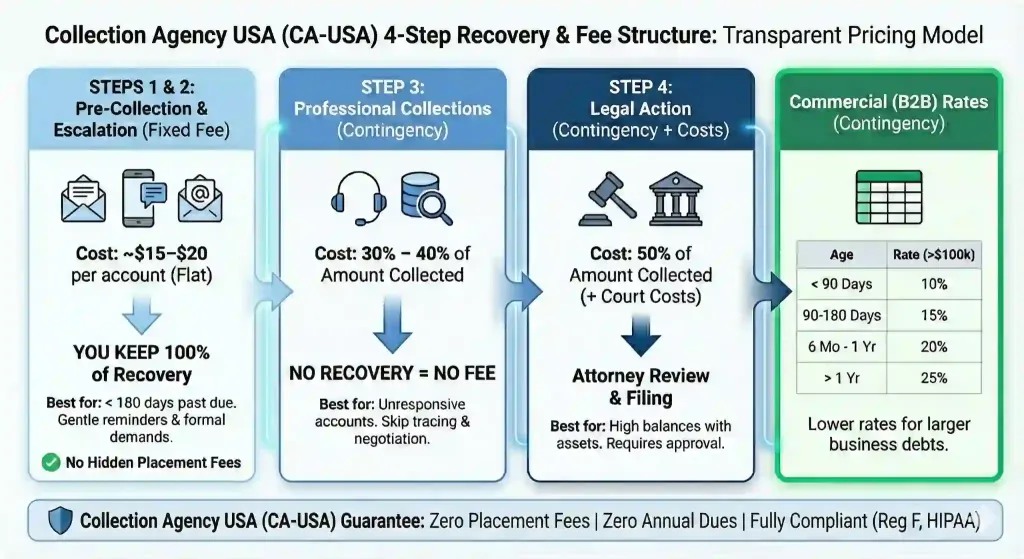
Our Simple Pricing:

$15 for fixed fee collections, 40% for Contingency Collections


Frequently Asked Questions

Does the CFPB’s rule banning medical debt from credit reports still apply?

No, not anymore, at least at the federal level. The CFPB finalized that rule in January 2025, but a federal court in Texas vacated it in its entirety in July 2025, ruling that the CFPB had exceeded its authority under the Fair Credit Reporting Act. What’s left standing are the credit bureaus’ own 2023 voluntary policies (already reflected in reduced reporting of paid debt and small balances) rather than a binding federal ban. The court also suggested that the FCRA may preempt similar state-level bans, which is worth watching if you operate in a state that’s passed its own version.

The page mentions strict Regulation F enforcement. What does that actually restrict day to day?

The most practical piece is the “7-in-7” call cap: no more than seven calls about a specific debt within any rolling seven-day period, and once a collector connects with the consumer, a mandatory seven-day pause before calling about that same debt again. Reg F also requires clear opt-out language for email and text contact and a detailed validation notice itemizing the debt. Most of the friction providers feel isn’t the rule itself, it’s that a single ER visit can generate several separate accounts, each technically its own “debt” under the cap, which legacy call-heavy workflows weren’t built to handle.

Are there federal rules that limit how aggressively a nonprofit hospital can pursue unpaid balances?

Yes, for tax-exempt hospitals specifically. Section 501(r) of the Internal Revenue Code requires nonprofit hospitals to maintain a written financial assistance policy, make reasonable efforts to determine charity-care eligibility, and avoid “extraordinary collection actions” (lawsuits, liens, credit reporting) until at least 120 days after the first bill and a documented eligibility determination. Falling short doesn’t just create bad press, it can jeopardize the hospital’s tax-exempt status itself, which raises the stakes well beyond any single account.


Final Thoughts

Healthcare collections demand empathy, airtight compliance, and surgical‑level precision in handling insurance data. Providers who blend patient‑friendly communication with tech‑powered workflows recover more revenue—and preserve the goodwill that keeps communities trusting their care.

Filed Under: collections

by

How to Assign Accounts to a Collection Agency: A Step-by-Step Guide for First-Time Clients

Handing your unpaid accounts to someone else can feel like losing control, especially the first time you do it. It shouldn’t. At CA-USA, assigning an account looks less like losing a customer and more like adding a specialist to your team: log in, upload the details, and let a licensed, bonded process take it from there.

  • More than 2,000 Google reviews put us at 4.8 stars, our support team actually answers when you call, and every account moves through a secure, fully compliant portal from the day you submit it to the day it’s resolved. Here’s exactly how that process works, step by step.
  • You’ll be assigned a direct representative who is available by cell phone whenever you need support.

What This Actually Costs

CA-USA pricing for collections

Pricing shouldn’t be a mystery, and it isn’t with us. Two structures cover almost every situation:

  • Fixed-Fee Recovery ($15/account): Ideal for early-stage receivables. Debtors pay 100% directly to you. No commissions.
  • Contingency Service (40%): Performance-based recovery. No Recovery, No Fee.

CA-USA provides a low cost, compliant, reputation-safe approach, equipped with all 50-state collections license, offering free credit reporting, free litigation, free bankruptcy scrubs, and zero onboarding fees. Secure – SOC 2 Type II compliant. Over 2,000 online reviews rate us 4.85 out of 5.  Over 20 years experience , delivering excellent B2B collection results.

Need an Easy to Use Collection Agency? Contact us


Successfully recovering unpaid accounts starts with assigning them properly. Below is a simple, complete walkthrough covering how to prepare, submit, and track your accounts, whether this is your first time working with a collection agency or your fiftieth.

Step 1: Choose the Right Collection Agency

Not all collection agencies are the same. Evaluate potential agencies on these factors:

  • Industry Specialization: Does the agency have real experience in your sector — medical, dental, commercial, or education? Industry-specific expertise measurably boosts recovery rates.
  • Compliance Record: Confirm the agency follows FDCPA, HIPAA, TCPA, and applicable state regulations to prevent costly legal issues down the line.
  • Reputation & Reviews: Look for agencies with strong, verifiable ratings and real customer testimonials, not just a handful of five-star reviews from year one.
  • Pricing Structure: Understand whether the agency works on a fixed-fee model (ideal for newer accounts) or contingency (better suited to older, harder-to-collect accounts) — see the cost breakdown below.

Step 2: Categorize Your Accounts

Divide your delinquent accounts clearly before you submit anything.

Early-Stage Accounts (30–90 days overdue)

Ideal for low-cost, fixed-fee collection services. These are typically recovered through polite demand letters and calls, which preserves the underlying customer relationship.

Late-Stage Accounts (90+ days overdue)

Best handled through contingency-based services. These usually require advanced skip tracing, negotiation, and possibly credit reporting or legal action to resolve.

Step 3: Prepare Your Documentation

Each account you assign should come with complete documentation:

  • Debtor’s full name, address, phone number, and email.
  • Detailed invoices or billing statements.
  • Contracts or terms of service.
  • Records of prior collection attempts (calls, letters).

Accurate, complete documentation increases collection success by up to 35%, since it lets the agency start working the account immediately instead of chasing down basic facts first.

Step 4: Submit Your Accounts

Once your documentation is ready, submission typically happens one of a few ways:

  • Secure Online Portal: The fastest and safest method, with built-in encryption and compliance checks baked in.
  • Batch Upload: Suited to businesses assigning multiple accounts at once, saving real administrative time.
  • Email or Fax: Still used occasionally, but less recommended; always confirm sensitive data is protected and encrypted if you go this route.

Step 5: Monitor Collection Progress

A good agency gives you a real client portal, not just periodic phone updates. Expect visibility into:

  • Status updates (active, settled, or escalated to legal).
  • Payment history and a clear breakdown of what’s been recovered.
  • Notes from collectors detailing their interactions with the debtor.

Checking in regularly helps you manage cash flow and keeps the whole process transparent on both sides.

blank

Step 6: Handling Payments & Remittance

Get clear on how payments will actually flow before you submit anything.

Direct Payments

Sometimes a debtor pays you directly instead of the agency. When that happens, you’re generally expected to report it back to the agency promptly (see the FAQs below for what that actually looks like in practice).

Agency-Collected Payments

Payments the agency collects are typically remitted to you after their agreed-upon fee is deducted, with a clear accounting of what was recovered and what was retained.

Step 7: Escalating Unresolved Accounts

If an account remains unpaid after initial collection attempts:

  • Discuss escalation options with your agency, such as credit reporting or legal action.
  • Confirm any additional costs or procedural steps tied to that escalation up front.

Timely escalation meaningfully increases recovery chances on genuinely difficult accounts — waiting too long tends to work against you.

Recent Recovery Result:

A dental practice with a backlog of 40 patient accounts, some three months old, some over a year, sorted them by age before submitting anything. The 30–90 day accounts went onto the light-touch, fixed-fee track and mostly resolved within a few weeks. The accounts over a year old went to contingency, and a handful needed skip tracing just to locate patients who had moved. Splitting the batch by age, rather than assigning all 40 accounts the same way, meaningfully outperformed what a single flat process would have recovered.

Who This Works For

The process above holds up whether you’re a:

  • Small or Mid-Sized Business submitting overdue B2B invoices.
  • School or University recovering unpaid tuition or fees.
  • Medical or Dental Practice handling patient balances.

The steps stay the same across all three; what changes is the documentation and compliance layer, which is covered below.

Trust & Compliance, In Plain Terms

  • HIPAA & BAA: For medical and dental accounts, we sign a Business Associate Agreement (BAA) before touching any patient data, and every step happens inside a HIPAA-compliant environment.
  • FDCPA: All consumer-facing communication follows the federal Fair Debt Collection Practices Act and applicable state equivalents, so an assigned account doesn’t turn into an unexpected liability for your business.
  • Secure Client Portal: Every account you submit, and every update on it, runs through an encrypted portal, not email attachments or phone calls where sensitive information can go missing.
  • Licensed & Bonded: Fully licensed and bonded across all 50 states, so the same process holds up whether your debtor is across town or across the country.

Benefits of Properly Assigning Accounts

  • Increased Recovery Rates: Up to 40% improvement compared to internal collection efforts.
  • Lower Costs: Outsourced collection typically reduces administrative expenses by 20–40%.
  • Better Compliance: Meaningfully reduces the risk of legal penalties and lawsuits tied to DIY collection attempts.

Our account placement process utilizes enterprise-grade security protocols—including 256-bit SFTP, direct API integration, and fully HIPAA and SOC 2-compliant file transfer standards—ensuring your sensitive financial and client data remains protected during assignment

Frequently Asked Questions

Once we assign an account, can we still accept a payment if the debtor pays us directly?

Usually yes, but tell the agency immediately rather than pocketing it quietly. Most agreements require you to report any direct payment right away so the account can be closed or adjusted, and depending on the pricing model, a fee may still be owed since the agency’s outreach may be what actually prompted the payment. Going quiet about a direct payment is one of the fastest ways to create a billing dispute with your own collection agency later.

Can we recall or un-assign an account once we’ve submitted it?

Generally yes, though not always for free. Fixed-fee accounts are usually simple to pull back since you’ve already paid the flat rate regardless of outcome. Contingency accounts can get more complicated if the agency has already invested real work, like skip tracing or a legal filing, since some of that cost may still be owed even if you take the account back. It’s worth asking about recall terms, like the ones covered when switching collection agencies, before you submit rather than after.

We accidentally assigned the same debtor’s account to two different agencies. What happens?

It happens more often than you’d think, especially with larger receivables teams. The bigger risk isn’t the paperwork mix-up itself, it’s that the debtor gets contacted twice by two different agencies claiming to represent the same balance, which can look unprofessional or even improper. Catch it fast: notify both agencies immediately, tell them which one you’re keeping, and get written confirmation that the other has closed its file.

Does assigning an account to collections count as writing it off on our books?

Not automatically, and the two are separate decisions. Assigning an account is an operational choice about who’s pursuing it; writing it off (or reserving for it) is an accounting decision, usually made independently by your finance team based on your own aging policy. Plenty of accounts get assigned and successfully recovered well before anyone would have written them off.

What happens to accounts already assigned if our company is acquired or changes ownership?

The accounts themselves don’t disappear, but the agency will need to update who has authority over them. Collection agreements are typically tied to the assigning entity, so an acquisition, merger, or ownership change usually requires new paperwork, and sometimes a new point of contact, to keep things moving without a gap. It’s worth flagging any pending ownership change to your agency early, rather than after the transition is already underway.


Filed Under: collections

by

Largest Consumer & Commercial Collection Agencies in USA

Below is a snapshot of the largest U S-based (or U S-operating) collection firms in the two very different segments of the industry. “Biggest” is measured by latest-available 2024 full-year top-line revenue, or—when the company is private and doesn’t publish audited accounts—by widely-cited analyst/market-data estimates. All numbers are in US dollars unless noted.


1 | Consumer (B2C) Debt-Collection Specialists

Rank Agency (headquarters) 2024 revenue Scale / focus Why they dominate
1 Transworld Systems Inc. (TSI) – Lake Forest, IL ≈ $5 billion (LeadIQ estimate, 10 000 employees) (LeadIQ) Healthcare RCM, student-loan & consumer receivables Grew through a string of acquisitions (ACT, Alltran, EOS Canada) and a tech-first model for first- and third-party servicing.
2 Encore Capital Group (Midland Credit Management) – San Diego, CA $1.31 billion TTM revenue 2024 (Companies Market Cap) Debt-purchasing/collection in US & 8 other countries Largest publicly-listed debt buyer; invests heavily in analytics to price and collect charged-off credit-card portfolios.
3 PRA Group Inc. – Norfolk, VA $1.11 billion 2024 revenue (+39 % YoY) (Companies Market Cap) Global debt purchaser/collector Strong US and European platforms; Q4 2024 cash collections +31 %. (PR Newswire)
4 GC Services – Houston, TX $1.4 – 1.7 billion (Growjo range, ≈ 5 800 employees) (Growjo) First- & third-party collections, customer-care BPO One of the largest privately-held ARM/BPO players since 1957.
5 Radius Global Solutions – Edina, MN/Philadelphia, PA ≈ $549 million (Growjo) Healthcare, financial-services & utility collections 4 000+ staff, omnichannel / AI-driven “RIVA” virtual agent.

Quick takeaway: The consumer side is dominated by very large, often publicly traded debt buyers (Encore, PRA) and BPO hybrids (TSI, GC Services) that can fund bulk portfolio purchases or run massive first-party campaigns at scale.


2 | Commercial (B2B) Collection Specialists

Rank Agency (U S operating hub) 2024 revenue* Primary services Notes
1 Allianz Trade Collections (formerly Euler Hermes) – Owings Mills, MD ≈ $2.8 billion group revenue 2023/24 (Zippia) B2B collections arm of the world’s largest trade-credit insurer Combines debt collection, credit insurance and bonding in 50+ countries; US team handles North-American claims.
2 Atradius Collections – Baltimore, MD €2.5 billion (~ $2.7 B) group revenue 2024 (Atradius) Global commercial collections + credit-insurance recovery Integrated with Atradius credit-insurance; multilingual in-house collectors cover 96 % of world GDP.
3 Altus Receivables Management – New Orleans, LA ≈ $63 million (Growjo) Third-party & 1st-party B2B, global legal escalation Branded “ARM Strong™” Salesforce platform; CLLA-, IACC-, CCA-certified.
4 Caine & Weiner – Sherman Oaks, CA ≈ $88 million  (Growjo) Commercial & hybrid consumer collections; 100-yr-old firm National network plus Mexico, UK, Hong Kong affiliates.
5 ABC-Amega – Buffalo, NY ≈ $15 – 20 million (LeadIQ / Growjo range) (Growjo) Third-party B2B collections, credit-group management One of only a handful of agencies triple-certified by CLLA, IACC and CCA of A.

*Group revenue shown for Allianz Trade and Atradius because their US collection arms are not separately reported; both run sizeable dedicated US teams.

Quick takeaway: Commercial collections are far more fragmented. Global credit-insurance giants (Allianz Trade/Euler Hermes, Atradius) dwarf US-only players, but midsize specialists such as Altus, Caine & Weiner and ABC-Amega compete on industry focus, certification and bespoke legal networks.

Need a Good Collection Agency? Contact us


How to use this list

  1. Match specialization to your ledger.
    If you’re chasing mostly consumer balances (medical, retail, fintech lending) the top five consumer firms above have the scale, skip-tracing data and compliance infrastructure you’ll need.
    If your A/R is business-to-business—especially export or multinational—look first to Allianz Trade or Atradius for one-stop credit-insurance + collection, or to Altus/ABC-Amega for pure contingency services.
  2. Check certification & compliance:
    For commercial work, CLLA/IACC/CCA-certified agencies undergo trust-account audits and bonding requirements.
    For consumer work, ensure the agency is licensed in every state you bill, follows Reg F (CFPB) rules, and is SOC 2 / ISO 27001 compliant.
  3. Demand performance data. Even the “biggest” varies widely in liquidation rates by debt age/industry. Ask for:
    • recovery percentages for portfolios similar to yours,
    • average days-to-collect,
    • complaint ratios,
    • indemnification coverage.
  4. Negotiate fee tiers. Large agencies will flex on contingency rates or fixed-fee “pre-collect” pricing if the volume is meaningful.

NOTE:

  • Specialized Expertise Over Size
    Smaller agencies with niche focus (like medical or education) often outperform big firms by understanding industry-specific regulations and client needs.
  • Transparency in Results
    Size alone doesn’t guarantee success — agencies should share recovery rates, timelines, and complaint records to prove real performance.
  • Client Relationship Focus
    Large agencies may treat accounts as numbers. Mid-sized firms often deliver more personalized attention and faster communication.
  • Technology vs. Human Touch
    The biggest firms rely heavily on automation. Balancing tech with compassionate human interaction often produces better recovery rates.

Methodology & caveats

  • Public-company figures come from SEC filings or press releases dated Feb 2025; private-company figures rely on market-intelligence aggregators (LeadIQ, Growjo) and may be ±10-15 %.
  • Some consumer giants (e.g., Alorica, Afni, Convergent) also top $500 M in ARM revenue, but they blend collections with customer-care outsourcing and were excluded to keep the tables focused on pure‐play or majority-collection companies.
  • Several former heavyweights (e.g., D&B RMS, NCO Group) have exited or been absorbed and no longer appear as stand-alone entities.

Use this as a directional guide and always request up-to-date audited numbers and client references before contracting.

Filed Under: collections

by

Statute of Limitations – Do you have to pay an older debt?

Understanding Time-Barred Debts: Statute of Limitations Explained

When you owe money, creditors typically have a certain period to legally pursue repayment. This legal timeframe is known as the statute of limitations. Once this period expires, the debt becomes “time-barred,” meaning creditors or collection agencies can no longer sue you to recover the debt. However, it doesn’t mean your debt completely disappears.

blank

What Exactly is a Time-Barred Debt?

A time-barred debt is one that has surpassed the statute of limitations, preventing creditors from legally enforcing repayment through the courts. This time limit varies widely by state and debt type, generally ranging between 3 to 6 years. Once expired, creditors can still attempt collections through phone calls or letters, but you’re not obligated by law to pay.

Can Time-Barred Debt Affect Your Credit?

Yes, absolutely. Even if the statute of limitations has expired, unpaid debts may stay on your credit report for up to seven years from the date of your first missed payment. This can significantly lower your credit score, making it harder to obtain loans, credit cards, or favorable interest rates.

Statute of Limitations by State (Common Debt Types)

State Written Contracts Oral Agreements Promissory Notes Open-Ended (Credit Cards)
Alabama 6 years 6 years 6 years 3 years
California 4 years 2 years 4 years 4 years
Florida 5 years 4 years 5 years 4 years
Illinois 10 years 5 years 10 years 5 years
Indiana 10 years 6 years 10 years 6 years
New York 6 years 6 years 6 years 6 years
Ohio 8 years 6 years 6 years 6 years
Texas 4 years 4 years 4 years 4 years
Washington 6 years 3 years 6 years 3 years

(*Note: Verify with local laws or consult an attorney, as laws occasionally change.)

How Debt Becomes “Revived”

If you make a payment—even a partial one—or acknowledge the debt verbally or in writing, you risk “reviving” the debt. This resets the statute of limitations, making the debt legally collectible again. For example, paying just $20 toward a $3,000 time-barred credit card debt can restart the clock, potentially exposing you to lawsuits again.

What Should You Do if Contacted About a Time-Barred Debt?

  1. Avoid Admitting Debt: Never confirm the debt is yours without legal consultation.
  2. Request Verification: Ask for documentation proving the debt and the date of your last payment.
  3. Know Your Rights: Debt collectors are legally prohibited from suing or threatening to sue you on time-barred debts.

Paying a Time-Barred Debt: Should You?

Consider carefully before deciding:

  • No Legal Obligation: You’re not legally required to pay once the statute expires.
  • Credit Score Impact: Paying won’t remove the debt immediately from your credit report unless you negotiate a “pay-for-delete” agreement.
  • Negotiate Wisely: If choosing to pay, settle for less and request the agreement in writing. For example, offering to settle a $2,000 debt for $800 could save you money and stress.

Real-Life Example:

Sarah from Texas was contacted about an old credit card debt of $5,000. The debt was 5 years old—beyond Texas’ 4-year statute for credit card debt. She confirmed the debt verbally, unintentionally restarting the statute of limitations. Now, Sarah can potentially face legal action, something avoidable had she understood her rights better.

Final Thoughts

Understanding the statute of limitations can protect your financial well-being and prevent unnecessary stress or costly mistakes. When dealing with old debts, always seek professional advice from financial counselors or attorneys to make informed decisions.

Every state sets its own time limits on collecting debts, and the rules can differ widely between medical, credit card, or written contracts. Our agency tracks these deadlines carefully so creditors never miss their legal window to recover funds.

Filed Under: collections

by

Recovering Company Equipment/Laptop Cost from Ex-Employees: Why and How to Do It Right

In today’s work-from-home environment, it has become more common for companies to provide laptops and other equipment to their employees. While this arrangement helps ensure smooth workflow and productivity, it can become problematic when employees quit or are laid off but fail to return their company-issued devices.

Despite repeated reminders and attempts to recover the equipment, some ex-employees may become unreachable or simply refuse to cooperate. In such situations, hiring a professional collection agency can be an effective strategy for recovering your property—or the associated costs—while protecting your organization’s reputation and legal interests.

Company laptop and asset return checklist illustrating recovery of equipment costs from former employees.

Below is an overview of the risks employers face when attempting to handle returns independently, and how professional collection agencies can help.


The Risks of Handling Recoveries on Your Own

  1. Reputational Damage
    When you directly demand the return of equipment or payment from a former employee, there is a risk of tarnishing your own image. The ex-employee, already disgruntled, may misinterpret your outreach or even claim harassment if they perceive your efforts as overly aggressive.
  2. Legal Complexities
    State and federal regulations govern debt collection practices. An employer that attempts to recover equipment or costs without a clear understanding of these laws may inadvertently break them. This can lead to countersuits, especially if the ex-employee is searching for grounds to take legal action against your organization.
  3. Limited Resources
    Tracing a former employee who has gone off the radar can be a time-consuming process. Most HR or administrative teams don’t have the specialized tools or time to locate someone who is actively avoiding contact, especially if they’ve moved states or changed phone numbers.

Why Hire a Professional Collection Agency

  1. Expertise and Legal Compliance
    Collection agencies follow strict federal and state regulations, ensuring that every attempt to recover property or costs is conducted ethically and lawfully. By engaging professionals, you reduce your risk of violating debt-collection or privacy laws. Our IT asset recovery workflows strictly adhere to corporate cybersecurity and compliance frameworks—including NIST SP 800-88 guidelines for media sanitization and SOC 2 asset management standards.
  2. Preservation of Reputation
    Because a neutral third party is handling the recovery efforts, any negative interaction or confrontation is distanced from your organization. The collection agency’s role shields your reputation from the potential fallout of direct conflict with a former employee.
  3. Emphasis on Professional Consequences
    Former employees often respond more seriously to a collection agency. They understand that persistence, credit bureau reporting, and possibly legal measures could follow if they fail to comply. This sense of urgency can accelerate the return of the company’s assets or the repayment of their costs.
  4. Advanced Recovery Techniques
    Collection agencies employ specialized tools and techniques such as skip tracing—used to locate individuals who have moved without leaving a forwarding address—and litigation scrubs, which identify potential legal risks. By uncovering the ex-employee’s history and current whereabouts, a collection agency can tailor the recovery strategy while advising you on possible legal pitfalls.

The Process of Recovering Costs via a Collection Agency

Let’s consider a practical example: Suppose the cost of the laptop (or other equipment) is $1,000. As an employer, you can place this amount for collection with a professional agency. From there, the collection agency proceeds as follows:

  1. Initial Contact and Negotiation
    The agency will attempt to contact the ex-employee and request either the immediate return of the equipment or the payment of the $1,000. They will use every legal channel available—phone calls, emails, letters—while adhering to all relevant regulations.
  2. Follow-Up and Persistent Efforts
    If initial efforts are ignored, the agency intensifies its efforts. This can include skip tracing if the ex-employee has become unreachable. Depending on state laws and the agency’s agreement with your company, they may also report the delinquency to credit bureaus or send formal notices of potential legal action.
  3. Resolution or Escalation
    The collection agency aims for a swift resolution. Once the ex-employee either returns the equipment directly to you or pays the $1,000, the agency retains its fee (based on the agreed-upon rate) and remits the remainder to you. If, however, the ex-employee still refuses to comply, the agency may recommend legal action, which could involve taking the case to court.

Best Practices for Employers

  1. Clear Equipment Policies
    Establish clear guidelines and agreements regarding company-issued equipment from the outset. Make sure employees acknowledge these policies in writing. This not only helps in recovery but also strengthens your position if legal action is necessary.
  2. Prompt Documentation
    Once you decide to terminate or accept an employee’s resignation, create a paper trail. Document each request for equipment return, including the dates and methods of communication. Detailed records bolster your case and help the collection agency in their efforts.
  3. Consultation with Legal Counsel
    If you are worried that an ex-employee may sue, particularly in cases where they have a history of litigation, consult with legal counsel before taking any collection steps. A well-informed approach can prevent costly lawsuits and reputational damage.
  4. Choose a Reputable Collection Agency
    Not all collection agencies are created equal. Research agencies that specialize in equipment recovery or have a track record with corporate clients. Look for firms that emphasize compliance, transparency, and professionalism in their collection processes.

Frequently Asked Questions

Can we just deduct the laptop’s cost from the employee’s final paycheck instead of hiring a collection agency?

In most states, not without a real fight, and in a handful (California, New York, and Massachusetts among them) it’s essentially off the table no matter what paperwork you have. Federal law under the FLSA technically allows equipment-cost deductions as long as pay doesn’t drop below minimum wage, but state law usually decides the outcome, and most states require a written agreement signed in advance, not just a handbook acknowledgment, authorizing that specific deduction. What’s close to universal: you generally can’t withhold the entire final paycheck until the equipment comes back; that’s treated as its own wage violation even in states that allow a deduction for the item’s value. Given how state-specific this gets, it’s often simpler and safer to pay out full final wages and pursue the equipment’s cost as a separate matter afterward.

At what point does an ex-employee keeping a laptop become theft rather than just an unpaid debt?

Legally, refusing to return company property after being asked can rise to civil conversion (treating someone else’s property as your own) even without criminal intent, and depending on the state and the specific facts, an employer can also file a police report alleging theft. In practice, most employers don’t pursue the criminal route: it’s slower, DAs often decline low-dollar cases, and it can escalate the relationship in a way that makes voluntary return less likely. We generally treat this as a civil recovery matter first, since it resolves faster, and reserve any mention of a police report for accounts where the ex-employee is clearly stonewalling rather than just slow to respond.

IT already remotely wiped and disabled the laptop for security reasons. Does that weaken our claim to the full replacement cost?

Not usually, and it’s often the right call to make regardless. Disabling a device to protect company data is a separate issue from who owns the hardware and who’s responsible for its value; a wiped laptop is still company property that wasn’t returned. If anything, documenting that the device was remotely disabled strengthens the record, since it shows you protected sensitive data rather than leaving stale credentials or files sitting on a device you no longer control. Just be aware that a bricked device can’t be resold or reused if it is eventually returned, so factor that into whether you’re pursuing the hardware itself or simply its value.

The ex-employee says the two-year-old laptop isn’t worth what we’re billing them for. Do we have to negotiate on price?

It’s worth deciding this upfront rather than debating it account by account. Most equipment agreements are written around either the original purchase cost or a depreciation schedule, and spelling that out in the signed policy, rather than picking a number case by case after someone pushes back, keeps it from becoming a negotiation. If the agreement is silent on this, a reasonable depreciated value is usually easier to actually collect than the full original price, since it’s harder for the ex-employee to argue against and less likely to look punitive if the account is ever challenged.


Conclusion

When an ex-employee refuses to return company-issued equipment or reimburse its cost, it can be both a logistical headache and a financial loss. Rather than risk damaging your own reputation or getting mired in legal difficulties, hiring a professional collection agency offers an efficient, compliant, and effective path to recovery. By leveraging their expertise in skip tracing, negotiation, and litigation, a reputable agency maximizes your chances of reclaiming either the device or its value—while ensuring that you remain on solid legal ground.

In today’s ever-evolving work culture, it’s more important than ever to have clear policies, documented processes, and a reliable partner who can navigate the complexities of recovering corporate assets. With these measures in place, your organization can protect its resources, maintain its professional standing, and stay focused on driving business growth.

Filed Under: collections

  • « Go to Previous Page
  • Page 1
  • Page 2
  • Page 3
  • Page 4
  • Page 5
  • Page 6
  • Go to Next Page »

Primary Sidebar

CA-USA: A 4.87 Rated Agency!

Collection Agency Good Reviews

Need a Collection Agency?

Kindly fill this form.
We’ll get in touch with you

    Please prove you are human by selecting the cup.

    Recent Posts

    • Utah B2B Collections | Salt Lake City, Provo & St. George
    • Virginia Commercial Collection Agency | B2B Debt Recovery
    • What Collection Agencies Do That Restoration Companies Can’t Handle In-House
    • Georgia Commercial Debt Recovery: Delivering Exceptional Recovery
    • Vermont B2B Collections: Recover Your Commercial Debt Fast

    Featured Posts

    • How to Assign Accounts to a Collection Agency: A Step-by-Step Guide for First-Time Clients
    • Maximize Your Revenue Recovery in Pennsylvania
    • Commercial Collections Oregon: Recover Cash Without Court
    • Texas Collection Agency Services: Compliant & Reputation Safe
    • Medical Collections: Why a Systematic Approach is so Important?

    Copyright © 2026 ·Copyright: CollectionAgencyUSA.com (CA-USA) | This content is provided for general informational purposes only and should not be considered legal advice. Collection laws and requirements may vary by state, account type, documentation, debtor status, and specific facts. Please consult qualified legal counsel for guidance regarding your particular situation. CA-USA and its authorized collection partners service accounts in accordance with applicable federal and state collection requirements.. Visit our home page to know more about us.

    X
    Need a Collection Agency?
    Contact Us