When a business tenant breaks a commercial lease, the balance is rarely just “unpaid rent.”
A landlord may be dealing with:
- Past-due base rent
- CAM or operating expenses
- Property taxes
- Utilities
- Repair or restoration costs
- Early-termination damages
- Re-leasing expenses
- Attorney fees where contractually and legally recoverable
- A personal guaranty
The mistake is treating all of those charges as one unexplained number.
CA-USA helps commercial landlords, property managers and real-estate companies recover documented lease balances from former business tenants throughout the United States.
Our approach begins with the lease, ledger and loss calculation—not with aggressive collection pressure.
The objective is to determine:
What does the lease actually allow?
Who is legally responsible?
Which amounts are already due?
What credits or mitigation must be considered?
Is there a personal guarantor?
For our broader commercial recovery approach, see B2B Commercial Debt Recovery.
CA-USA provides a low cost, compliant, reputation-safe approach, equipped with all 50-state collections coverage, offering free credit reporting, free pre-litigation checks, free bankruptcy scrubs, and zero onboarding fees. Secure – SOC 2 Type II compliant. Over 2,000 online reviews rate us 4.85 out of 5. Over 20 years experience , delivering excellent B2B collection results.
You’ll receive the direct mobile number of a dedicated representative, ensuring prompt support by call or text whenever you need assistance.
Need a Commercial Collection Agency? Contact us
Build the Claim From the Lease, Not Just the Rent Ledger
A strong commercial lease collection file should explain how the final balance was calculated.
That can include:
Base Rent
Past-due rent through surrender, termination or another relevant date.
Additional Rent
CAM, operating expenses, taxes, utilities or other charges authorized by the lease.
Physical Damage or Restoration
Documented costs associated with repairing or restoring the premises where the tenant is contractually responsible.
Security Deposit Credit
The final accounting should clearly show how any deposit was applied where permitted.
Future Lease Damages
These require more care. The lease language and applicable state law can affect acceleration, mitigation, re-leasing credits and the amount ultimately recoverable.
A clear claim is much easier to negotiate than a large unexplained demand.
The Personal Guaranty Can Completely Change the File
Many commercial tenants sign leases through an LLC or corporation.
If that company closes, the lease debt does not automatically become the owner’s personal debt.
But a personal guaranty can create a separate source of liability.
Before pursuing a guarantor, we want to review:
- Who signed the guaranty
- Whether it was signed personally
- What obligations it covers
- Whether liability is capped
- Whether it decreases over time
- Whether amendments affected it
- Whether surrender language limits exposure
Commercial leases may contain a full guaranty, a limited guaranty, or in some markets a surrender-based or “good-guy” guaranty.
Those differences matter.
A collection strategy should be built around the guaranty that was actually signed—not merely the fact that an owner exists.
Can a Landlord Collect All Remaining Rent?
Sometimes—but this should never be assumed.
The answer can depend on:
- Governing state law
- Lease language
- Acceleration provisions
- Termination provisions
- Mitigation requirements
- When the premises were surrendered
- Whether the space was re-leased
- Replacement rent
- Concessions given to the new tenant
A landlord may have a valid claim for future lease damages, but calculating that claim can be more complicated than:
monthly rent × months remaining
That is why CA-USA prefers a documented lease-loss calculation before pursuing a significant future-rent claim.
Re-Leasing Information Can Strengthen the Claim
When mitigation is relevant under the lease or governing law, good documentation matters.
Useful information may include:
- Listing agreements
- Broker correspondence
- Marketing activity
- Showing history
- New lease commencement date
- Replacement rent
- Free-rent concessions
- Tenant-improvement allowances
- Brokerage expenses
This helps distinguish actual lease damages from amounts that may have been reduced after the space was reoccupied.
CAM, Taxes and Restoration Charges Need Documentation
Commercial lease disputes often become difficult because the former tenant says:
“I don’t agree with those extra charges.”
The best response is not simply repeating the balance.
It is showing how each charge was created.
For CAM or operating expenses, provide:
- Lease provision
- Tenant’s proportionate share
- Reconciliation
- Supporting calculation
For restoration or repairs, provide:
- Move-out inspection
- Photographs where available
- Repair invoices
- Contractor estimates or paid invoices
- Lease provision establishing responsibility
Separating well-documented charges from genuinely disputed items often moves negotiations forward faster.
The Security Deposit Should Be Visible in the Accounting
A commercial security deposit should not disappear from the collection file.
Where applicable, the final accounting should clearly show:
Total documented charges
minus permitted security-deposit application
minus other credits
equals net amount placed for collection
This helps avoid a simple debtor objection:
“They already have my deposit.”
The collection agency should be able to explain the net claim.
What If the Tenant LLC Closed?
A closed LLC does not necessarily mean the collection file is over.
The first step is to determine what actually happened.
Did the business:
- Shut down completely?
- Sell its assets?
- Change names?
- Move operations to another entity?
- Continue through a related company?
- File bankruptcy?
- Leave behind an enforceable guaranty?
Business verification can identify the current entity status and decision-makers.
But a related company or business owner should not automatically be treated as liable merely because operations appear connected.
Contractual liability must still be established.
Bankruptcy Changes the Collection Strategy Immediately
If the commercial tenant files bankruptcy, ordinary collection efforts against the debtor generally need to stop because of the federal automatic stay.
Commercial landlords can also face special bankruptcy rules concerning:
- Lease assumption or rejection
- Unpaid pre-bankruptcy rent
- Post-petition obligations
- Termination damages
- Proofs of claim
Federal bankruptcy law also limits certain landlord claims for damages resulting from termination of a real-property lease.
That makes bankruptcy screening especially important before escalating an old commercial lease balance.
Two Commercial Lease Recovery Patterns
Office Tenant + Personal Guaranty
A tenant LLC closed and claimed there was nothing left to collect.
Instead of continuing to pursue an inactive company, the lease documents were reviewed and an enforceable personal guaranty identified. The claim was reorganized around documented rent, applicable credits and guaranty obligations before negotiations shifted to the responsible guarantor.
Use an actual verified CA-USA recovery percentage here.
Lease Balance + CAM Dispute
A former tenant disputed an entire balance because it disagreed with year-end CAM charges.
The claim was separated into past-due base rent, documented CAM, restoration costs and disputed adjustments. Negotiations focused first on the undisputed portion instead of allowing one CAM disagreement to freeze the entire account.
Use an actual verified CA-USA recovery percentage here.
Performance-Based Commercial Lease Recovery
CA-USA generally handles commercial collection accounts on a contingency basis.
You pay a collection commission when money is successfully recovered.
Commercial contingency rates typically range from 10% to 45%, depending on factors such as:
- Balance size
- Account age
- Documentation
- Complexity
- Debtor condition
Higher balances and newer accounts generally qualify for lower rates.
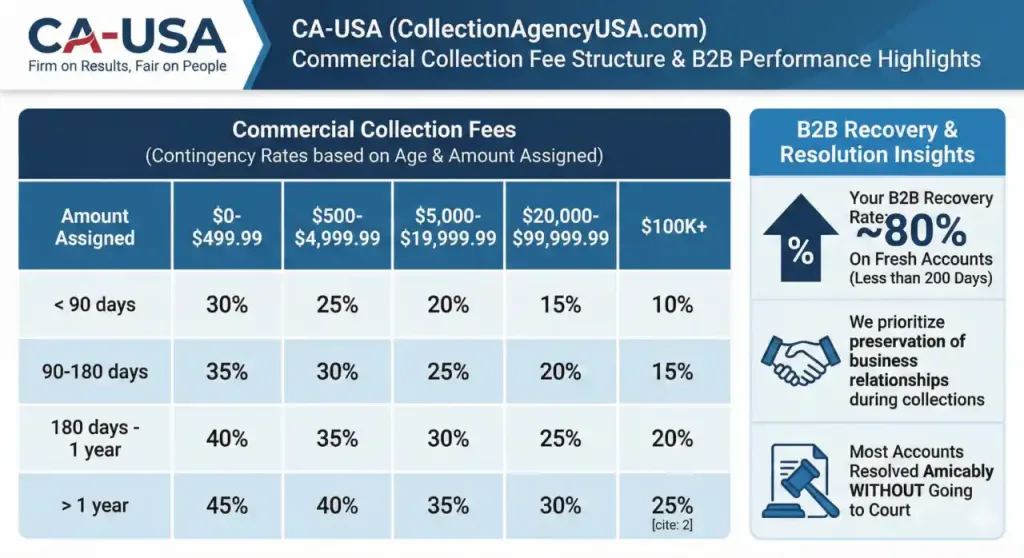
For qualifying fresh commercial accounts under approximately 200 days old with strong documentation, CA-USA’s internal results can approach ~80% recovery.
Results vary substantially by account and are not guaranteed.
See B2B Commercial Collection Agency Pricing for more information.
What to Send With a Broken Commercial Lease Account
A strong placement package usually includes:
- Signed lease
- Lease amendments
- Personal guaranty
- Rent ledger
- Default notices
- Termination or surrender correspondence
- Security-deposit accounting
- CAM reconciliations
- Tax or utility allocations
- Repair and restoration invoices
- Move-out inspection documentation
- Re-leasing information
- Payment history
- Relevant tenant or guarantor correspondence
Better documentation can mean fewer disputes and faster commercial negotiations.
Our Escalation Approach
CA-USA begins with commercial recovery rather than litigation.
Review the claim.
Understand the lease, ledger, guaranty and supporting charges.
Verify the debtor.
Confirm the tenant entity, guarantor and current business status.
Check bankruptcy.
A bankruptcy filing can immediately change permissible collection activity.
Define disputes.
Separate legitimate disagreements from undisputed rent or charges.
Negotiate professionally.
Reach the person with authority to resolve the account.
Use commercial credit reporting where appropriate.
Eligible B2B accounts may be reportable to participating commercial credit bureaus when applicable requirements are satisfied.
Attorney referral comes last.
Legal escalation is considered only when reasonable collection efforts have failed, the documentation and economics support further action, and the client approves it.
Commercial Lease Collection FAQs
Can a landlord collect the remaining rent after a business breaks a commercial lease?
Potentially, but not automatically in every case. The recoverable amount depends on the lease language, applicable state law, whether future rent may be accelerated, the landlord’s mitigation obligations, re-leasing activity, security deposits and other credits. A commercial lease claim should be calculated from the actual lease and loss history rather than simply multiplying monthly rent by the months remaining.
Does a commercial landlord have to find a new tenant before collecting future rent?
That depends on the governing state law and the lease. Some jurisdictions impose a duty to mitigate damages, while the timing and effect of re-leasing can differ. A landlord should document marketing, re-leasing efforts, replacement rent, concessions and the date the premises were reoccupied before calculating a remaining lease claim.
Can a landlord pursue the business owner personally if the tenant LLC closes?
Not merely because the person owned or managed the tenant company. Personal liability may exist if the owner signed an enforceable personal guaranty or another legally recognized basis for individual liability applies. The guaranty should be reviewed for its scope, dollar cap, duration, amendments and any surrender or good-guy provisions before collection begins.
Can CAM charges, taxes, utilities and repair costs be sent to collections after a commercial tenant leaves?
They may be recoverable when the lease makes the tenant responsible and the amounts can be supported. The collection file should include CAM reconciliations, tax or utility allocations, repair invoices, inspection records, restoration charges and the lease provisions authorizing those amounts. Unsupported estimates can make an otherwise strong lease claim harder to resolve.
Should the security deposit be applied before a commercial lease balance goes to collections?
The lease and applicable state law should control how the deposit is handled. As a practical accounting matter, the landlord should clearly show the deposit and any permitted application of it when preparing the final ledger so the collection agency is pursuing the documented net balance rather than an unexplained gross figure.
What happens to commercial lease debt if the tenant files bankruptcy?
A bankruptcy filing generally triggers the federal automatic stay, which can stop collection activity against the debtor for pre-bankruptcy claims. Commercial lease claims can also be affected by bankruptcy rules governing assumption or rejection of leases and the statutory cap on certain landlord termination damages. The account should be reviewed for bankruptcy status before further collection activity.
When should a broken commercial lease be sent to a collection agency?
Early review is useful when the tenant has surrendered the premises, stopped responding, repeatedly broken payment promises, dissolved or changed entities, disputed charges after move-out, or appears financially distressed. The landlord does not need to wait until every possible future charge has accumulated if a well-documented current balance is already due, although future damages should be handled according to the lease and applicable law.
What documents should a landlord provide for commercial lease collections?
A strong file typically includes the signed lease and amendments, personal guaranty, rent ledger, default and termination notices, security-deposit accounting, CAM or operating-expense reconciliations, repair and restoration invoices, surrender correspondence, inspection records, re-leasing information, payment history and relevant communications with the tenant or guarantor.
Recover the Lease Balance With the Documents Behind It
A broken commercial lease can create a substantial receivable.
But the strongest claim is not necessarily the largest number on the landlord’s spreadsheet.
It is the amount that can be explained, documented and tied directly to the lease.
CA-USA helps landlords and property managers recover commercial lease debt through documentation review, business verification, bankruptcy screening, professional negotiation and measured escalation.
For nationwide commercial collections, see B2B Commercial Debt Recovery.
When you are ready to place the account, see How to Assign Accounts to Collections.
Recover the documented balance. Preserve leverage. Escalate only when it makes commercial sense.
Need a Collection Agency? Contact us