Your business is not a charity.
Need help recovering unpaid business invoices? CA-USA is a nationwide commercial collection agency specializing in B2B debt recovery for companies that delivered the product, completed the work, or honored the contract—and still have not been paid.
Our commercial recovery process combines contract and invoice review, business verification, bankruptcy screening, skip tracing, UCC-aware account review, reputation-safe negotiation, and commercial credit reporting where eligible.
Attorney referral is considered only after reasonable collection and negotiation efforts have failed and the account supports further escalation. Any legal action is pursued only with your written authorization. A 4.85★ Google rating reflects our commitment to professional service and client support.
| We collect debt every day. Our commercial collectors use persistence, experience, and proven recovery tools to get you paid. Contingency-based: You pay only when we recover. No recovery, no fee. Direct support: You get cell phone access to a dedicated representative whenever you need help. Ready to assign overdue accounts? Connect with us now CA-USA provides nationwide collection coverage with required licenses, registrations, and bonds, a SOC 2 Type II secure environment, dedicated support, and 20+ years of collection experience. |
What Is B2B Commercial Debt Collection?
Commercial debt collection is the recovery of money owed from one business to another business.
Typical accounts include:
- Unpaid invoices for goods or materials
- SaaS and software subscriptions
- Freight and logistics balances
- Professional-service fees
- Equipment rentals and leases
- Construction and subcontractor accounts
- Manufacturing and supplier receivables
- Commercial property obligations
- Staffing and consulting invoices
- Restoration and contractor balances
Business debt is not simply consumer debt with a larger balance.
B2B accounts may involve contracts, purchase orders, corporate entities, personal guarantees, security interests, UCC filings, payment disputes and valuable ongoing customer relationships.
B2B Collections Work Differently From Consumer Collections
The FDCPA Generally Does Not Cover Business Debt
The federal FDCPA primarily governs debts incurred for personal, family or household purposes. Ordinary business debts generally fall outside its scope.
Commercial collections can still be subject to state laws, licensing requirements, contract law, bankruptcy rules, UCC provisions and other applicable requirements.
Reputation Matters in B2B
Your delinquent customer may still be a major buyer, distributor, referral source or long-term client.
Recovering one invoice should not unnecessarily destroy years of future business.
That is why CA-USA uses reputation-safe collection tactics—firm on the balance, but professional with the people.
When Should a B2B Account Go to Collections?
There is no universal rule that every account must reach exactly 90 days before placement.
Consider outside collection when:
- Repeated reminders produce no meaningful response
- Payment promises are repeatedly broken
- Accounts payable stops responding
- A payment plan defaults
- A previously accepted invoice suddenly becomes “disputed”
- The debtor appears to be experiencing financial trouble
- The outstanding balance creates meaningful cash-flow risk
- An important contractual or legal deadline is approaching
For many companies, 60–90 days past due is a reasonable escalation point, but behavior and risk can justify earlier action.
A $100,000 customer that suddenly disappears may deserve attention long before day 90.
What Should Be Sent With a Commercial Collection Account?
A strong commercial file should show:
What was agreed → what was delivered → what became due → what remains unpaid.
Useful documents include:
- Contracts and credit applications
- Invoices and statements
- Purchase orders
- Proof of delivery or completion
- Payment history
- Emails and account correspondence
- Dispute documentation
- Personal guarantees
- Security agreements
- Relevant UCC information
- Prior payment plans or settlements
Good documentation limits the debtor’s ability to create confusion later.
The CA-USA Commercial Recovery Framework
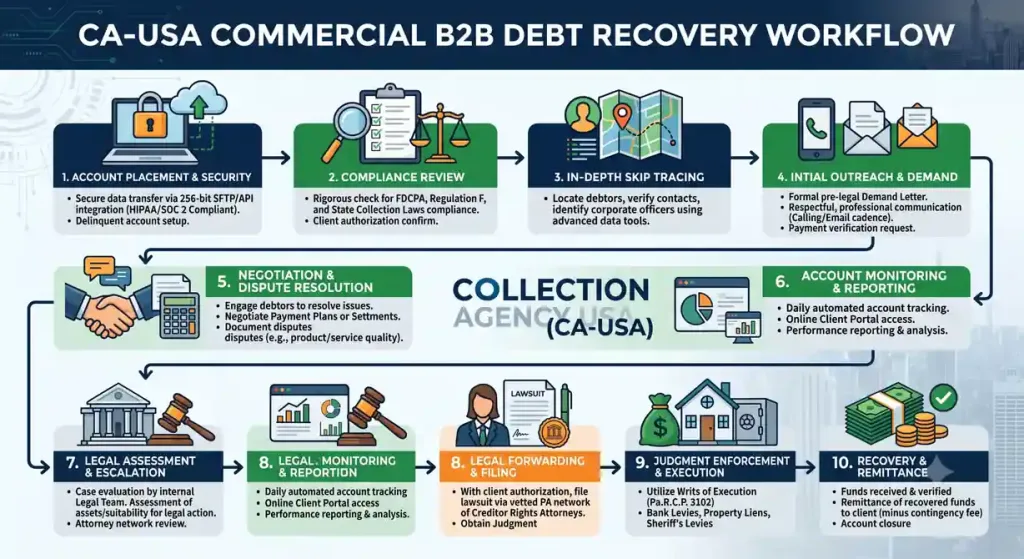
Step 1: Contract, Invoice & Account Review
We review the available contracts, invoices, purchase orders, guarantees, statements and dispute history before collection strategy is chosen.
We also confirm the correct debtor entity—particularly important when businesses operate through several LLCs, subsidiaries or DBAs.
Step 2: Bankruptcy Screening & Business Verification
Before escalation, we screen for bankruptcy and verify relevant business information.
Available records may help identify:
- Corporate status
- Current business addresses
- Ownership information
- Operating status
- Relevant public records
- Available UCC information
The goal is to understand who owes the money and what recovery path is realistic.
Step 3: Reputation-Safe Business Outreach
Commercial collection works best when the right person is contacted.
Depending on the debtor, that may be accounts payable, the controller, CFO, finance director, owner or senior management.
Our communication is professional, persistent and focused on resolution—not unnecessary confrontation.
Step 4: Dispute Resolution & Negotiation
B2B debts frequently involve disputes over pricing, delivery, scope, credits, quality or contract terms.
We identify the actual dispute and separate legitimate issues from simple delay.
Sometimes only part of an invoice is disputed.
Separating undisputed amounts from disputed amounts can unlock payments that would otherwise remain frozen.
When appropriate, payment arrangements or negotiated resolutions may be considered with client authority.
Step 5: Commercial Credit Reporting — Where Eligible
Eligible delinquent business accounts may be reportable to participating commercial credit bureaus.
Commercial credit reporting provides an important non-legal recovery tool because payment behavior can influence how lenders, vendors and other businesses evaluate a company’s creditworthiness.
-
Dun & Bradstreet (D&B)
-
Experian Business
-
Equifax Business
Step 6: Management Review
Before any legal recommendation, we review documentation strength, debtor status, prior negotiations, collectability and the economics of further action.
Step 7: Attorney Referral — Only as a Last Resort
Legal action is not the default collection strategy.
Attorney referral is considered only when reasonable non-legal collection efforts have failed and the balance, documentation and likelihood of recovery justify escalation.
The client remains involved in that decision.
Why UCC Information Can Matter
The Uniform Commercial Code can become important when a transaction involves:
- Equipment
- Inventory
- Goods
- Accounts receivable
- Secured financing
- Other business collateral
A UCC filing does not tell us whether a debtor has cash available.
It may, however, reveal security interests claimed by other creditors.
That can materially affect collection strategy when several creditors are competing for the same assets.
CA-USA therefore reviews relevant contracts, guarantees, security agreements and available UCC information before assuming secured-creditor leverage exists.
Personal Guarantees Can Change the Recovery Path
An unpaid corporate invoice does not automatically make an LLC member or corporate owner personally liable.
But a properly executed and enforceable personal guarantee may create an additional obligation.
That can become particularly important if the operating company:
- Stops trading
- Has few assets
- Dissolves
- Files bankruptcy
Guarantees should therefore be identified early rather than discovered after months of unsuccessful collection activity.
Recent Commercial Recovery Scenarios
Contract Dispute Resolved Without Legal Action
A commercial construction materials supplier placed a $64,500 account after a regional general contractor withheld payment, disputing delivery milestones and material spec variances. Rather than immediately escalating the account to court, our team reviewed the signed purchase orders, proof-of-delivery tickets, and change-order correspondence, isolating the valid scope adjustment from the undisputed balance. After direct, structured negotiations with the debtor’s CFO, $56,000 (87%) was recovered in 34 days without attorney involvement.
What mattered: Comprehensive documentation and targeted mediation created faster leverage than an immediate lawsuit threat.
Business Had Stopped Responding — Verification Changed the Strategy
A wholesale distribution firm placed a $42,800 past-due account after broken payment promises turned into complete radio silence. Corporate entity verification, bankruptcy screening, and asset discovery revealed that while the original trade name was dormant, the principal had transitioned operations under a newly registered operating entity at an active distribution warehouse. Using this operational intelligence, we re-established contact directly with the managing partner, securing a $38,500 (90%) structured settlement paid out over 60 days.
What mattered: The account required more than another routine demand letter. Identifying the debtor’s active business operations changed the entire recovery path.
What If the Debtor Files Bankruptcy?
A bankruptcy filing generally creates an automatic stay that stops ordinary collection activity against the debtor for pre-bankruptcy obligations.
The creditor may instead need to participate in the bankruptcy process, including filing a proof of claim where appropriate.
That is why bankruptcy screening happens before escalation.
A business bankruptcy also does not automatically resolve every related issue. Separate guarantors or other liable parties may require individual review.
Nationwide Commercial Collections
Modern B2B transactions frequently cross state lines.
Your company may be in one state, the customer in another, the contract governed by another state’s law, and the guarantor located somewhere else entirely.
State collection requirements, limitation periods, contract rules and litigation procedures can vary.
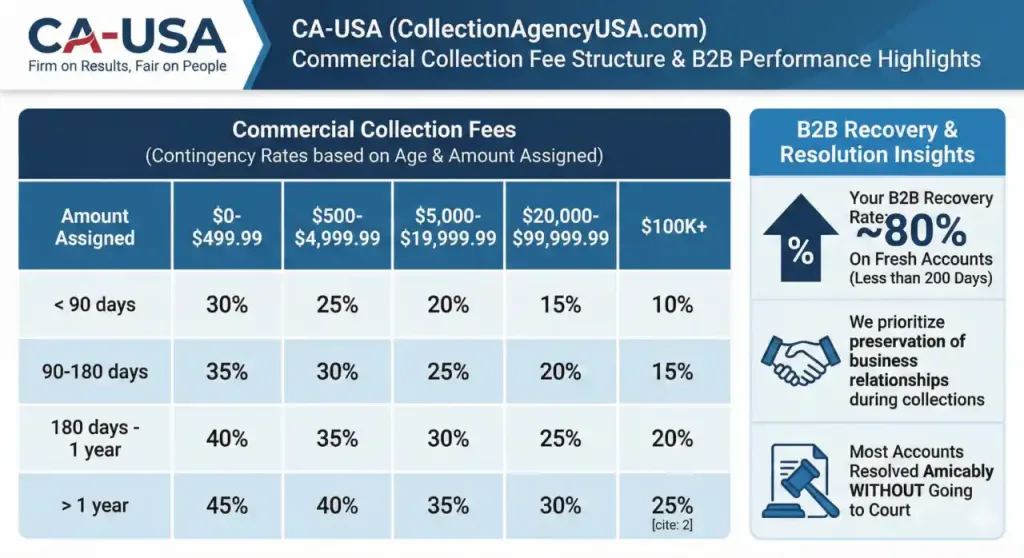
CA-USA maintains nationwide collection licensing coverage, including required licenses, registrations and bonds, allowing businesses with customers across the United States to use one commercial recovery partner. We see nearly an 80% recovery rate on newer debt that is viable and assigned around 90 Days.
Industries We Serve
Technology & SaaS
Subscription, licensing, implementation and enterprise software balances.
Logistics, Freight & Transportation
Freight invoices, carrier balances, warehouse charges and transportation receivables.
Manufacturing & Distribution
Inventory, components, wholesale goods, equipment and trade-credit accounts.
Construction & Trades
Subcontractor, material-supplier, equipment-rental and project balances.
Professional Services
Consulting, staffing, accounting, marketing, engineering and IT invoices.
Commercial Real Estate & Property Services
Commercial tenant obligations, property services and business lease balances.
Restoration & Contractors
Water, fire, remediation, reconstruction and commercial restoration invoices.
Agriculture & Farm Supply
Equipment, fertilizer, feed, seed and other commercial agricultural balances.
Life Sciences & Healthcare Vendors
B2B laboratory, pharmaceutical, medical-device and healthcare-supplier receivables.
What Makes CA-USA Different?
Reputation-Safe Commercial Collections
We pursue the balance without unnecessarily damaging valuable business relationships.
Commercial Credit Reporting
Eligible accounts may benefit from business credit reporting as a non-legal recovery tool.
Contract, Guarantee & UCC-Aware Review
We look beyond the invoice when supporting documents can materially affect recovery options.
Bankruptcy Screening
Accounts are checked before escalation so ordinary collection does not blindly continue against a debtor protected by bankruptcy.
Business Skip Tracing
We help locate businesses and decision-makers when account information has become outdated.
Secure SOC 2 Type II Environment
Sensitive account information is handled through secure infrastructure designed for professional receivables management.
Nationwide Collection Licensing Coverage
CA-USA maintains required collection licenses, registrations and bonds nationwide.
No Recovery, No Contingency Fee
If we do not recover money on a contingency placement, there is no collection commission on the unrecovered account.
FAQs About B2B Commercial Debt Recovery
Does the FDCPA apply to commercial B2B debt?
The federal FDCPA generally applies to debts incurred primarily for personal, family or household purposes and does not ordinarily cover business debts. Commercial collections can still be subject to state laws, licensing requirements, bankruptcy rules, contract law, UCC provisions and other applicable requirements.
When should I send an unpaid B2B invoice to a collection agency?
There is no single deadline for every account. Many businesses consider outside collection after approximately 60–90 days of unsuccessful internal follow-up, but repeated broken payment promises, sudden silence, a defaulted payment plan or signs of financial distress may justify earlier placement.
What documents should I provide to a commercial collection agency?
Ideally provide contracts, credit applications, invoices, statements, purchase orders, proof of delivery or completion, account correspondence, payment history, dispute records, personal guarantees and relevant security or UCC documents. Better documentation generally allows the account to be handled more effectively.
Can CA-USA report an unpaid business account to commercial credit bureaus?
Eligible delinquent commercial accounts may be reportable to participating business credit bureaus when applicable documentation and reporting requirements are satisfied. Commercial credit reporting can provide an additional non-legal incentive for a debtor to resolve an outstanding account.
Can we collect a company’s debt from the owner personally?
Not simply because someone owns or manages an LLC or corporation. A signed and enforceable personal guarantee, sole-proprietor status or another legally recognized basis for personal liability may change the situation. Ownership alone should not be treated as automatic personal liability.
What happens if the debtor business files bankruptcy?
A bankruptcy filing generally creates an automatic stay that stops ordinary collection activity against the debtor for pre-bankruptcy debts. The creditor may instead need to participate in the bankruptcy process, including filing a proof of claim where appropriate.
How can UCC filings affect commercial debt collection?
UCC filings can reveal security interests claimed in business collateral such as equipment, inventory or receivables. When several creditors claim the same collateral, perfection and priority can materially affect their rights. A UCC filing does not prove that a company has money available to pay.
Do B2B collection accounts usually have to go to court?
No. CA-USA first uses professional outreach, documentation review, dispute resolution, negotiation and other appropriate non-legal recovery tools. Attorney referral is considered only when reasonable collection efforts fail and the account supports further escalation.
How much does a B2B commercial collection agency charge?
Commercial collection fees typically depend on the age, balance, complexity and legal status of the account. CA-USA primarily handles commercial collections on contingency, meaning the collection fee is earned only when money is successfully recovered.
Turn Past-Due Receivables Back Into Working Capital
Your company delivered the product, provided the service or fulfilled the contract.
Your team should not spend month after month trying to convince another business to honor an overdue obligation.
CA-USA provides a structured commercial recovery process built around documentation, business intelligence, negotiation, reputation protection and measured escalation.
Firm on the balance. Professional with the people. Legal only when reasonable collection efforts have failed.
Start your recovery process? Contact us