Handing your unpaid accounts to someone else can feel like losing control, especially the first time you do it. It shouldn’t. At CA-USA, assigning an account looks less like losing a customer and more like adding a specialist to your team: log in, upload the details, and let a licensed, bonded process take it from there.
- More than 2,000 Google reviews put us at 4.8 stars, our support team actually answers when you call, and every account moves through a secure, fully compliant portal from the day you submit it to the day it’s resolved. Here’s exactly how that process works, step by step.
- You’ll be assigned a direct representative who is available by cell phone whenever you need support.
What This Actually Costs
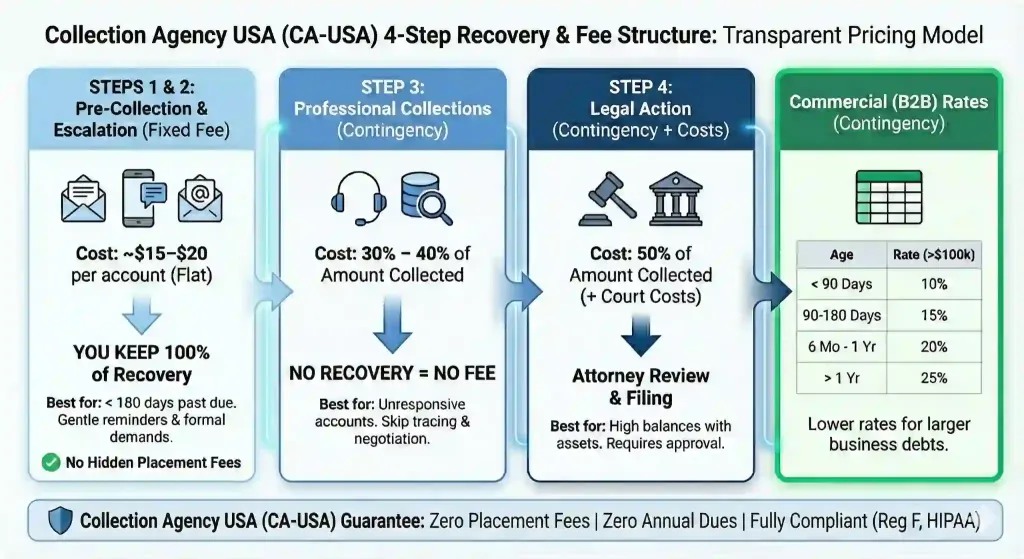
Pricing shouldn’t be a mystery, and it isn’t with us. Two structures cover almost every situation:
- Fixed-Fee Recovery ($15/account): Ideal for early-stage receivables. Debtors pay 100% directly to you. No commissions.
- Contingency Service (40%): Performance-based recovery. No Recovery, No Fee.
CA-USA provides a low cost, compliant, reputation-safe approach, equipped with all 50-state collections coverage, offering free credit reporting, free pre-litigation checks, free bankruptcy scrubs, and zero onboarding fees. Secure – SOC 2 Type II compliant. Over 2,000 online reviews rate us 4.85 out of 5. Over 20 years experience , delivering excellent B2B collection results.
Need an Easy to Use Collection Agency? Contact us
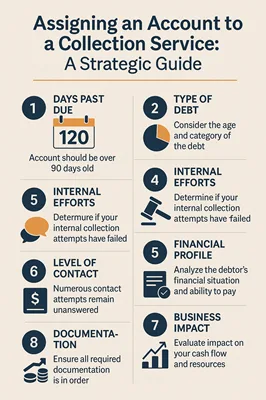
Successfully recovering unpaid accounts starts with assigning them properly. Below is a simple, complete walkthrough covering how to prepare, submit, and track your accounts, whether this is your first time working with a collection agency or your fiftieth.
Step 1: Choose the Right Collection Agency
Not all collection agencies are the same. Evaluate potential agencies on these factors:
- Industry Specialization: Does the agency have real experience in your sector — medical, dental, commercial, or education? Industry-specific expertise measurably boosts recovery rates.
- Compliance Record: Confirm the agency follows FDCPA, HIPAA, TCPA, and applicable state regulations to prevent costly legal issues down the line.
- Reputation & Reviews: Look for agencies with strong, verifiable ratings and real customer testimonials, not just a handful of five-star reviews from year one.
- Pricing Structure: Understand whether the agency works on a fixed-fee model (ideal for newer accounts) or contingency (better suited to older, harder-to-collect accounts) — see the cost breakdown below.
Step 2: Categorize Your Accounts
Divide your delinquent accounts clearly before you submit anything.
Early-Stage Accounts (30–90 days overdue)
Ideal for low-cost, fixed-fee collection services. These are typically recovered through polite demand letters and calls, which preserves the underlying customer relationship.
Late-Stage Accounts (90+ days overdue)
Best handled through contingency-based services. These usually require advanced skip tracing, negotiation, and possibly credit reporting or legal action to resolve.
Step 3: Prepare Your Documentation
Each account you assign should come with complete documentation:
- Debtor’s full name, address, phone number, and email.
- Detailed invoices or billing statements.
- Contracts or terms of service.
- Records of prior collection attempts (calls, letters).
Accurate, complete documentation increases collection success by up to 35%, since it lets the agency start working the account immediately instead of chasing down basic facts first.
Step 4: Submit Your Accounts
Once your documentation is ready, submission typically happens one of a few ways:
- Secure Online Portal: The fastest and safest method, with built-in encryption and compliance checks baked in.
- Batch Upload: Suited to businesses assigning multiple accounts at once, saving real administrative time.
- Email or Fax: Still used occasionally, but less recommended; always confirm sensitive data is protected and encrypted if you go this route.
Step 5: Monitor Collection Progress
A good agency gives you a real client portal, not just periodic phone updates. Expect visibility into:
- Status updates (active, settled, or escalated to legal).
- Payment history and a clear breakdown of what’s been recovered.
- Notes from collectors detailing their interactions with the debtor.
Checking in regularly helps you manage cash flow and keeps the whole process transparent on both sides.
Step 6: Handling Payments & Remittance
Get clear on how payments will actually flow before you submit anything.
Direct Payments
Sometimes a debtor pays you directly instead of the agency. When that happens, you’re generally expected to report it back to the agency promptly (see the FAQs below for what that actually looks like in practice).
Agency-Collected Payments
Payments the agency collects are typically remitted to you after their agreed-upon fee is deducted, with a clear accounting of what was recovered and what was retained.
Step 7: Escalating Unresolved Accounts
If an account remains unpaid after initial collection attempts:
- Discuss escalation options with your agency, such as credit reporting or legal action.
- Confirm any additional costs or procedural steps tied to that escalation up front.
Timely escalation meaningfully increases recovery chances on genuinely difficult accounts — waiting too long tends to work against you.
Recent Recovery Result:
A dental practice with a backlog of 40 patient accounts, some three months old, some over a year, sorted them by age before submitting anything. The 30–90 day accounts went onto the light-touch, fixed-fee track and mostly resolved within a few weeks. The accounts over a year old went to contingency, and a handful needed skip tracing just to locate patients who had moved. Splitting the batch by age, rather than assigning all 40 accounts the same way, meaningfully outperformed what a single flat process would have recovered.
Who This Works For
The process above holds up whether you’re a:
- Small or Mid-Sized Business submitting overdue B2B invoices.
- School or University recovering unpaid tuition or fees.
- Medical or Dental Practice handling patient balances.
The steps stay the same across all three; what changes is the documentation and compliance layer, which is covered below.
Trust & Compliance, In Plain Terms
- HIPAA & BAA: For medical and dental accounts, we sign a Business Associate Agreement (BAA) before touching any patient data, and every step happens inside a HIPAA-compliant environment.
- FDCPA: All consumer-facing communication follows the federal Fair Debt Collection Practices Act and applicable state equivalents, so an assigned account doesn’t turn into an unexpected liability for your business.
- Secure Client Portal: Every account you submit, and every update on it, runs through an encrypted portal, not email attachments or phone calls where sensitive information can go missing.
- Licensed & Bonded: Fully licensed and bonded across all 50 states, so the same process holds up whether your debtor is across town or across the country.
Benefits of Properly Assigning Accounts
- Increased Recovery Rates: Up to 40% improvement compared to internal collection efforts.
- Lower Costs: Outsourced collection typically reduces administrative expenses by 20–40%.
- Better Compliance: Meaningfully reduces the risk of legal penalties and lawsuits tied to DIY collection attempts.
Our account placement process utilizes enterprise-grade security protocols—including 256-bit SFTP, direct API integration, and fully HIPAA and SOC 2-compliant file transfer standards—ensuring your sensitive financial and client data remains protected during assignment
Frequently Asked Questions
Once we assign an account, can we still accept a payment if the debtor pays us directly?
Usually yes, but tell the agency immediately rather than pocketing it quietly. Most agreements require you to report any direct payment right away so the account can be closed or adjusted, and depending on the pricing model, a fee may still be owed since the agency’s outreach may be what actually prompted the payment. Going quiet about a direct payment is one of the fastest ways to create a billing dispute with your own collection agency later.
Can we recall or un-assign an account once we’ve submitted it?
Generally yes, though not always for free. Fixed-fee accounts are usually simple to pull back since you’ve already paid the flat rate regardless of outcome. Contingency accounts can get more complicated if the agency has already invested real work, like skip tracing or a legal filing, since some of that cost may still be owed even if you take the account back. It’s worth asking about recall terms, like the ones covered when switching collection agencies, before you submit rather than after.
We accidentally assigned the same debtor’s account to two different agencies. What happens?
It happens more often than you’d think, especially with larger receivables teams. The bigger risk isn’t the paperwork mix-up itself, it’s that the debtor gets contacted twice by two different agencies claiming to represent the same balance, which can look unprofessional or even improper. Catch it fast: notify both agencies immediately, tell them which one you’re keeping, and get written confirmation that the other has closed its file.
Does assigning an account to collections count as writing it off on our books?
Not automatically, and the two are separate decisions. Assigning an account is an operational choice about who’s pursuing it; writing it off (or reserving for it) is an accounting decision, usually made independently by your finance team based on your own aging policy. Plenty of accounts get assigned and successfully recovered well before anyone would have written them off.
What happens to accounts already assigned if our company is acquired or changes ownership?
The accounts themselves don’t disappear, but the agency will need to update who has authority over them. Collection agreements are typically tied to the assigning entity, so an acquisition, merger, or ownership change usually requires new paperwork, and sometimes a new point of contact, to keep things moving without a gap. It’s worth flagging any pending ownership change to your agency early, rather than after the transition is already underway.