• Skip to main content
  • Skip to primary sidebar

Collection Agency USA

collections

by

Collection Agency to Collect Lease Break Fees, CAM, and Damages

A tenant disappears. The last invoices are ignored. The suite is left damaged.
And suddenly you’re financing their exit.

Commercial lease defaults aren’t “just unpaid rent.” They’re often a layered claim: arrears + CAM/NNN + early termination charges + make-good obligations + repair invoices. The longer it sits, the more it turns from a receivable into a write-off.

CA-USA (CollectionAgencyUSA) specializes in B2B commercial lease breakage recovery (office and commercial space), including property damage claims tied to move-out.

We have a dedicated Commercial Collections department, a Google rating of 4.87/5, and on viable debts under one year old with adequate documentation, our recovery rates run 75%+.

Contact us to get a free quotation


What Creates Outstanding Balances in Commercial Leases

Most landlords focus on rent and miss the rest. Common sources of recoverable balances include:

  • Unpaid base rent (often the last 1–3 months before they vanish)

  • Early termination / accelerated rent (where the lease provides for it)

  • CAM / NNN reconciliations (estimated payments made… final true-up refused)

  • Taxes, utilities, security, access control, HVAC charges passed through and left unpaid

  • Holdover rent (tenant stays past term but doesn’t pay the higher holdover rate)

  • Tenant improvement (TI) clawbacks (credits/allowances tied to term length)

  • Make-good obligations (restore walls, flooring, cabling, signage, unauthorized alterations)

  • Move-out damages (repairs that quickly jump into five figures)

Translation: the claim is usually bigger than the landlord expects—and more defensible than the tenant pretends.


Why Collecting Lease Debt Is Different From Normal B2B Invoices

Lease break recovery has three traits that make it uniquely challenging:

  • Complex contracts
    Leases include amendments, addenda, side letters, guarantees, assignment clauses, and remedies that vary by state.

  • Entity games
    The tenant entity on paper may be thin, while money and assets sit with owners, guarantors, or related entities.

  • A “dispute posture” by default
    Defaulting tenants rarely say “you’re right.” They say: “We’re insolvent.” “You can’t enforce that.” “We didn’t cause that damage.” “Those charges aren’t valid.”

This is why lease recovery needs a specialist—not a generic approach.


Why Internal Recovery Usually Fails (Even for Strong Teams)

Property managers are good at buildings. They’re not equipped for commercial enforcement.

Typical internal disadvantages:

  • No skip tracing tools to find decision-makers who changed numbers, moved, or re-formed under a new entity

  • No bankruptcy screening process or playbook for the moment an automatic stay appears

  • Limited familiarity with collection laws and disclosure rules that vary by state (a sloppy call or letter can create legal risk)

  • Most employees don’t want to be part-time debt collectors—and inconsistent follow-up teaches debtors that ignoring you works

Professional collections isn’t “being aggressive.” It’s being trained, persistent, compliant, and systematic.


The Legal Lanes That Commonly Apply in Lease Break Recovery

This isn’t legal advice, but these are the core legal lanes that show up in commercial lease defaults:

  • Contract law (the lease controls): rent, remedies, default terms, fees, attorney clauses, acceleration language, and make-good obligations

  • State commercial landlord-tenant rules: notice requirements, mitigation expectations, and enforcement procedures vary by jurisdiction

  • Bankruptcy: if the tenant files, collection activity may pause and the claim must be handled through the proper bankruptcy channel

  • Fraudulent transfer concepts: if assets were moved to dodge creditors, counsel may evaluate clawback or related remedies

  • Credit reporting standards: commercial credit reporting can be used as pressure where appropriate; if a personal guarantor is involved, the strategy must be handled carefully

The core idea: Commercial claims are enforceable—but only if they’re worked correctly and compliantly.


What Can Be Legally “Attached” to Recover the Debt?

In many cases, the real leverage begins after a judgment. The exact tools depend on state law and case facts, but common enforcement targets include:

  • Business bank accounts (levy/attachment where permitted)

  • Accounts receivable (garnishing payments owed to the debtor by its customers)

  • Equipment, inventory, and other non-exempt business assets (writ of execution / seizure and sale)

  • Judgment liens on real property (when the debtor owns real estate)

  • LLC/partnership interests (charging orders against distributions)

  • Debtor exams / turnover orders (forcing disclosure of assets and payment sources)

Not every debtor has collectible assets—but many do. The mistake is assuming “they can’t pay” when the truth is “we haven’t applied the right leverage yet.”


Our Commercial Lease Recovery Process at CA-USA

We don’t run a one-script approach. Each case gets a plan based on the lease, the debtor profile, and your goals.

Step 1: Build the claim like it’s going to court

We organize the file so the debtor understands you’re not guessing:

  • Lease + amendments + guarantees

  • Ledger and itemization of charges (rent, CAM/NNN, fees, damages)

  • Default notices and correspondence

  • Move-out inspection reports, photos, repair invoices

Strong documentation = faster payment and better settlements.

Step 2: Liability review (we don’t stop at the tenant entity)

We evaluate whether recovery can extend to:

  • Personal guarantees

  • Corporate guarantees

  • Related entities / successor businesses (where counsel may have options)

  • Practical collectability signals (still operating? rebranded? new location?)

Step 3: Demand + negotiation that’s actually informed

We run outreach that is firm, specific, and consistent:

  • Clear demand supported by lease terms and evidence

  • Direct contact with decision-makers

  • Payment plans or settlements when that produces higher net recovery faster

Step 4: Commercial credit reporting (when appropriate)

For business debtors, trade credit matters. When used correctly, commercial credit reporting can trigger a fast resolution because it impacts future leasing, vendor terms, and financing.

Step 5: Legal escalation (last resort)

Legal action is generally the final option, not the opening move. We consider escalation when:

  • The balance justifies it

  • Documentation is strong

  • The debtor has assets or enforceable liability paths


Contingency Fees: What It Typically Costs (And Why It’s Often Worth It)

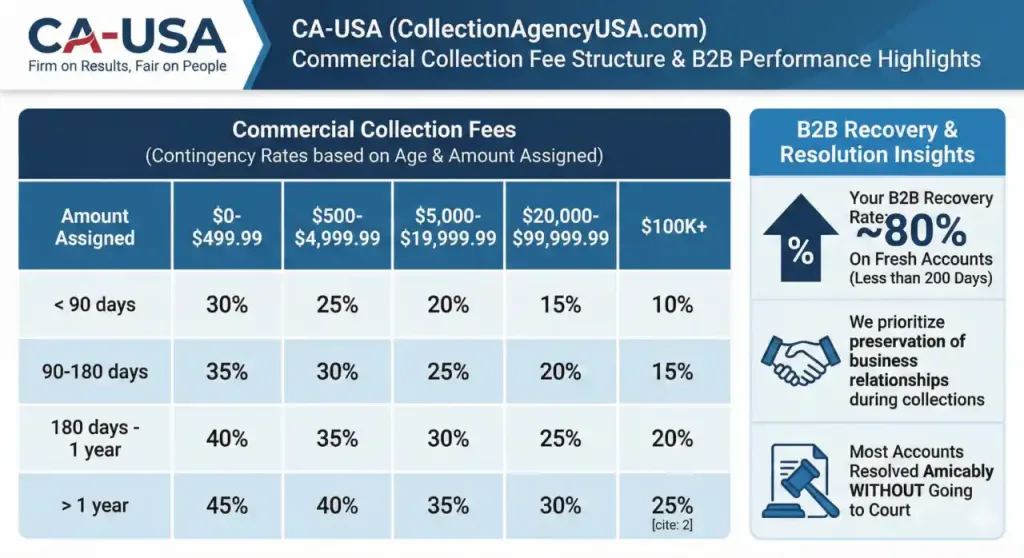
For commercial lease break and damage claims, contingency collection fees commonly range from 20% to 40%. The exact rate depends on balance size, how old the account is, and case complexity (lease clauses, guarantees, disputes, multiple entities, damage documentation, etc.).

No recovery means no fee.

CA-USA gets paid only when money is collected. In most cases, we push hard to resolve matters without court through documentation-driven demand, negotiation, and commercial credit pressure; legal enforcement is typically the last step used only when every other option has been exhausted.

Contact us – Serving clients Nationwide !


Recent Case Resolutions

Case 1: Early exit with significant term remaining

A professional services tenant vacated early and stopped responding. The claim included rent arrears plus lease-break charges.

What we did:

  • Validated remedies in the lease and tightened the balance presentation

  • Mapped decision-makers and current contact channels

  • Delivered a documentation-based demand and negotiated from evidence

Result:
A high-percentage settlement resolved quickly—without litigation.

Case 2: Move-out damage dispute that turned into real money

A tenant denied responsibility for restoration costs and argued “normal wear and tear.”

What we did:

  • Organized photos, inspection notes, and contractor invoices into a clean claim package

  • Presented the damage claim clearly and unemotionally

  • Negotiated a structured payment plan instead of a deadlocked argument

Result:
Full recovery via a payment plan and a closed file—no court required.

Case 3: Tenant entity went dark, guarantor exposure remained

The operating company collapsed quickly after default, but the paperwork suggested exposure beyond the tenant entity.

What we did:

  • Reviewed guarantees and mapped potential liability paths

  • Confirmed practical collectability signals

  • Negotiated a realistic resolution rather than treating it as a dead file

Result:
Meaningful recovery secured without dragging the matter into court.


Why CA-USA Is the Right Fit for Commercial Lease Debt

  • Dedicated Commercial Collections department

  • Custom approach per case (documentation-driven, not script-driven)

  • 75%+ recovery rates on viable debts under one year with adequate documentation

  • 4.87/5 client rating built on results and professionalism

  • Commercial credit reporting used strategically

  • Legal is last resort, not the first move


If a Tenant Walked, Don’t Wait

Commercial debt gets harder with time—not because your lease gets weaker, but because debtors move, rebrand, shift assets, and bury the trail.

If you have unpaid rent, CAM/NNN, lease-break charges, or move-out damages, the most cost-effective moment to act is now, while the debt is fresh and the documentation is still clean.

CA-USA is built for this exact problem: recovering commercial lease losses with persistence, professionalism, and smart escalation.

Filed Under: collections

by

B2B Commercial Debt Recovery with 80% Recovery Rates

Your business is not a charity.

When invoices go unpaid, it creates a domino effect. You struggle to make payroll, order inventory, or fund growth. You shouldn’t have to finance your clients’ operations at the expense of your own.

Handled early and systematically, those same overdue accounts can easily deliver a recovery rate close to 80% on fresh placements (Preferably less than eight months old, backed by adequate documentation). Left to age, they turn into permanent losses and distractions. That gap between “paid” and “written off” is exactly where CA-USA’s B2B commercial debt recovery services operate.

We are a collection agency. This is what our agents do all day long—they have the patience, persistence, skill, and every tool in their toolkit to get your payment recovered.

Our commercial collectors work on a contingency basis and get paid only when they successfully collect for you. No recovery means no fee charges to you.

Ready to assign your overdue accounts? Connect with us now

Why You Need a Pro

Going it alone costs you time and money.

  • Higher Success Rates: We know the excuses and how to counter them.

  • Legal Compliance: We navigate state and federal laws so you don’t have to.

  • Focus on Your Business: You should be closing new deals, not chasing old ones.


Why B2B Commercial Debt Recovery Needs a Different Strategy

Business debt is not just “bigger consumer debt.” It behaves differently and needs its own collections strategy.

Commercial debts, commercial rules

These are obligations between companies, guided mainly by:

  • Contracts and terms & conditions

  • Commercial codes and state rules

  • Licensing requirements

  • General “unfair practices” standards

That environment gives more flexibility in how a commercial debt collection agency can approach a business debtor, but it also demands discipline and professionalism.

Relationships and reputation matter

A slow-paying customer might still be one of your most important accounts. One harsh phone call or clumsy letter can damage:

  • Future sales

  • Referrals

  • Online reviews and brand trust

Good B2B collections are firm on the money, respectful in tone and always aware of the bigger relationship.

Complex invoices and disputes

B2B commercial debt recovery often involves:

  • Retainers and milestone billing

  • Change orders and project overruns

  • Disputes around performance or quality

Effective recovery work separates genuine disputes from simple delay tactics and builds solutions both sides can accept.


The CA-USA B2B Collections Process

CA-USA follows a structured, business-friendly process designed to maximize recovery while keeping most matters out of court.

1. Solid Setup: Credit and Contracts

Effective B2B debt recovery starts at the front end:

  • Basic credit checks on new business customers

  • Sensible credit limits based on risk

  • Clear payment terms, due dates and late-fee language

  • Clauses covering collection costs, jurisdiction and dispute handling

Good paperwork now means stronger leverage if invoices become overdue later.


2. Clean Invoicing and Early Follow-Up

Most business customers will pay if you make it easy and stay visible:

  • Accurate, timely invoices with correct PO numbers, line items and tax details

  • Prompt sending instead of waiting weeks after delivery

  • Automated reminders before and after the due date

  • Friendly follow-ups from AR or the account manager in the first 30–45 days past due

This keeps good relationships intact and prevents simple oversights from turning into serious collection problems.


3. Internal Escalation

When balances drift into 60–90 days past due with no valid dispute:

  • Escalated communication from finance leadership

  • Temporary credit hold on new orders or services

  • A clear final internal demand with amount, deadline and consequences

At this stage, every extra week of delay erodes the chance of full recovery. This is usually the right moment to move the file to CA-USA’s business debt recovery services.


4. Professional B2B Collections with CA-USA

Once files are placed, CA-USA moves quickly but professionally:

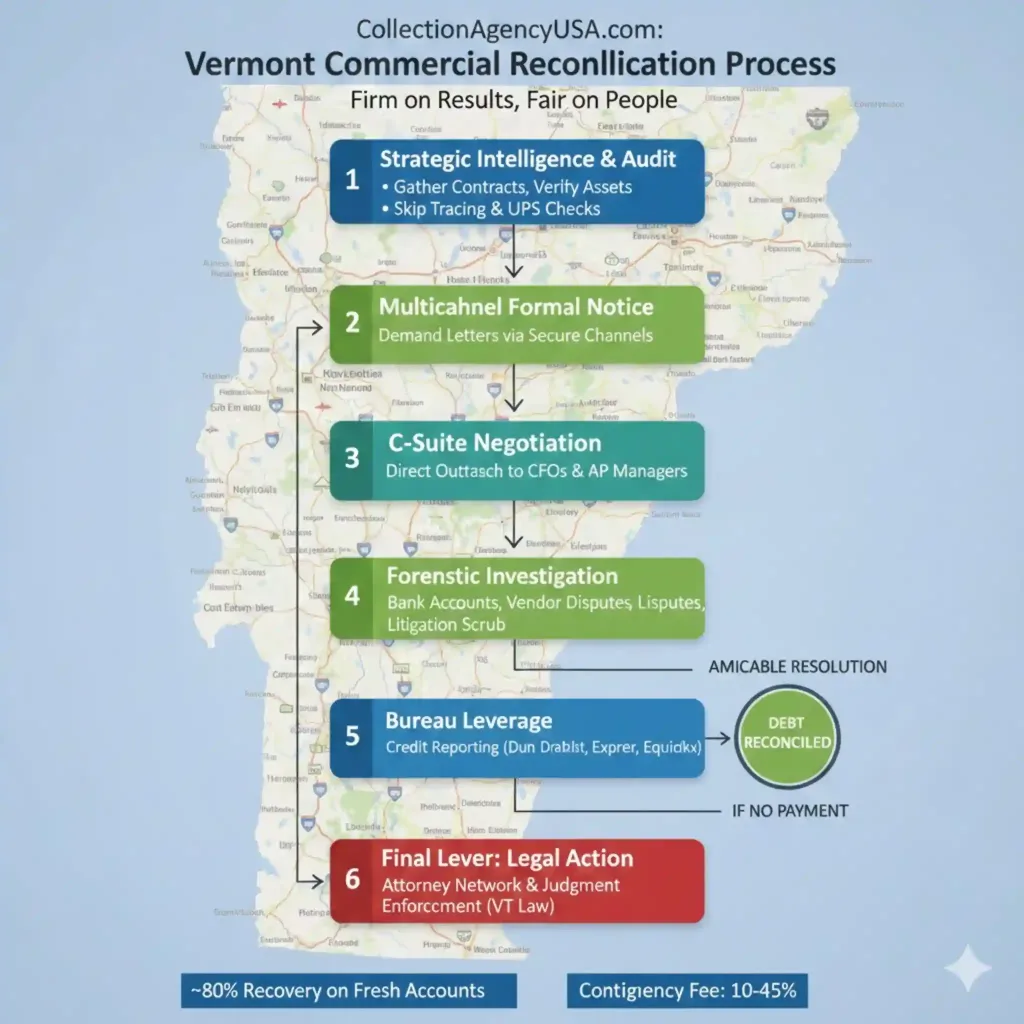
  1. File review and skip-tracing
    Contracts, invoices and prior emails are reviewed. Where helpful, business status, ownership and financial clues are refreshed.

  2. Structured outreach
    Focused letters, emails and calls go directly to people who can authorize payment—owners, controllers, CFOs, AP managers. The tone is firm, factual and respectful.

  3. Negotiation and payment arrangements
    CA-USA works toward either a lump-sum payment or a short, realistic payment plan. Settlement options are used carefully so you recover more than you would by simply waiting it out.

  4. Commercial credit reporting leverage
    For seriously delinquent and non-responsive accounts, CA-USA can report to major business credit bureaus such as:

    • Dun & Bradstreet (D&B)

    • Experian Business

    • Equifax Business

    A negative mark on a company’s business credit file makes future financing and vendor terms tougher—often enough to bring them back to the table without a legal fight.


5. Legal Options – Used Carefully and Sparingly

Only a small minority of claims are a good fit for full-blown litigation. Before recommending legal action, CA-USA looks at:

  • Strength of documentation and contracts

  • Evidence that the debtor has assets or ongoing operations

  • Realistic legal cost vs. likely recovery

Even when a lawsuit is filed, most B2B commercial debt cases are resolved without an actual court trial. The credible possibility of legal action often leads to negotiated settlements, consent judgments or payment agreements. Litigation is a lever, not a default.


High Recovery, Protected Reputation

CA-USA is built around three priorities that matter most for B2B commercial debt recovery.

1. Strong recovery rates

By intervening early, using structured workflows and leveraging multiple channels (including business credit reporting), CA-USA routinely sees recovery rates nearing 80% on fresh, well-documented placements.

Older and heavily aged accounts are tougher for everyone, which is why timing matters so much.

2. Brand-safe communication

Every touchpoint is designed to protect your reputation and long-term relationships:

  • No theatrics or personal attacks

  • Clear, calm explanations of what is owed and what happens next

  • Consistent documentation of all contacts

This approach helps you collect past-due invoices without damaging your brand.

3. Resolution without unnecessary court battles

The vast majority of files are resolved through:

  • Negotiation

  • Payment plans

  • Credit-bureau leverage

Most clients see results without ever stepping into a courtroom, which keeps legal costs down and allows your team to stay focused on running the business.


What Makes CA-USA Different from Other Commercial Collection Agencies?

Plenty of firms say they collect B2B debt. A few things set CA-USA apart as a commercial debt collection agency:

  • Proven performance
    Recovery rates on fresh placements regularly approach 80%, keeping more of your hard-earned revenue in your bank account instead of the write-off column.

  • Reputation you can see
    CA-USA holds a Google rating of about 4.85 out of 5, reflecting how both clients and counterparties experience the work—firm, fair and professional.

  • Deep commercial focus
    The team works exclusively with business-to-business portfolios, across industries and balance sizes, so strategies are built for corporate decision-makers rather than consumers.

  • Balanced pressure and tools
    Phone, email, letters, the option to report to D&B, Experian Business and Equifax Business, and, when justified, legal escalation are combined in a controlled way. The goal is the same every time: get you paid without blowing up the relationship.

  • Transparent, data-driven process
    You see where each file stands, what’s been tried, and what’s planned next. That clarity makes it easy to defend your collections strategy internally and fine-tune your credit policies.


FAQs About B2B Commercial Debt Recovery with CA-USA

1. When should I send B2B accounts to a commercial debt collection agency?
A good rule of thumb is to consider placement when an invoice hits 90+ days past due with no valid dispute and no realistic payment plan. At that point, recovery odds start to fall sharply, and professional B2B collections can protect you from unnecessary write-offs.

2. Can CA-USA report my customer’s unpaid debt to business credit bureaus?
Yes. For seriously delinquent and non-responsive accounts, CA-USA can use business credit bureau reporting to Dun & Bradstreet (D&B), Experian Business and Equifax Business as part of the recovery strategy. This adds real-world consequences without jumping straight to litigation.

3. Will B2B commercial debt recovery damage my relationship with the customer?
It doesn’t have to. CA-USA’s process is firm but respectful. The focus is on facts, contracts and clear expectations, not embarrassment or pressure tactics. Many customers continue doing business after resolving their past-due balances.

4. Do most B2B collection cases end up in court?
No. 90% cases are resolved through negotiation, payment plans and credit-bureau leverage. Litigation is used selectively for larger, well-documented debts where there is a realistic chance of recovery.

5. How does CA-USA measure success in B2B commercial debt recovery?
Key metrics include recovery rate, speed of recovery, impact on bad-debt write-offs and client satisfaction. The nearly 80% recovery rate on fresh placements and a 4.85★ Google rating are strong indicators of performance.

Start your recovery process? Contact us

Filed Under: collections

by

Handling the 6 Biggest Collection Agency Sales Objection

Let’s be direct — hiring a collection agency is a big decision. Most businesses don’t do it lightly. It means you’ve tried to collect in-house, you’ve sent reminders, and patience has run thin. At that point, trust becomes everything.

And trust starts with transparency. We’ve heard every concern from business owners, CFOs, and office managers — and the best way to build confidence is to answer those objections head-on, not sidestep them.

Here’s a candid look at the most common objections to hiring a collection agency — and the real answers that smart businesses deserve.

handling collection sales objections


1. The Reputation Question

“Will you harass my customers and ruin my brand?”

This is the number one fear — and it’s valid. Your customers are the foundation of your business. You’ve spent years earning their trust; one wrong conversation can undo that.

The truth is, the “aggressive debt collector” stereotype is outdated. Modern agencies are relationship-focused, not confrontation-focused. Every collector on our team is trained in empathy, negotiation, and professional communication. We don’t pressure — we persuade.

We act as a polite, third-party mediator, not a threat. Our approach protects your brand, your compliance obligations, and often your relationship with the client. Especially for medical and dental offices, where HIPAA and sensitivity are paramount, we view every call as a reflection of your reputation.

A good collection agency doesn’t burn bridges; it rebuilds cash flow without damaging trust.


2. The Cost Question

“Your fees seem high — is it even worth it?”

Fair question. At first glance, a 30–40% contingency fee can seem steep. But the right way to think about it is this: What’s the cost of not collecting anything at all?

An unpaid invoice that’s been sitting for 90 or 120 days isn’t earning you interest — it’s silently costing you. The 100% you keep from uncollected debt is zero.

We only get paid when you do. That means zero risk, zero upfront cost, and potentially thousands in revenue recovered. When you factor in the hours your staff spends chasing overdue accounts — hours that could’ve gone to productive, paying work — our service doesn’t cost you money. It recovers money you were about to lose forever.


3. The In-House Question

“My team can just make the calls.”

That’s true — they can. But should they?

Your office manager, AR clerk, or billing coordinator already wears multiple hats. When they’re spending half their day chasing late payments, they’re not focusing on new revenue, active customers, or patient experience.

Collections require specialized training, skip-tracing tools, legal knowledge, and — most importantly — emotional distance. Debtors respond differently when a neutral third party calls. The dynamic shifts from “I’ll get to it later” to “I need to resolve this professionally.”

Let your team do what they do best — grow your business. Let us do what we do best — get you paid.


4. The Partner Question

“We already have a collection agency.”

Good — that means you understand the value of professional recovery. But the next question is: Are you satisfied?

Most companies have no real benchmark for how their current agency is performing. Are they recovering the right percentage? Are they compliant? Are they protecting your brand voice?

We often suggest a no-risk performance trial — what we call a second placement test. Send us a sample batch of accounts your current agency couldn’t collect. If we don’t recover anything, you’ve lost nothing. But if we outperform them, you’ll see why many businesses re-evaluate who they partner with long-term.

The best partnerships are built on results, not habit.


5. The ROI Question

“How do I know this will actually work?”

This one’s all about trust and data. You want proof — not promises.

That’s why we give our clients full visibility: real-time online reports, detailed activity logs, and recovery dashboards that show exactly where every dollar is in the process.

We also provide industry-specific benchmarks — so you can see how similar businesses in your field (medical, dental, B2B, etc.) have performed. While no agency can guarantee 100% recovery, we can show consistent, data-driven results that turn your uncertainty into confidence.

Transparency builds trust. Trust drives performance.


6. The Compliance & Legal Question (Bonus — and often overlooked)

“Will you keep us compliant and out of legal trouble?”

Absolutely — and this is non-negotiable.

Between Regulation F, TCPA, HIPAA, and state-specific consumer laws, compliance is no longer just an operational checkbox; it’s the backbone of how we collect.

A professional agency invests in ongoing legal updates, call recording, data security, and staff certification. Compliance isn’t just protection for us — it’s protection for you. When you choose a compliant partner, you’re shielding your brand from regulatory risk while maintaining a professional, ethical standard that clients appreciate.


The Bottom Line

Objections aren’t obstacles — they’re opportunities to show what kind of partner you really are.

A great collection agency isn’t just a company that chases money. It’s an extension of your accounts receivable process, your customer service values, and your brand promise.

When you hear these objections, don’t just counter them — answer them honestly. That’s how you build lasting partnerships, recover lost revenue, and turn hesitation into trust.

Filed Under: collections

by

Maximize Your Revenue Recovery in Pennsylvania

blank

Turn Delinquent Accounts from a Liability into a Liquid Asset

You did the work. You delivered the product, provided the service, sent the invoice—and the money still hasn’t arrived. Meanwhile, payroll doesn’t wait. Neither do vendors or growth plans. Aging accounts receivable quietly erode margins, stall expansion, and tie up the time of your most valuable people.

That’s where Collection Agency USA comes in. We are a collection agency that helps Pennsylvania businesses turn overdue invoices into recovered revenue—professionally, compliantly, and without distracting your team from what actually grows your company.

When you partner with us, your delinquent accounts stop being an ongoing headache and start becoming a predictable source of cash flow.


Pennsylvania Debt Facts: Did You Know?

  • 4 Years: The Statute of Limitations on written contracts (breach of contract) in Pennsylvania. If you wait longer than this, the debt becomes legally uncollectible.

  • No Commercial Wage Garnishment: Unlike New Jersey or Ohio, Pennsylvania generally prohibits wage garnishment for commercial debts or credit cards. This surprises many creditors. (We use Bank Levies and Property Liens to get you paid instead).

  • 5 Years: The lifespan of a court judgment in PA, which can be revived repeatedly to keep the pressure on.


The Inefficiency and Risk of In-House Collections

Many companies try to “just handle it internally.” It feels thrifty—until it isn’t.

  • High opportunity cost. Every hour your staff spends chasing payments is an hour not spent selling, serving patients, fulfilling orders, or improving operations.

  • Lack of specialization. Your people are experts in your business—not in the psychology, data, and legal nuance of recovery. Effective collections require trained negotiators and disciplined workflows.

  • Compliance landmines. Consumer debt collection is governed by strict rules. The FDCPA and Pennsylvania’s Fair Credit Extension Uniformity Act (FCEUA) set strict standards. A single misstep can lead to penalties. Why take that risk?

Need a Collection Agency? Contact us


Industry-Specific Expertise You Can Count On

We tailor our collection strategies to the industries that drive Pennsylvania’s economy, from the “Eds & Meds” of Philadelphia to the manufacturing hubs of Pittsburgh.

Medical & Dental (Healthcare)
You operate in a complex revenue cycle—coordination of benefits, denials, and patient sensitivity. We bring HIPAA-conscious workflows and the empathy needed to maintain patient relationships—while still resolving balances. Whether you are a large health system in Philadelphia or an independent practice in Allentown, your staff gets relief, and your practice gets paid.

Commercial (B2B)
Business debt is different. Purchase orders, credit terms, and personal guarantees require a different language. Our collectors specialize in B2B disputes, particularly for Manufacturing & Logistics companies along the I-81 corridor. We prioritize preserving viable partnerships where possible and documenting disputes where necessary, so resolutions stick.

Consumer (B2C)
If you manage high-volume consumer AR—retail, rental, or lending—we scale with you. Our data-driven segmentation and multi-channel outreach handle thousands of accounts without losing the personal, compliant touch that moves consumers to act.


The Collection Agency USA Advantage

Superior Recovery Technology
We combine seasoned collectors with modern data. Our team leverages advanced skip-tracing to find debtors who have moved. We use structured, respectful follow-ups—phone, email, SMS, and mail—timed and sequenced for results.

Ironclad Compliance and Peace of Mind
Compliance isn’t a footnote—it’s a framework. We are licensed and bonded to collect in Pennsylvania, and our specialists operate under the FDCPA, FCEUA, and Regulation F. We document what we do, why we do it, and when we did it—so you can sleep at night.


Flexible, Powerful Collection Solutions

Contingency-Based Collections Simple promise:
We don’t get paid until you do.
Ideal for older or harder-to-collect accounts, our contingency model aligns our incentives with yours. We deploy full skip-tracing, persistent outreach, and skilled negotiators to drive liquidations—while you keep your upfront costs at zero.

Fixed-Fee Programs:
A smart, low-cost first step for early-stage delinquency. We apply the weight of our brand and a disciplined contact cadence—formal demand letters plus compliant initial outreach—at a predictable, flat cost per account. Many balances resolve here, quickly and economically.

Full-Service Legal Forwarding:
When diplomacy needs a stronger lever, we can—with your written authorization—escalate to our Pennsylvania network of vetted creditor-rights attorneys. Since wage garnishment is often off the table in PA, our attorneys focus on Bank Account Seizures and Real Estate Liens to enforce judgments.

Take the First Step to Improved Cash Flow

Stop letting delinquent accounts dictate your financial health. With Collection Agency USA, you gain a partner focused on one thing: turning past-due balances into present-day revenue.

Ready to recover what you’ve earned? Contact us today to schedule a quick, no-obligation consult. One conversation can change your cash flow for the year.

Filed Under: collections

by

Top Sectors Relying on B2B Commercial Debt Recovery

Here are the top industries specifically for B2B Commercial Debt Collections where delinquent accounts frequently occur and professional collection services are highly valued:

1. Manufacturing & Wholesale Distribution

  • Delayed or unpaid invoices from retailers, distributors, and supply-chain partners.

  • Significant reliance on credit terms, making consistent cash flow vital.

2. Construction & Building Materials

  • Frequent payment disputes, delayed payments from contractors, subcontractors, and developers.

  • High dollar-value contracts increase the importance of debt recovery.

3. Commercial Real Estate & Property Management

  • Outstanding rent payments, maintenance charges, lease defaults, or broken contracts from commercial tenants.

  • Critical to sustain operating budgets and property upkeep.

4. Professional Services Firms

  • Accounting, legal, advertising, consulting, IT and software services facing unpaid invoices from business clients.

  • Work often performed upfront, creating increased exposure to collection risks.

5. Transportation, Freight & Logistics

  • Non-payment or disputed invoices from shippers, brokers, or corporate customers.

  • Collections ensure working capital for operational expenses.

6. Business Lending & Equipment Financing

  • Unpaid or overdue commercial loans, leases, credit lines, and financed equipment.

  • Collections crucial due to high financial exposure and lending risks.

7. Healthcare Equipment & Medical Suppliers

  • Hospitals, clinics, and medical offices frequently delay payments to equipment or supply providers.

  • Collection services become necessary to maintain operational capital.

8. Energy, Utilities & Telecom Providers

  • Non-payment or delayed payments from corporate accounts for electricity, gas, internet, phone, and network services.

  • High transaction volumes increase importance of timely collections.

9. Technology & SaaS Providers

  • Subscription-based business software, cloud services, or IT solutions companies experiencing payment delays or cancellations.

  • High reliance on recurring revenue, making debt recovery essential.

10. Agricultural & Food Supply Chains

  • Distributors, processors, and suppliers regularly face delayed payments from wholesale buyers or retail chains.

  • Collections crucial for tight-margin operations.


Ready to assign your overdue accounts? Connect with us now 

Commercial Collection Process

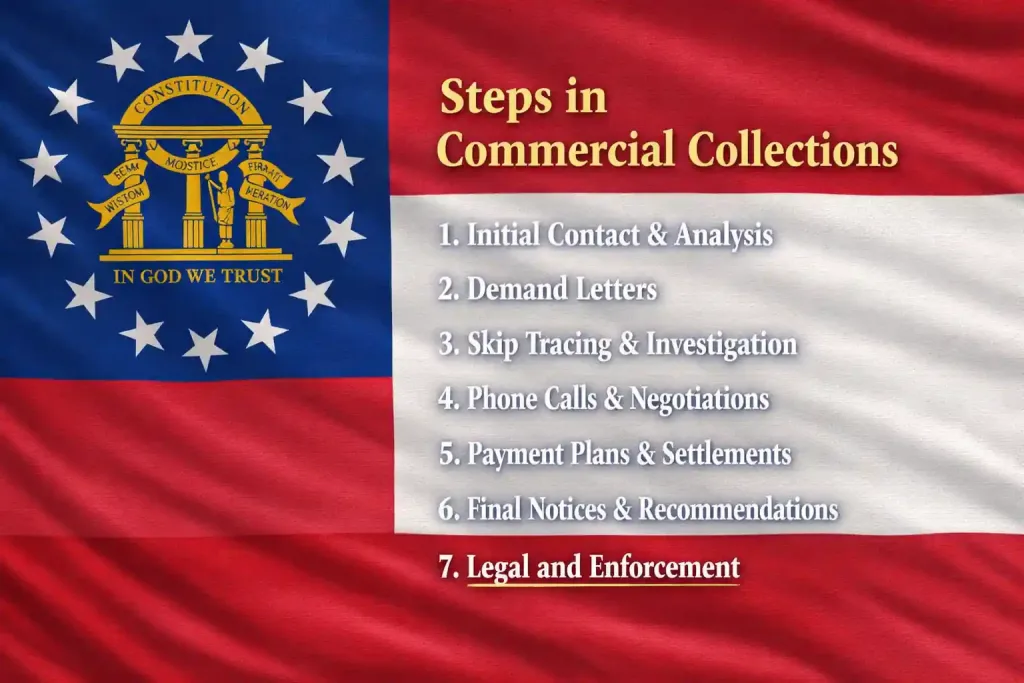
  • ✅ Account Review – Verify debt, contract terms, and payment history.

  • 📞 Initial Contact – Call, email, or mail to request payment.

  • ⚠️ Reminder Notices – Send formal demand letters or payment reminders.

  • 🤝 Negotiation – Offer payment plans or settlements, if needed.

  • 👔 Escalation – Transfer to a professional collection agency.

  • ⚖️ Legal Action – File a lawsuit if recovery efforts fail.

  • 💰 Debt Recovery – Collect full/partial payment or enforce judgment.

Filed Under: collections

by

Debt Collection Challenges in the Healthcare Sector

blank

Most people associate hospitals and clinics with healing, not invoices. Yet unpaid medical bills are a fast‑growing line item on the balance sheet of nearly every provider. Collecting those balances brings its own set of hurdles—many of which simply don’t exist in typical consumer or B2B collections.

1. Strict Privacy & Compliance Rules

  • HIPAA restrictions prevent agencies from seeing—or even discussing—certain patient details unless airtight Business Associate Agreements are in place.
  • State surprise‑billing laws and No Surprises Act protections create extra disclosure requirements at every step of the revenue cycle.

Example: A regional imaging center had to redact diagnostic codes from every past‑due statement before forwarding accounts, adding weeks to its internal workflow.

2. Emotion‑Driven Payment Decisions

Healthcare debt often follows illness, trauma, or job loss, so patients can be anxious—or angry—when collectors call. A hard‑sell script that works fine for retail cards can tank response rates here.

  • Patient trust and brand reputation matter; an overly aggressive call could trigger a social‑media backlash that costs far more than the balance owed.
  • Medical credit scores (e.g., VantageScore 4.0) weigh medical debt differently, meaning consumers may not feel the same urgency to pay.

Example: A children’s hospital replaced its robo‑dialer with SMS reminders that include a “Need help? Click to set a payment plan” button. Roll‑to‑agent escalations dropped 38 %, and monthly recoveries climbed.

3. Insurance and Coding Complexities

Disputes rarely hinge on willingness; they hinge on EOB confusion, denials, and miscoded CPTs.

  • Coordination‑of‑benefits delays keep charges in limbo.
  • Patients often assume insurers will eventually pay—and ignore collection letters in the meantime.

4. High‑Dollar, Low‑Frequency Balances

A hospital may carry fewer accounts than a utility company, but each bill is larger. That makes recovery cycles lumpy and forecasting tricky.

5. Fragmented Account Ownership

One emergency room visit can generate four separate bills (facility, physician group, lab, radiology). Patients see “one hospital” and get frustrated by multiple collectors.


Five Field‑Tested Strategies to Overcome These Obstacles

Strategy Why It Works
Compassion‑First Scripting Acknowledges hardship, keeps net‑promoter scores intact, and satisfies CFPB expectations of “consumer‑focused” communication.
Omnichannel Self‑Service Mobile‑friendly portals let patients verify insurance, upload documents, and choose a payment plan without human friction.
Insurance Follow‑Up Teams Specialized reps chase down payors, correct coding errors, and resubmit claims—often converting a “bad debt” into reimbursed revenue.
Consolidated Billing Rolling multiple provider invoices into one statement reduces patient confusion and call volume, boosting first‑touch resolutions.
Data‑Driven Segmentation Machine‑learning models flag charity‑care candidates vs. high‑propensity payers, ensuring the right account hits the right workflow.

Quick Wins You Can Implement This Quarter

  1. Add QR codes to paper statements that launch a mobile wallet checkout.
  2. Sync with patient‑engagement apps (MyChart®, Healow®, etc.) so balances appear alongside test results.
  3. Create a micro‑video for first‑notice emails explaining insurance vs. patient responsibility.

Why us

  • Patient Education on Billing
    We provide clear explanations of charges and insurance adjustments, reducing confusion that often delays payment.
  • Flexible Installment Plans
    Offering structured payment plans aligned with patient budgets helps increase recovery while maintaining goodwill.
  • Early-Out Programs
    Our team can step in right after billing to handle reminder calls and letters—preventing accounts from ever becoming delinquent.
  • Compliance with State-Specific Rules
    Beyond HIPAA, we stay current on evolving state healthcare debt laws, ensuring providers remain fully compliant.

Final Thoughts

Healthcare collections demand empathy, airtight compliance, and surgical‑level precision in handling insurance data. Providers who blend patient‑friendly communication with tech‑powered workflows recover more revenue—and preserve the goodwill that keeps communities trusting their care.

Filed Under: collections

  • Page 1
  • Page 2
  • Page 3
  • Go to Next Page »

Primary Sidebar

CA-USA: A 4.87 Rated Agency!

Collection Agency Good Reviews

Need a Collection Agency?

Kindly fill this form.
We’ll get in touch with you

    Please prove you are human by selecting the key.

    Recent Posts

    • Collection Agency to Collect Lease Break Fees, CAM, and Damages
    • B2B Commercial Debt Recovery with 80% Recovery Rates
    • Handling the 6 Biggest Collection Agency Sales Objection
    • Maximize Your Revenue Recovery in Pennsylvania
    • Top Sectors Relying on B2B Commercial Debt Recovery

    Copyright © 2025 ·Copyright: CollectionAgencyUSA.com (CA-USA) | All information on this website is for general information only and is not an experts advice. Visit our home page to know more about us.

    X
    Need a Collection Agency?
    Contact Us