California commercial collections are no longer just about how persistent a collector can be.
The more important question is:
What kind of commercial debt are we dealing with—and which California rules apply to it?
Since July 1, 2025, California has extended parts of its Rosenthal Fair Debt Collection Practices Act to certain defined small-business commercial credit debts of up to $500,000.
That does not mean every B2B invoice in California is treated the same way.
A Silicon Valley software invoice, a Los Angeles freight balance, a Central Valley equipment sale and a San Diego construction receivable can involve very different contracts, deadlines and recovery leverage.
CA-USA helps businesses recover commercial accounts throughout Los Angeles, San Francisco, San Diego, San Jose, Sacramento, Oakland, Fresno, Orange County and across California using professional negotiation, documentation analysis, debtor verification, bankruptcy screening, UCC-aware review and commercial credit reporting where appropriate.
The objective is straightforward:
Identify the strongest legitimate leverage first. Use legal escalation last.
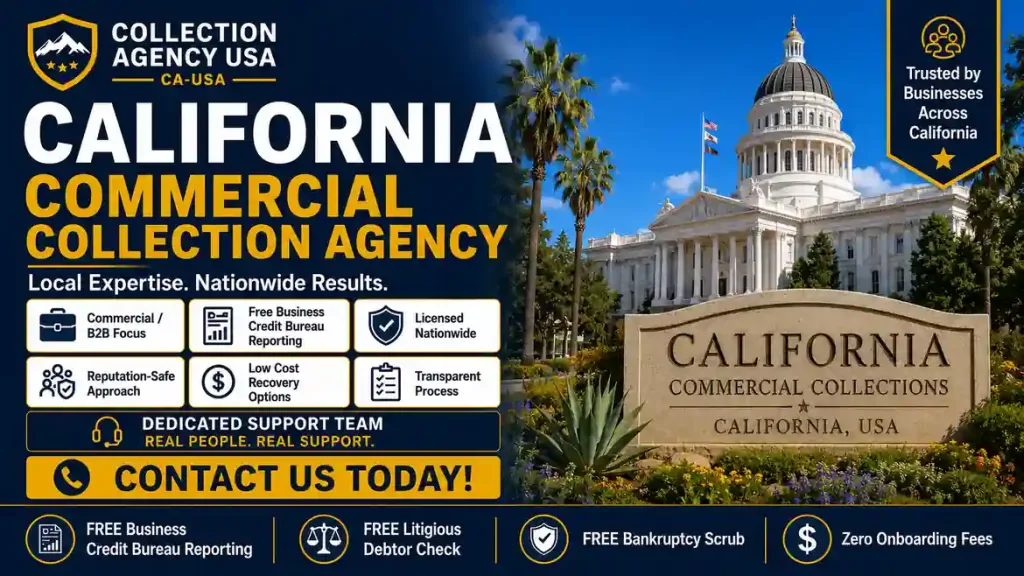
CA-USA provides a low cost, compliant, reputation-safe approach, equipped with all 50-state collections coverage, offering free credit reporting, free pre-litigation analysis, free bankruptcy scrubs, and zero onboarding fees. Secure – SOC 2 Type II compliant. Over 2,000 online reviews rate us 4.85 out of 5. Over 20 years experience , delivering excellent B2B collection results.
You have direct cell phone access to one of our dedicated representatives, who is available whenever you need assistance
Need a Commercial Collection Agency in California: Contact Us
For our nationwide commercial recovery approach, see B2B Commercial Debt Recovery.
California Changed the Rules for Some Small-Business Debt
California’s Rosenthal Fair Debt Collection Practices Act historically focused primarily on consumer debt.
That changed for certain commercial credit transactions beginning July 1, 2025.
The expanded provisions can apply to defined covered commercial debt involving qualifying commercial credit transactions where the applicable amount is no more than $500,000.
This is important—but the distinction matters.
The law does not mean that every unpaid invoice between two corporations automatically becomes covered commercial debt.
That is why a California commercial collection file should begin with the transaction itself:
- Was this trade credit?
- A loan or commercial financing transaction?
- A sale of goods?
- Professional services?
- Construction work?
- Is the debtor an individual guarantor or a business entity?
- When was the transaction entered into, renewed, sold or assigned?
In California, classification can matter almost as much as collection strategy.
One Invoice Can Have Three Different California Clocks
California does not have one universal limitation period for every commercial account.
Written Contracts — Generally Four Years
Actions based on written contracts, written obligations and many written account claims generally have a four-year limitation period.
Oral Contracts — Generally Two Years
A contract or obligation that is not founded on a written instrument can generally carry a shorter two-year limitation period.
Sales of Goods — Generally Four Years
California’s Commercial Code generally provides four years for breach of a contract for the sale of goods.
That can be particularly relevant to manufacturers, distributors, equipment vendors, agricultural suppliers and technology-hardware businesses.
The lesson is simple:
Do not determine a California deadline merely by looking at the invoice date. Determine what legal relationship created the receivable.
See our Statute of Limitations for Debt Collection resource for a broader discussion.
The Name on the Invoice May Not Be the Company That Owes You
California businesses frequently operate through:
- LLCs
- Corporations
- Subsidiaries
- DBAs
- Trade names
- Related operating companies
That can create trouble when a creditor knows the customer by its brand name rather than its registered legal entity.
California’s UCC requires particular accuracy when identifying registered organizations. A financing statement using only a debtor’s trade name is not sufficient.
Before relying on UCC leverage, we want to understand:
Which entity signed?
Which entity received the goods or services?
Which entity was invoiced?
Was there a security agreement?
Was the UCC filing made against the correct legal debtor?
That analysis can be far more valuable than simply increasing the number of collection calls.
California Construction Accounts Run on a Different Clock
Construction receivables deserve early attention.
For many California private projects, a direct contractor generally must record a mechanic’s lien before the earlier of:
- 90 days after completion of the work, or
- 60 days after the owner records a notice of completion or cessation.
For many subcontractors and suppliers, the deadline can shorten to 30 days after a notice of completion or cessation, subject to the applicable statutory requirements.
And there is another deadline after filing:
A California mechanic’s lien generally must be enforced within 90 days after it is recorded, unless a qualifying extension applies.
Sending an overdue construction invoice to collections does not automatically preserve lien rights.
For contractors, suppliers and equipment companies, the recovery strategy and lien calendar need to be considered separately.
A Dispute Should Be Defined, Not Allowed to Swallow the Account
California’s technology, manufacturing and professional-services markets generate complex invoices.
A customer may say:
“We dispute this balance.”
That statement should lead to another question:
Exactly which part?
If a customer owes $85,000 and can document a genuine dispute involving $12,000, there may be no commercial reason for the remaining $73,000 to remain frozen.
We review the contract, purchase order, invoices, acceptance records, correspondence, credits and payment history to separate:
Undisputed amount → documented dispute → unsupported withholding
That often creates a much cleaner negotiation path.
California Accounts We Commonly See Become Complex
California’s economy creates several recurring commercial collection patterns:
Technology & SaaS: accepted services, renewals, implementation disputes and multi-entity customers.
Manufacturing & Distribution: purchase orders, delivered goods, warranties, UCC issues and supply-chain balances.
Life Sciences & MedTech: specialized equipment, laboratories, research services and high-value vendors.
Agriculture & Food Processing: seasonal cash flow, equipment, packaging, freight and supplier credit.
Freight & Logistics: ports, warehousing, trucking, distribution and disputed shipment charges.
Construction & Trades: progress payments, retention disputes, material balances and rapidly moving lien deadlines.
Need to Recover an Unpaid Debt in California: Contact Us
Recent Recovery Results
California SaaS Account — 76% Recovered
A customer attempted to treat several months of accepted services as one large contract dispute after a corporate restructuring.
The file was reorganized by contracting entity, accepted service period and genuinely disputed credits. Instead of debating the entire balance with accounts payable, negotiations moved to the finance decision-maker responsible for the surviving entity.
Recovery: 76% of the placed balance without litigation.
Southern California Distributor — 69% Recovered
The debtor operated under a trade name while invoices and purchase records pointed to a separate legal LLC.
The recovery approach began with entity verification and document reconciliation, followed by bankruptcy and UCC review. Once responsibility was established, the undisputed balance was negotiated independently from a smaller product claim.
Recovery: 69% of the placed balance.
Recovery Economics: Our Fee Moves With the Result
CA-USA’s commercial collection model is designed so our compensation depends on successful recovery.
For most California B2B accounts, contingency rates typically range from 10% to 45%, depending on:
- Balance size
- Account age
- Documentation
- Complexity
- Debtor condition
Larger balances and newer accounts generally receive lower contingency rates.
Pricing is communicated before placement.
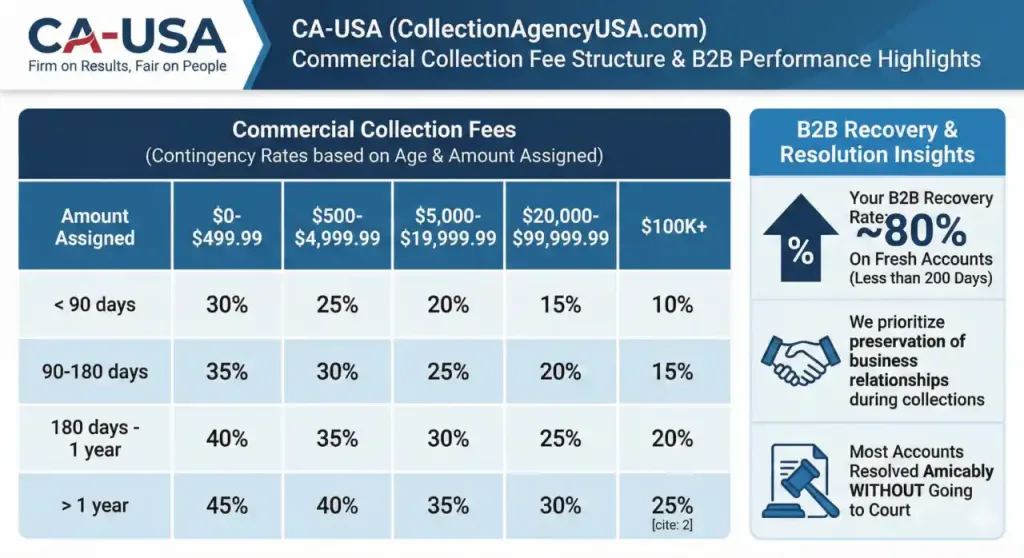
For qualifying fresh commercial accounts under approximately 200 days old and supported by adequate documentation, CA-USA’s internal results can approach ~80% recovery.
That is not a guaranteed recovery rate. Actual results vary by account age, disputes, debtor condition, documentation and other circumstances.
See B2B Commercial Collection Agency Pricing for more information.
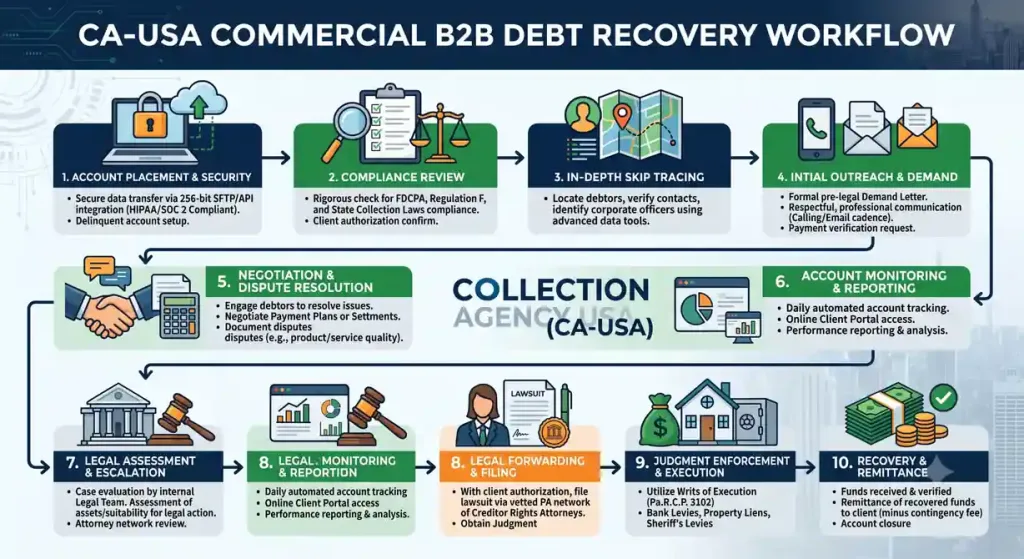
The CA-USA Escalation Model
We prefer a short escalation ladder rather than turning every file into a legal matter.
1. Establish the facts
Confirm the legal debtor, documentation, disputes, bankruptcy status and available commercial information.
2. Negotiate with the person who can authorize payment
That may be the CFO, owner, controller, finance director or accounts-payable manager.
Eligible accounts may also be considered for reporting to participating commercial credit bureaus where applicable requirements are satisfied.
3. Escalate only when economics justify it
Attorney referral is considered after reasonable non-legal recovery efforts fail, documentation supports the claim, escalation makes commercial sense and the client approves it.
CA-USA combines more than 20 years of collection experience with nationwide collection licensing coverage where required, SOC 2 Type II controls, dedicated support and reputation-conscious commercial negotiation.
California Commercial Collection FAQs
Does California’s Rosenthal Act now apply to business debt?
Beginning July 1, 2025, California expanded the Rosenthal Fair Debt Collection Practices Act to certain defined covered commercial debts. The expansion generally concerns qualifying commercial credit transactions of no more than $500,000 and applies to covered commercial credit or debt entered into, renewed, sold or assigned on or after July 1, 2025. It does not automatically mean every ordinary B2B trade invoice in California is covered, so the transaction should be classified before assuming the statute applies.
Is the California statute of limitations four years for every unpaid business invoice?
No. California generally provides four years for actions based on written contracts and certain written accounts, while obligations not founded on a written instrument can generally have a two-year period. Contracts for the sale of goods generally have a four-year period under California’s Commercial Code. The underlying transaction and accrual date should be reviewed before assuming a deadline.
My California customer uses a DBA. Which company should I send to collections?
Start with the legal entity that actually incurred the obligation. Review the contract, credit application, purchase order, invoices and acceptance records rather than relying solely on the customer’s trade name. This is especially important for secured transactions because a California UCC financing statement using only a debtor’s trade name does not sufficiently provide the debtor’s name.
Can a California contractor lose mechanic’s-lien rights while the invoice is being collected?
Yes. Collection activity does not stop California mechanic’s-lien deadlines. Depending on the claimant and whether a notice of completion or cessation was recorded, lien-recording deadlines can be considerably shorter than the ordinary contract limitation period. A recorded mechanic’s lien also generally must be enforced within 90 days after recordation unless a qualifying extension applies.
Can the owner of a California LLC be personally responsible for an unpaid company invoice?
Not merely because the person owns or manages the LLC. California generally treats an LLC’s obligations as liabilities of the company rather than its members or managers. Personal liability may arise in circumstances such as a written guarantee, another contractual undertaking, participation in wrongful conduct or a legally established alter-ego theory.
Can collection fees or attorney fees simply be added to a California commercial debt?
Not automatically. Additional fees must have a valid contractual or legal basis. California law also makes attorney-fee clauses in many contract actions reciprocal, meaning a provision written to benefit one contracting party can allow the prevailing party to recover reasonable attorney fees. Before adding collection expenses or representing that attorney fees are recoverable, the underlying agreement and applicable law should be reviewed.
Recover a California Commercial Account With the Facts on Your Side
California rewards creditors that understand the account before escalating it.
Before pursuing an overdue balance, ask:
What created the debt?
Which legal entity owes it?
Which deadline applies?
Is there a real dispute?
Is there secured or lien leverage that could expire?
CA-USA combines commercial negotiation, debtor verification, contract review, UCC-aware analysis, bankruptcy screening, commercial credit reporting where appropriate and measured legal escalation.
When you are ready to place accounts, see How to Assign Accounts to Collections.

Professional enough to preserve the relationship. Persistent enough to recover the balance.
| Need a Commercial Collection Agency? Contact Us Serving Hundreds of Businesses !Easy to use • Fully Compliant with Federal and State Laws • USA Citizens-Only Team • 24×7 Secure Portal • High Recovery Rates • Over 20 years Experience • Free Commercial Credit Bureau reporting • Low fee • Highly Rated ! |