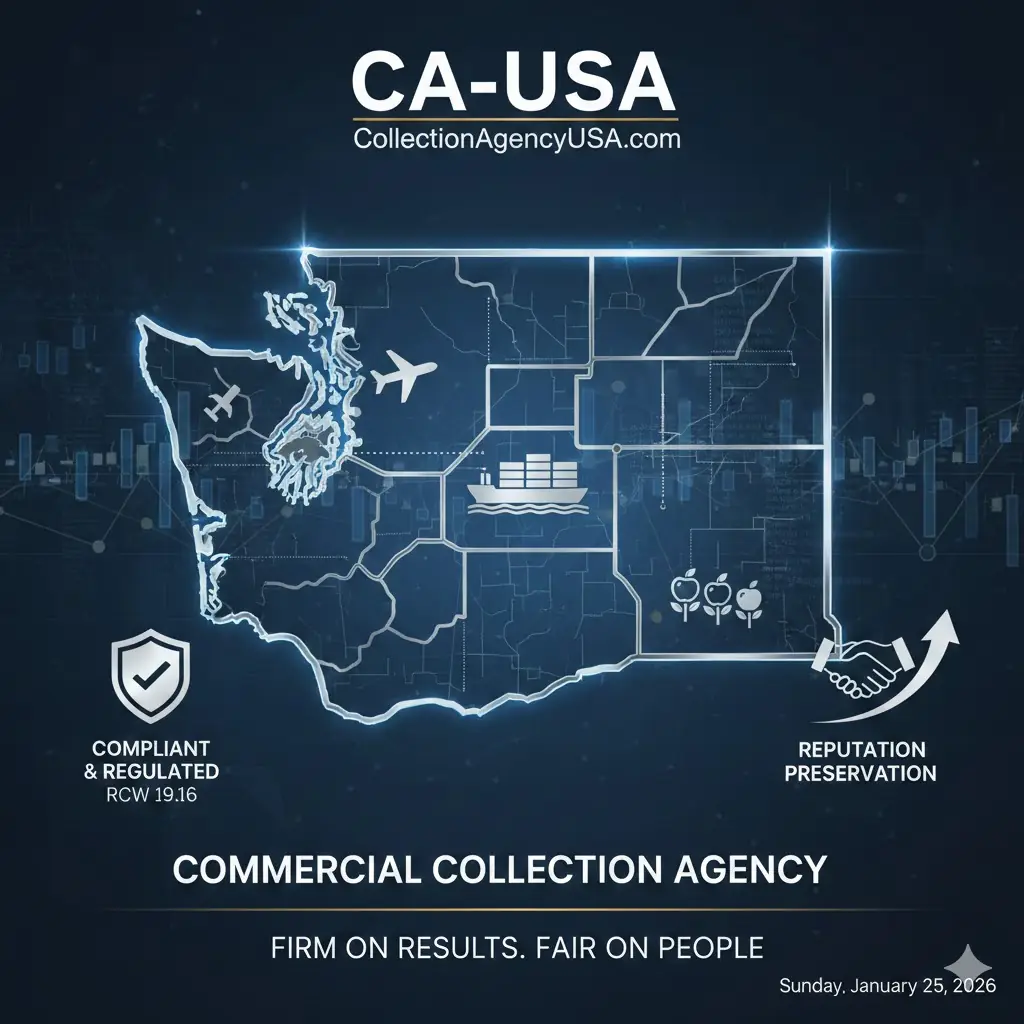
Washington businesses operate through some of the country’s most complex commercial networks—from software and cloud services in Seattle, Bellevue and Redmond to aerospace suppliers around Everett, maritime trade through Seattle and Tacoma, and agriculture and food production east of the Cascades.
When a customer stops paying, another demand letter is not always the answer.
CA-USA helps businesses recover past-due commercial accounts across Seattle, Bellevue, Redmond, Everett, Tacoma, Spokane, Vancouver and throughout Washington using contract review, business verification, bankruptcy screening, UCC-aware collection strategy, commercial credit reporting where eligible and reputation-safe negotiation.
Our first objective is resolution.
Attorney referral is considered only after reasonable collection and negotiation efforts fail, the documentation and collectability support further action, and you authorize escalation.

CA-USA provides a low cost, compliant, reputation-safe approach, equipped with all 50-state collections coverage, offering free credit reporting, free pre-litigation check, free bankruptcy scrubs, and zero onboarding fees. Secure – SOC 2 Type II compliant. Over 2,000 online reviews rate us 4.85 out of 5. Over 20 years experience , delivering excellent B2B collection results.
You’ll receive the direct mobile number of a dedicated representative, so help is always just a call or text away.
Need a Commercial Collection Agency? Contact us
Washington Is Different: Commercial Collection Agencies Must Be Properly Licensed
Washington is particularly important from a licensing standpoint.
The Washington Collection Agency Act specifically defines a “commercial claim” as an obligation arising from a transaction that is not primarily for personal, family or household purposes.
Washington also requires collection agencies and qualifying out-of-state collection agencies to obtain the appropriate state license before acting as a collection agency in the state.
That makes licensing more than a generic trust badge here—it is directly relevant to commercial collections.
A business collecting its own receivables through its own employees and under its own name is generally treated differently from an outside third-party collection agency.
For businesses with customers across several states, our B2B Commercial Debt Recovery guide explains CA-USA’s broader nationwide commercial recovery framework.
Before We Contact a Washington Debtor, We Want Four Things Clear
1. Who Actually Owes the Money?
Washington companies frequently operate through multiple:
- LLCs
- Corporations
- Subsidiaries
- Trade names
- DBAs
- Related operating entities
The business name your salesperson recognizes may not be the legal entity that signed the agreement.
We compare available contracts, purchase orders, credit applications, invoices and corporate information so the recovery effort begins against the correct debtor.
That distinction becomes particularly important when personal guarantees, UCC filings or attorney referral are involved.
2. What Does the Documentation Establish?
A strong commercial file should tell one consistent story:
What was agreed → what was delivered → what became due → what remains unpaid.
Useful documents can include:
- Signed contracts
- Credit applications
- Purchase orders
- Invoices
- Statements
- Proof of delivery
- Completion records
- Emails and correspondence
- Payment history
- Credit memos
- Personal guarantees
- Security agreements
- Relevant UCC information
When the debtor raises a dispute, good documentation usually creates more leverage than simply making the demand more aggressive.
3. Why Has Payment Stopped?
A delinquent business may be:
- Experiencing temporary cash-flow pressure
- Disputing only part of an invoice
- Waiting on internal approval
- Operating from a new location
- Deliberately delaying suppliers
- Losing customers or financing
- Preparing for bankruptcy
- No longer operating
Different problems require different collection strategies.
4. What Leverage Actually Exists?
A large invoice does not automatically mean the creditor has strong legal or commercial leverage.
Contracts, guarantees, security interests, UCC filings, bankruptcy status, competing creditors and the debtor’s current condition can materially change the recovery path.
Our job is to understand those facts before choosing how aggressively the account should be pursued.
Professional Negotiation Comes Before Legal Pressure
The right person matters in B2B collection.
Depending on the debtor, resolution may require communication with:
- Accounts payable
- Controller
- Finance director
- CFO
- Owner
- Managing member
- Senior executive
Our communication is professional, factual and persistent.
If a debtor raises a dispute involving pricing, delivery, scope, quality, credits or contract terms, we identify the actual issue instead of automatically treating the objection as a delay tactic.
Suppose a Washington customer disputes $12,000 of a $75,000 account.
That does not necessarily justify withholding the remaining $63,000.
Separating disputed from undisputed amounts can move significant cash back to the creditor while the narrower dispute is resolved.
Performance-Based Value: Our Alignment of Interests
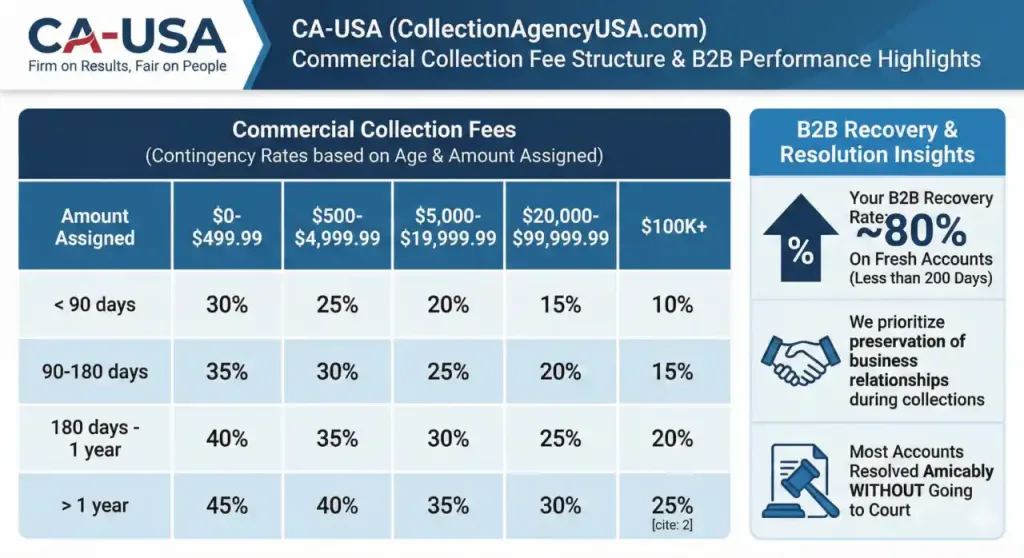
We operate on a pure Contingency Model. Our fee ranges between 10% to 45% depending on the balance, age, and complexity of the case. We prioritize transparency: higher balances and younger debt receive our lowest rates, incentivizing early assignment. If we don’t recover your funds, you owe us nothing. This model ensures our team is as invested in your bottom line as you are.
The 80% Performance Stat
In Washington’s competitive tech and maritime sectors, speed is the ultimate lever. We achieve an ~80% recovery rate on fresh commercial accounts (those less than 200 days old). Once a debt crosses the 200-day threshold, the probability of recovery in the B2B world begins to plummet. Early intervention by our specialists is the difference between a reinvested profit and a tax write-off.
Payment Arrangements Can Preserve Valuable Washington Customers
A solvent business experiencing temporary cash-flow pressure may be more valuable on a realistic payment arrangement than in a lawsuit.
This is especially relevant in industries where suppliers, manufacturers, contractors and technology companies work with the same counterparties repeatedly.
The key question is whether the debtor is genuinely cooperating.
A realistic payment plan that is being honored can make commercial sense.
Three broken payment promises tell a very different story.
Commercial Credit Reporting Provides Non-Legal Leverage
Eligible delinquent commercial accounts may be reportable to participating business credit bureaus when applicable documentation and reporting requirements are satisfied.
Commercial credit information can influence how lenders, suppliers and other businesses assess a company’s payment behavior.
The purpose is not to threaten to destroy a debtor’s credit.
It creates a legitimate commercial consequence:
How a company pays its obligations may affect how future creditors evaluate it.
That can encourage resolution without immediately involving attorneys.
UCC Review Matters in Washington’s Goods-Heavy Industries
Washington’s aerospace, maritime, agriculture, manufacturing and distribution sectors frequently involve:
- Equipment
- Inventory
- Aircraft components
- Agricultural products
- Machinery
- Goods in transit
- Accounts receivable
- Other business collateral
Security agreements and UCC financing statements can therefore matter substantially.
A UCC filing does not prove that a debtor has the cash to pay an invoice.
It may show that another lender or creditor already claims a security interest in particular collateral.
Before relying on secured-creditor leverage, available contracts, guarantees, security agreements and relevant UCC information should be reviewed.
A Washington Case Shows Why Maintaining UCC Perfection Matters
In a Washington commercial priority dispute, a creditor had properly perfected a security interest by filing a UCC financing statement.
The creditor later allowed the effectiveness of that filing to lapse.
Once the financing statement lapsed, the interest became unperfected and lost the priority protection it previously enjoyed against competing liens.
What this teaches: Secured-creditor rights are not something to assume simply because a filing once existed.
Perfection, continuation, collateral description and competing interests can materially affect the leverage available when a commercial debtor is financially distressed.
A Washington Guarantee Case Shows Why Signature Capacity Matters
In another Washington commercial case, the president of a corporate tenant signed a lease guarantee and added his corporate title to the signature.
When the business later failed, he argued that he had signed only in his representative capacity.
The Washington Supreme Court concluded that the guarantee created personal liability because interpreting the corporation itself as guarantor would effectively mean the company was guaranteeing its own obligation.
What this teaches: A personal guarantee can be powerful commercial documentation, but signatures, capacity and the actual contract language need to be read carefully rather than assumed.
Washington Commercial Collection Deadlines
Written Contracts and Accounts Receivable — Generally Six Years
Washington generally provides a six-year limitation period for written contracts.
Importantly for businesses, Washington law also specifically provides six years for an account receivable, defined as an obligation for payment incurred in the ordinary course of the claimant’s business or profession.
Certain Non-Written Contracts — Generally Three Years
A contract or liability that is not in writing and does not arise from a written instrument generally falls under Washington’s three-year provision, except where another statute—such as the account-receivable rule—applies.
Contracts for the Sale of Goods — Generally Four Years
Washington’s Uniform Commercial Code provides a four-year limitation period for breach of a contract for sale.
This can be particularly important for:
- Aerospace suppliers
- Equipment vendors
- Manufacturers
- Agricultural suppliers
- Food producers
- Distributors
- Wholesalers
The UCC rule is more specific than the general contract framework, so commercial accounts should be reviewed according to the actual transaction rather than assuming every written invoice gets six years.
Washington Construction Accounts Can Have Much Shorter Deadlines
Construction receivables deserve separate attention.
Washington generally requires a mechanics’ or materialman’s claim of lien to be recorded within 90 days after the claimant stops furnishing labor, professional services, materials or equipment.
The lien claimant generally must then provide a copy to the owner or reputed owner within 14 days after recording to preserve certain fee and cost rights.
A recorded lien also has separate enforcement deadlines.
Sending an account to collections does not automatically preserve construction-lien rights.
Contractors, subcontractors, equipment companies and material suppliers should therefore review time-sensitive lien options promptly rather than treating the account like an ordinary overdue invoice.
Industries We Serve Across Washington
Technology, SaaS & Cloud Services
Subscription, software licensing, implementation, professional-service and enterprise contract balances across Seattle, Bellevue and Redmond.
Aerospace & Advanced Manufacturing
Aircraft components, engineering, tooling, materials, equipment and supplier receivables across Everett, Snohomish County and the broader Puget Sound aerospace cluster.
Maritime, Freight & Logistics
Carrier, warehouse, terminal, marine-service, freight and distribution accounts connected with the ports of Seattle and Tacoma and Washington’s broader maritime economy.
Agriculture, Food & Beverage
Equipment, packaging, ingredients, transportation, fertilizer, feed and supplier balances involving growers, food processors and agricultural businesses across Eastern and Central Washington.
Businesses serving farms and agricultural customers can also review our Collection Agency for Farm Supply & Agriculture Businesses resource.
Life Sciences & Biotechnology
Laboratory, research, biotechnology, medical-device and other B2B supplier or professional-service receivables across Seattle, Bothell and Washington’s life-sciences ecosystem.
Clean Technology & Energy
Engineering, equipment, infrastructure, professional-service and technology balances connected with Washington’s clean-energy and advanced-energy industries.
Construction & Trades
Subcontractor, equipment-rental, material-supplier and commercial-project balances where documentation and separate lien deadlines can materially affect recovery strategy.
Professional & Business Services
Consulting, staffing, accounting, marketing, engineering, technology support and other contract-based commercial receivables.
Trust & Compliance
Washington Collection Agency Licensing
Washington specifically regulates collection agencies and commercial claims. CA-USA maintains the licensing required to service qualifying Washington collection accounts.
Contract, Invoice & UCC-Aware Review
We evaluate contracts, invoices, purchase orders, guarantees, security agreements and relevant UCC information when those documents may materially affect recovery strategy.
Bankruptcy Screening
Accounts are screened before escalation so ordinary collection activity does not continue blindly against a debtor protected by a bankruptcy automatic stay.
Business Skip Tracing & Entity Verification
Lawful business-information resources help confirm legal entities, updated locations, operating status and decision-makers.
Commercial Credit Reporting
Eligible delinquent business accounts may be reported to participating commercial credit bureaus where appropriate and permitted.
Reputation-Safe Collection Tactics
We prioritize professional communication, dispute resolution and negotiation designed to recover the balance without unnecessarily damaging valuable business relationships.
Secure Portal & SOC 2 Type II
Accounts and supporting documents are handled through a secure environment backed by SOC 2 Type II controls.
Nationwide Collection Licensing Coverage
CA-USA maintains nationwide collection licensing coverage, including all required state collection licenses, registrations and bonds.
Attorney Referral — Only as a Last Resort
Attorney referral is considered only after reasonable collection and negotiation efforts fail, the documentation and economics support escalation, and the client approves the next step.
Commercial Collection Pricing
CA-USA primarily handles commercial collection accounts on a contingency basis.
Fees can vary based on:
- Balance
- Age
- Documentation
- Complexity
- Account location
- Whether additional legal work becomes necessary
On contingency placements, the collection fee is earned when money is successfully recovered.
Businesses comparing rates can also review What Should a B2B Commercial Collection Agency Charge?.
FAQs About Washington B2B Commercial Collections
Does Washington require a collection agency license for commercial B2B debt?
Yes. Washington’s Collection Agency Act expressly recognizes commercial claims and generally requires a collection agency or qualifying out-of-state collection agency to obtain the appropriate Washington license before acting as a collection agency in the state. A business collecting its own accounts through its own employees and under its own name is generally treated differently under the statute.
How long can we pursue an unpaid business invoice in Washington?
Washington generally provides six years for written contracts and specifically for accounts receivable. Certain non-written contractual claims generally have a three-year limitation period, while contracts for the sale of goods generally fall under Washington’s UCC four-year limitation period. The applicable deadline depends on the underlying transaction and facts.
How does Washington’s UCC affect commercial debt collection?
Washington’s UCC can affect sales of goods, security interests, financing statements, collateral and creditor priority. A properly perfected security interest may provide important rights, while an expired or defective filing can materially weaken a creditor’s position. Relevant contracts, security agreements and UCC information should therefore be reviewed before relying on secured-creditor leverage.
Can we pursue an owner of a Washington LLC personally for the company’s debt?
Usually not merely because someone owns or manages the LLC. Washington law generally provides that an LLC’s debts and obligations belong to the company rather than automatically to its members or managers. A personal guarantee, another agreement creating personal responsibility or another legally recognized basis for liability can change the analysis.
What should Washington contractors and suppliers know about construction-lien deadlines?
Washington generally requires a construction lien claim to be recorded within 90 days after the claimant stops furnishing qualifying labor, professional services, materials or equipment. Additional notice and enforcement requirements also apply. Sending an account to a collection agency does not automatically preserve lien rights, so construction receivables should be reviewed promptly.
Can an unpaid Washington business account be reported to a commercial credit bureau?
Eligible delinquent commercial accounts may be reportable to participating business credit bureaus when applicable documentation and reporting requirements are satisfied. Commercial credit reporting can provide an additional non-legal incentive for a business to resolve an outstanding balance.
When does CA-USA refer a Washington commercial account to an attorney?
Legal action is a last resort. CA-USA first uses documentation review, business verification, professional outreach, dispute resolution, reputation-safe negotiation, commercial credit reporting where appropriate and other non-legal recovery tools. Attorney referral is considered only after reasonable collection efforts fail, the account supports further escalation and the client approves the next step.
Ready to Recover a Past-Due Washington Business Account?
A good Washington commercial collection strategy should answer four questions before applying pressure:
Who legally owes the money?
What do the documents prove?
Why has payment stopped?
What leverage actually exists?
CA-USA combines commercial collection experience with documentation, debtor intelligence, UCC-aware review, negotiation, commercial credit reporting and measured escalation to help Washington businesses turn past-due receivables back into working capital.
If you are preparing accounts for placement, our How to Assign Your Accounts to a Collection Agency guide explains what documentation and account information helps us begin efficiently.
Firm on the balance. Professional with the people. Legal only when reasonable collection efforts have failed.

Reclaiming Capital in the Innovation State: A Washington B2B Masterclass
Recover your Business Debts? Contact us