Florida is one of the few states where commercial collections have their own regulatory framework.
That matters when a Miami distributor, Tampa contractor, Orlando professional-services firm or Jacksonville logistics company turns an unpaid invoice over to collections.
Florida does not treat every overdue account as the same problem.
A strong recovery strategy begins by identifying:
Who legally owes the money?
What created the debt?
Which Florida deadline applies?
What leverage still exists?
CA-USA helps recover overdue B2B accounts throughout Miami, Tampa, Orlando, Jacksonville, Fort Lauderdale, West Palm Beach, Naples, Sarasota and across Florida using professional negotiation, reputation safe methodology, contract and invoice review, business verification, bankruptcy screening, UCC-aware analysis and commercial credit reporting where appropriate.
The goal is to recover the balance without turning every commercial disagreement into litigation.
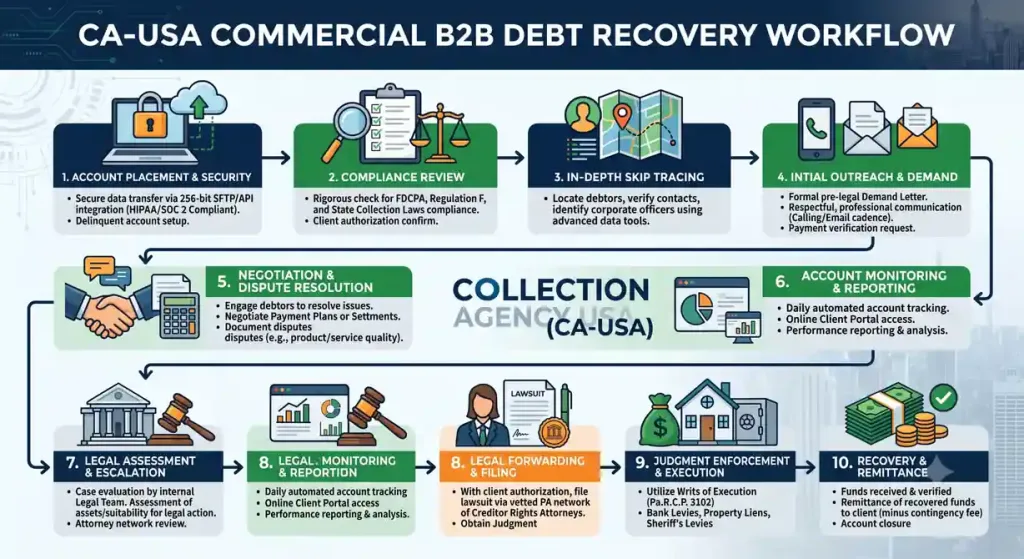
Attorney referral is considered only after reasonable non-legal recovery efforts fail, the documentation and economics justify escalation, and the client approves the next step.
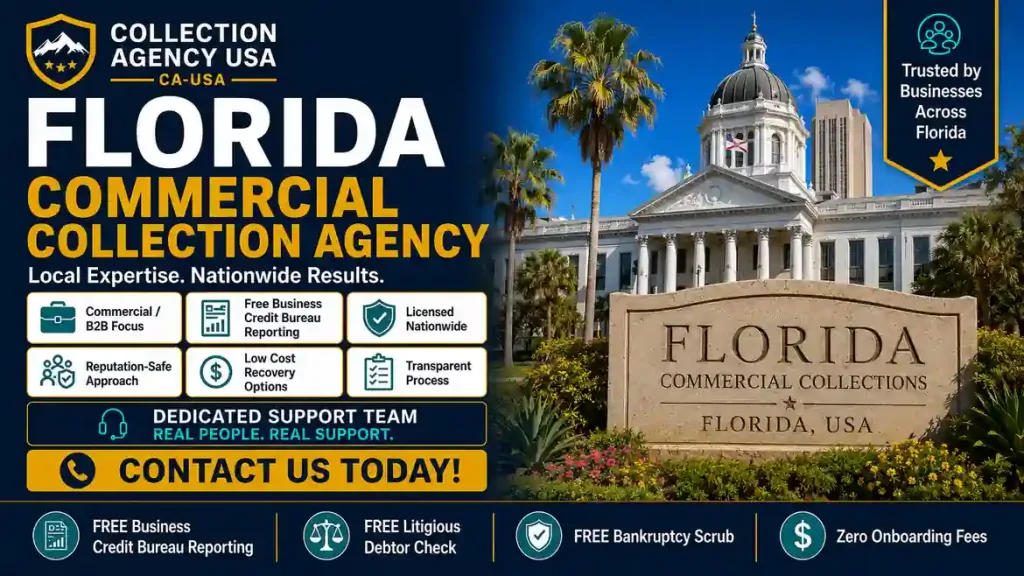
CA-USA provides a low cost, compliant, reputation-safe approach, equipped with all 50-state collections coverage, offering free credit reporting, free pre-litigation checks, free bankruptcy scrubs, and zero onboarding fees. Secure – SOC 2 Type II compliant. Over 2,000 online reviews rate us 4.85 out of 5. Over 20 years experience , delivering excellent B2B collection results.
You’ll be assigned a direct representative who is available by cell phone whenever you need support.
Need a Commercial Collection Agency in Florida? Contact us
For our nationwide approach, see B2B Commercial Debt Recovery.
Florida Has Specific Rules for Commercial Collection Agencies
Florida separates commercial collection activity from consumer collection regulation.
Under Florida’s Commercial Collection Practices Act, agencies operating as commercial collection agencies and subject to the statute generally must register with the Florida Office of Financial Regulation.
The current registration framework also requires a $50,000 surety bond for covered commercial collection agencies.
That is a meaningful distinction.
Commercial debt deserves commercial expertise—not consumer collection language copied onto a business account.
In Florida, the Contract Can Change the Clock
There is no single Florida deadline for every unpaid business invoice.
Written Agreements — Generally Five Years
Florida generally provides a five-year limitation period for actions based on a contract, obligation or liability founded on a written instrument.
Non-Written Agreements — Generally Four Years
Claims based on obligations that are not founded on a written instrument can generally have a four-year limitation period.
Sales of Goods — Generally Four Years
Commercial transactions involving the sale of goods generally fall under Florida’s UCC, which ordinarily provides a four-year period for breach of a sales contract.
That distinction matters for:
- Equipment suppliers
- Manufacturers
- Wholesalers
- Food distributors
- Aviation suppliers
- Marine suppliers
- Industrial vendors
A creditor should therefore look beyond the invoice date.
What created the receivable can determine which deadline applies.
For a broader discussion, see our Statute of Limitations for Debt Collection guide.
The Customer’s Trade Name May Not Be the Legal Debtor
Florida businesses commonly operate through LLCs, corporations, subsidiaries, DBAs and related entities.
The name your sales department recognizes may not be the entity that actually signed the agreement.
Florida’s UCC is clear that a financing statement providing only a debtor’s trade name is not sufficient.
Before relying on secured-creditor leverage, we review questions such as:
Which entity signed the agreement?
Who received the goods or services?
Was a security agreement executed?
Was the UCC financing statement filed under the correct legal debtor name?
Is there a personal guarantee?
Correct entity identification can be more valuable than simply making more collection calls.
A Florida LLC Debt Is Usually the Company’s Debt
Florida law generally treats an LLC’s debts and liabilities as obligations of the company.
An owner or manager is not personally responsible merely because that person owns or manages the LLC.
A valid personal guarantee or another legally recognized basis for personal liability may change the result.
That means finding the owner is not enough.
The important question is:
Did that person personally agree to pay if the company did not?
Florida Construction Receivables Need Early Attention
Florida construction accounts operate on a much shorter lien calendar than an ordinary contract claim.
A Florida claim of lien generally must be recorded no later than 90 days after the lienor’s final furnishing of labor, services or materials.
And recording the lien is not the end of the process.
A Florida construction lien generally lasts one year after recording unless an enforcement action is commenced, although certain procedures can shorten the enforcement period.
Placing an overdue construction account with a collection agency does not automatically preserve lien rights.
That is particularly important for:
- General contractors
- Subcontractors
- Restoration companies
- HVAC contractors
- Electrical contractors
- Roofing companies
- Material suppliers
- Equipment-rental companies
Collection strategy and lien strategy should be reviewed together—but treated as separate deadlines.
Florida’s Commercial Economy Creates Different Types of Receivables
Logistics, Shipping & Distribution
Florida’s ports, warehouses, freight networks and distribution centers generate large volumes of B2B invoices involving transportation, storage, accessorial charges, equipment and delivered goods.
Aerospace, Aviation & Defense
Florida has more than 3,000 aerospace and aviation establishments, creating a significant ecosystem of manufacturers, MRO providers, engineering companies and specialized suppliers.
These accounts can involve purchase orders, inspection disputes, delivered components and high-value technical services.
Manufacturing
Manufacturers and industrial suppliers frequently need purchase-order, delivery, warranty and UCC documentation reviewed before a disputed balance can be resolved effectively.
Maritime
Ship repair, marine equipment, port services and commercial maritime businesses create specialized B2B accounts where the parties and contractual documents must be identified correctly.
Technology & Professional Services
Software, consulting, staffing, accounting and engineering companies often perform substantial work before payment becomes due.
A vague claim that “the work was not satisfactory” months later should be compared against approvals, acceptance history and earlier communications.
Construction & Restoration
Florida’s construction and property-restoration markets generate high-value receivables where payment disputes and lien deadlines often exist at the same time.
A Better Way to Handle a Partial Dispute
Suppose a Florida distributor is owed $96,000.
The customer later alleges that $14,000 of the delivered goods were defective.
That does not automatically explain why the remaining $82,000 has not been paid.
Instead of arguing over the entire balance, the account can be separated into:
Documented undisputed amount
Legitimate disputed amount
Unsupported withholding
This often changes the conversation from:
“We dispute the invoice.”
to:
“Why is the undisputed balance still unpaid?”
That is a much stronger commercial negotiation position.
Recent Florida Recovery Results
Jacksonville Commercial Account — 72% Recovery
A debtor was withholding payment across several invoices because of a dispute tied to one project.
The invoices were separated by project, the genuinely disputed portion was isolated, and negotiations moved from general accounts payable to the person responsible for financial approval.
Recovery: 72% of the placed balance without litigation.
South Florida Equipment Account — 67% Recovery
The customer was operating under a trade name while the contract and delivery records pointed to a separate Florida LLC.
Entity verification, document reconciliation and bankruptcy review established the responsible company before negotiations began.
Recovery: 67% of the placed balance.
Recovery Economics: We Succeed When You Recover
For most Florida commercial accounts, CA-USA works on a contingency basis.
There is no collection commission unless money is recovered.
Rates typically range from 10% to 45%, depending on:
- Balance size
- Account age
- Documentation
- Complexity
- Debtor condition
Larger balances and younger accounts generally qualify for the lowest rates.
Pricing is confirmed before placement.
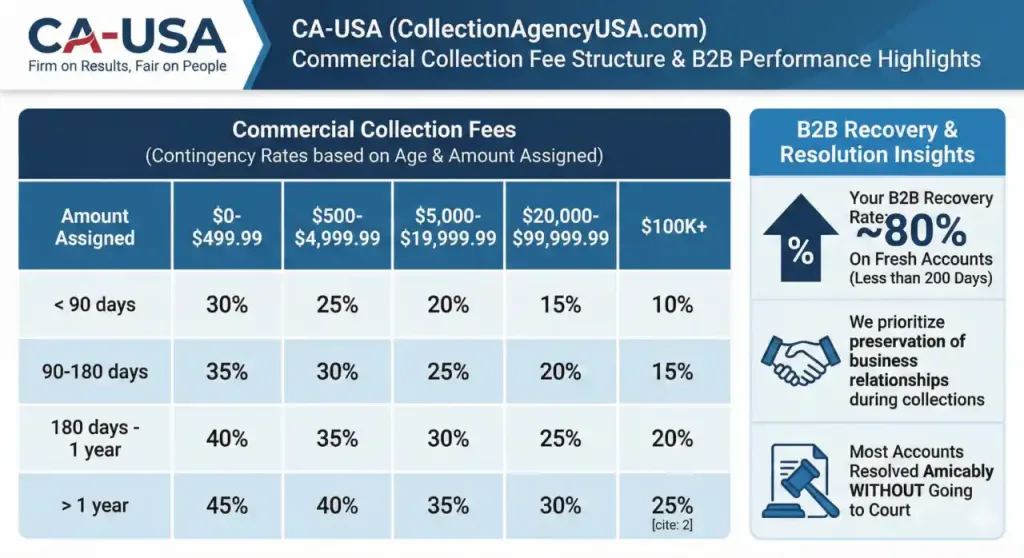
For qualifying fresh commercial accounts under approximately 200 days old with adequate documentation, CA-USA’s internal results can approach ~80% recovery.
This is not a guaranteed recovery rate. Actual results vary according to account age, debtor condition, disputes, documentation and other factors.
See B2B Commercial Collection Agency Pricing for more information.
Before We Recommend an Attorney
Our preferred escalation path is deliberately commercial.
Verify the debtor.
Confirm the responsible legal entity and current operating status.
Review the documentation.
Contracts, purchase orders, invoices, delivery records, correspondence and guarantees tell us what can actually be supported.
Screen for bankruptcy.
A bankruptcy filing can immediately alter permissible collection activity.
Define the dispute.
A legitimate dispute involving one part of an account should not automatically freeze everything else.
Review UCC information where relevant.
Security interests and competing creditors can affect recovery leverage.
Negotiate with decision-makers.
Owners, CFOs, controllers and finance executives can often resolve balances that routine AP follow-up cannot.
Use commercial credit reporting where eligible.
Qualifying delinquent business accounts may be reportable to participating commercial credit bureaus when applicable requirements are satisfied.
Attorney referral comes last.
Legal escalation is considered only after reasonable recovery efforts fail and the client determines that the documentation, balance and economics justify it.
Florida Commercial Collection FAQs
Does Florida require commercial collection agencies to register?
Yes. Florida has a specific Commercial Collection Practices Act. Commercial collection agencies subject to that law generally must register with the Florida Office of Financial Regulation and maintain the required registration. Florida’s current registration process also requires a $50,000 surety bond. Statutory exemptions exist, so applicability depends on the agency and its activities.
How long do I have to collect an unpaid Florida business invoice?
It depends on the obligation. Florida generally provides five years for actions founded on a written instrument and four years for obligations not founded on a written instrument. Contracts involving the sale of goods generally have a four-year period under Florida’s UCC. The agreement and transaction should be reviewed before assuming the applicable deadline.
Does Florida’s consumer collection law apply to ordinary B2B debt?
Pure commercial claims are treated differently from consumer debts. Florida has a separate Commercial Collection Practices Act specifically addressing commercial collection agencies and commercial claims. A commercial claim is generally one arising from credit used primarily for commercial rather than personal, family or household purposes.
My Florida customer uses a DBA. Which entity actually owes the invoice?
The responsible party should be determined from the contract, credit application, purchase order, invoices, delivery records and other transaction documents rather than relying solely on the trade name. This is especially important for secured transactions because Florida’s UCC states that a financing statement providing only the debtor’s trade name does not sufficiently provide the debtor’s name.
How quickly must a Florida construction lien be recorded?
A Florida claim of lien generally must be recorded no later than 90 days after the lienor’s final furnishing of labor, services or materials. A recorded lien generally must then be enforced within one year, although certain statutory procedures can shorten that period. Sending the debt to collections does not automatically preserve lien rights.
Can I pursue the owner of a Florida LLC for the company’s unpaid invoice?
Not simply because that person owns or manages the LLC. Florida generally treats an LLC’s debt as an obligation of the company. A personal guarantee or another legally recognized basis for personal liability can change the analysis, so the credit application, contract and guarantee documents should be reviewed.
Recover the Florida Account Before the Options Narrow
The best commercial collection strategy often starts before the account becomes seriously aged.
Ask:
Which company owes the money?
What documents support the balance?
Which Florida deadline is running?
Is any part of the balance genuinely disputed?
Is there UCC, lien or guarantee leverage?
CA-USA combines commercial negotiation, debtor verification, documentation review, bankruptcy screening, UCC-aware analysis, commercial credit reporting where appropriate and measured escalation.
When you are ready to place accounts, see How to Assign Accounts to Collections.
Firm on the balance. Professional with the people.
| Need a Commercial Collection Agency? Contact Us Serving Hundreds of Businesses !Easy to use • Fully Compliant with Federal and State Laws • USA Citizens-Only Team • 24×7 Secure Portal • High Recovery Rates • Over 20 years Experience • Free Commercial Credit Bureau reporting • Low fee • Highly Rated ! |