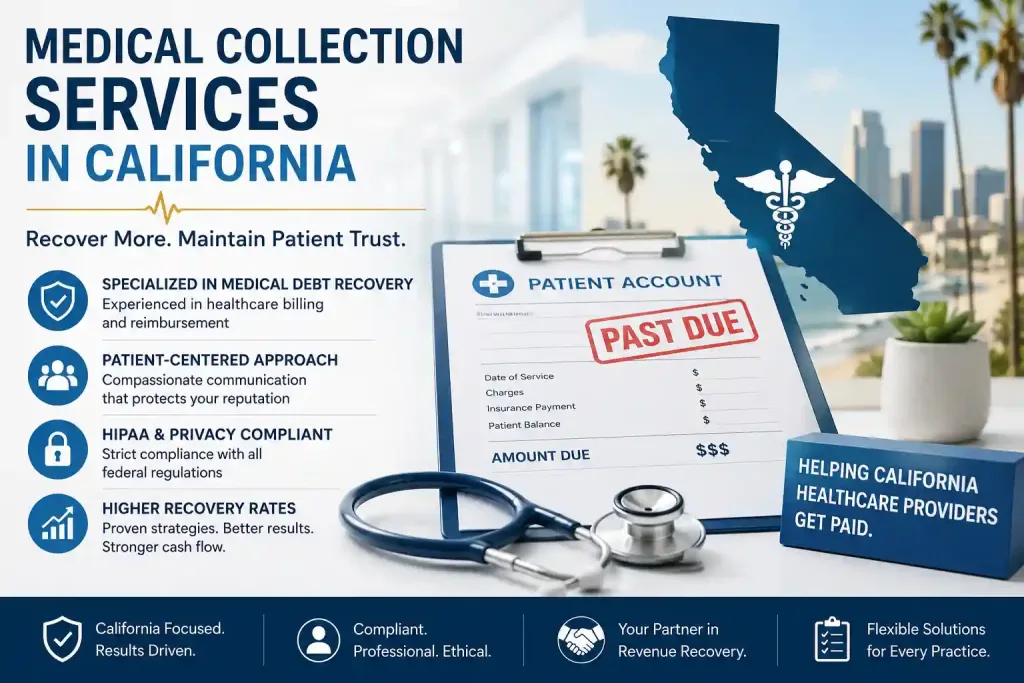
When medical bills go unpaid, healthcare providers often rely on collection agencies to recover outstanding balances.
Choosing the right agency is critical for maintaining financial health and preserving patient relationships. This article offers comprehensive insights into shortlisting a medical collection agency in California, with a focus on key considerations, legal compliance, and practical scenarios.
Need a Medical Collection Agency? Contact us
Factors to Consider When Shortlisting a Medical Collection Agency
1. Experience and Expertise
- Industry-Specific Knowledge: Choose agencies specializing in medical debt collection. These agencies understand healthcare regulations, billing intricacies, and patient sensitivities, ensuring compliance and ethical practices.
- Types of Medical Debt: Ask about the agency’s experience with various forms of medical debt, including primary care, hospital bills, and specialized treatments.
- Proven Track Record: Opt for agencies with years of experience and measurable success in recovering medical debt. Agencies with a long-standing presence in the healthcare sector often demonstrate a deeper understanding of the unique challenges involved.
2. Success Rate and Collection Strategies
- Recovery Rate: Prioritize agencies with a high success rate. While industry averages can serve as a benchmark, it’s crucial to seek agencies that consistently outperform them.
- Ethical Practices: Ensure the agency adheres to ethical standards, avoiding aggressive or deceptive tactics. Look for agencies that respect patient dignity while pursuing collections.
- Technological Advancements: Agencies using data analytics to segment patient accounts and personalize strategies often achieve superior results. For instance, using analytics to determine the likelihood of payment can refine the approach.
- Multilingual Patient Communication – In California’s diverse population, offering debt recovery in Spanish, Mandarin, or other common languages builds trust and improves recovery rates.
- Coordination with Insurance Appeals – Many unpaid balances stem from denied claims. A collection partner that helps track appeals and coordinates with insurers reduces disputes and speeds up payment.
3. Pricing Structure and Transparency
|
CA-USA provides a low cost, compliant, reputation-safe approach, equipped with all 50-state collections license, offering free skip tracing, free litigation, free bankruptcy scrubs, and zero onboarding fees. Secure – SOC 2 Type II & HIPAA compliant. Over 2,000 online reviews rate us 4.85 out of 5. Over 20 years experience, delivering excellent medical collection results. Need a Medical Collection Agency? Contact us Transparent Recovery PricingWe believe in straightforward math, tailored to your risk comfort:
|
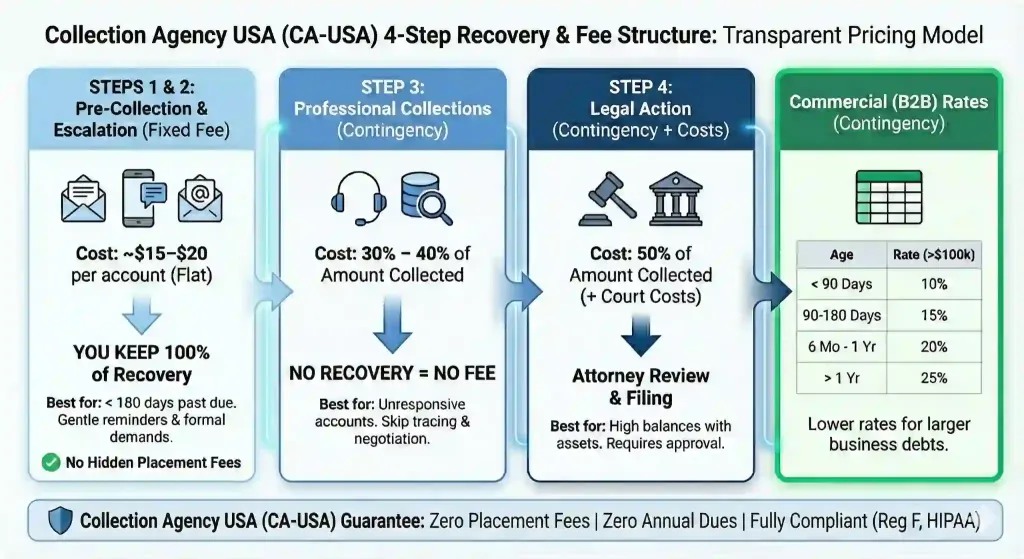
- Fixed-Fee Services: This structure involves a flat fee for specific collection tasks. Fixed-fee services are ideal for newer accounts where recovery likelihood is high, making it a cost-effective solution.
- Contingency Fee Services: Under this model, the agency takes a percentage of the amount recovered. This approach is commonly used for older or more challenging accounts where upfront costs may not be justified.
- Transparency: Regardless of the pricing model, ensure complete transparency in costs to avoid hidden fees.
4. Compliance and Regulatory Adherence
- California-Specific Laws: California’s Rosenthal Fair Debt Collection Practices Act prohibits abusive or deceptive collection practices. Medical collection agencies must also comply with time-barred debt regulations and provide clear, written communication during their initial contact with debtors.
- HIPAA Compliance: Patient data privacy is paramount. Ensure the agency prioritizes data security and complies with HIPAA regulations.
5. Reputation and Reviews
- Client Testimonials: Seek feedback from other healthcare providers. Positive testimonials can indicate strong performance and ethical standards.
- Online Reputation: Research reviews and ratings on trusted platforms. A solid online presence often reflects professionalism and reliability.
California-Specific Medical Debt Collection Laws
- Rosenthal Fair Debt Collection Practices Act: This law ensures that debt collectors operate transparently and without harassment or deceit.
- Time-Barred Debt: Agencies are restricted from filing lawsuits for debts past the statute of limitations and must include specific language in their initial communication regarding time-barred debts.
- AB 1020: This law limits the ability of healthcare providers to transfer unpaid bills to collections without offering a fair payment plan or making a good-faith effort to contact the patient.
- Hospital Fair Pricing Act: Requires hospitals to offer reduced payment plans to low-income patients before transferring debts to collections.
Real-World Scenarios in Debt Recovery
- Scenario 1: Miscommunication Leading to Delays A patient disputes a bill due to lack of clarity on insurance coverage. An experienced medical collection agency mediates between the healthcare provider and patient, ensuring accurate billing and prompt payment resolution.
- Scenario 2: Legal Compliance An agency’s failure to provide clear disclosures leads to a lawsuit under California’s debt collection laws. Healthcare providers must ensure the agency’s strict adherence to legal requirements to avoid liability.
- Scenario 3: Ethical Recovery Practices A patient undergoing financial hardship faces aggressive collection tactics. Choosing an agency with an empathetic approach protects the provider’s reputation while achieving recovery goals.
Frequently Asked Questions
Can we still report unpaid medical debt to credit bureaus in California?
No, not anymore. Since January 1, 2025, California law (Civil Code § 1785.27, from SB 1061) bans reporting medical debt to consumer credit reporting agencies entirely, and prohibits using medical debt as a factor in credit decisions. This isn’t a soft guideline: if a provider or collector knowingly reports medical debt anyway, the debt itself becomes legally void and unenforceable. Since July 1, 2025, contracts creating medical debt must also include specific disclosure language confirming this protection, or the contract is void for the same reason. Credit reporting is off the table as leverage here, so the strategy has to lean on payment plans, direct communication, and, where it applies, legal escalation instead.
This page mentions AB 1020 limiting how “healthcare providers” send bills to collections. Does that cover my private practice, or just hospitals?
Just hospitals and emergency physician groups, specifically. AB 1020 amended California’s Hospital Fair Pricing Act, and its screening and payment-plan requirements are written around hospital billing, not general medical practice. An independent clinic, urgent care, dental office, or private physician group isn’t bound by the Act’s specific mandates the same way a hospital is. That said, offering a genuine payment plan and a real attempt at contact before escalating is good practice everywhere, hospital or not, and it’s the kind of thing that holds up better if an account is ever challenged.
Can we pursue a patient’s spouse for an unpaid medical bill, even though they never received treatment?
Often, yes. California is a community property state, and medical care is treated as a “necessity” under an expanded version of the common-law Doctrine of Necessaries, meaning debt incurred by either spouse during the marriage is generally treated as a shared community obligation, regardless of whose name is on the bill. That changes at separation (debts after that point are usually the incurring spouse’s own responsibility) and gets more complicated with pre-marital debt or a written agreement separating the couple’s property. It’s worth confirming marital status and timing before treating a spouse as an unrelated third party with no obligation on the account.
A patient claims they’re eligible for Medi-Cal but never enrolled, and that’s why the bill went unpaid. Does that change anything?
It’s worth checking before escalating, but eligibility alone isn’t the same as coverage. Medi-Cal (and Covered California) generally can’t be applied retroactively to a service the patient never actually enrolled for at the time of treatment, though a hospital-specific financial assistance screening may still apply (see the AB 1020 question above). A vague claim of “I probably would have qualified” isn’t the same as a documented enrollment or an active application, and those two situations get handled very differently, since one is a real coverage gap and the other is closer to a stall tactic.
How does California’s own surprise billing law (AB 72) affect what we can collect from a patient?
AB 72 predates the federal No Surprises Act and works alongside it: for HMO and PPO-covered patients treated by an out-of-network provider at an in-network facility for non-emergency care, California limits the patient’s responsibility to their in-network cost-sharing amount, and the provider has to seek the remainder from the health plan rather than the patient. It doesn’t touch a patient’s ordinary in-network copay or deductible, so most straightforward unpaid balances aren’t affected, but it’s worth checking whether an account involves an out-of-network provider at an in-network facility before treating the full billed amount as collectible directly from the patient.
Conclusion
Selecting a medical collection agency in California requires careful consideration of expertise, ethical practices, compliance with state laws, and transparency in pricing. Fixed-fee services are cost-effective for newer accounts, while contingency fees suit older debts. Agencies that adhere to California’s strict medical debt collection laws and prioritize patient relationships stand out as reliable partners for healthcare providers. By conducting thorough evaluations and choosing wisely, healthcare providers can achieve effective debt recovery without compromising their values.