Priceless Advice:
- How to hire a collection agency for your medical practice or hospital and maximize results cost-effectively?
- Solution: Begin the collection process with fixed-fee written demand letters, regardless of what the collection agency representative recommends. This will initiate the collections process in an amicable manner, protect your reputation and maximize returns.

CA-USA provides a low cost, compliant, reputation-safe approach, equipped with all 50-state collections license, offering free credit reporting, free bankruptcy scrubs, and zero onboarding fees. Secure – HIPAA & SOC 2 Type II compliant. Over 2,000 online reviews rate us 4.85 out of 5. Over 20 years experience, delivering excellent collection results.
You’ll receive the direct mobile number of a dedicated representative, so help is always just a call or text away.
Need a Collection Agency? Contact us
Collecting medical debts is a highly sensitive task, governed by strict government regulations, privacy laws like HIPAA, and stringent credit reporting restrictions. While experienced collection agencies understand the necessity of treating patients respectfully and adhering to all compliance & legal requirements, there’s an even more critical aspect that demands your attention.
For a medical collection agency to work effectively on your behalf, it’s crucial to manage the process systematically. Simply handing over debts and allowing the agency to operate as they see fit may lead them to use methods that benefit their interests over yours. This could negatively impact your profits and reputation. In this article, we will tell you how to hire and use a medical collection agency effectively, any why you should always start collections with fixed-fee services instead of contingency-fee services.
Your collection agency should act as an extension of your front desk. We prioritize ‘Patient Retention‘ over ‘Aggressive Tactics,‘ ensuring your reputation remains 5-star.
Timing Is Crucial
The most critical factor in determining how much money you will recover is how quickly you submit accounts to a collection agency. We strongly recommend submitting accounts for collection between 60 to 90 days after the first default. After three months of reminders, your staff may lose motivation to continue pursuing non-paying patients, who might believe they can evade payment altogether. Waiting any longer is like throwing money away.
Begin with Fixed-Fee Collection Demand Services
For medical debts, it’s essential to start with a Fixed-Fee Collection Demand Service rather than immediately resorting to collection calls.
Frankly, collection agencies barely profit from fixed-fee services, but it’s an excellent cost-effective option for you.
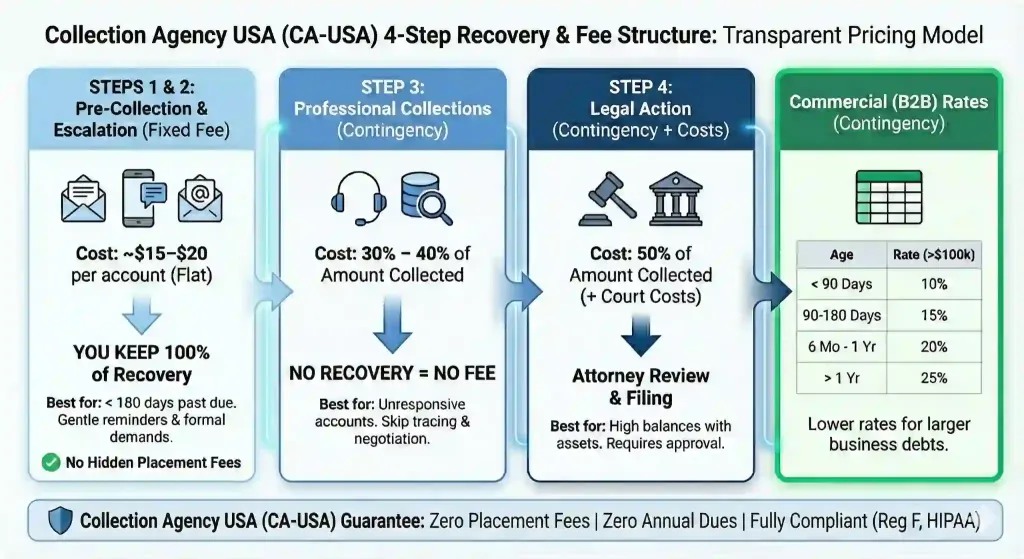
Fixed-fee collection demands are a patient-friendly way to recover debts, providing ample time for patients to pay. They receive five written notices every ten days, which helps them avoid the discomfort of speaking directly to a collector. Sending these five demands costs about $15, and since they’re sent on a medical collection agency’s letterhead, they carry significantly more weight than notices sent from your office. Patients pay you directly. If you attempted to send these demands yourself, the cost could be $50 to $100 or more when all expenses are considered. This approach is not only cost-effective but can also become a zero-cost service if you write it off as a business expense.
Transition to Collection Calls with Care
If written demands have been unsuccessful and the debt remains outstanding, it makes sense to proceed to Collection Calls, which are more direct. By this point, you’ve given your patients sufficient opportunity to settle their debts amicably, now a diplomatic yet a slightly-firm approach is required.
Accounting Tip: Your accounting treatment can remain separate from collection activity. Consult your accounting professional regarding when a receivable should be classified or written off for financial or tax purposes.
Key Qualities to Look for in a Medical Collection Agency
When selecting a medical collection agency, consider the following important factors:
- Nationwide Licensing & HIPAA Compliance: Ensure the agency is licensed to operate nationwide and fully compliant with HIPAA regulations.
- Fixed-Fee Written Demand Services: The agency should offer fixed-fee written demand services as a starting point for collections, averaging $15 per account. There should not be any fee on top of that and patients must be instructed to pay you directly.
- Secure Online Client Portal: A secure portal allows you to monitor and submit accounts conveniently. They should also be easy to use, and backed by a single point of contact who acts as your customer service representative.
- Litigious Patient Scrub: The agency should perform a litigious patient scrub to avoid pursuing patients who have a history of suing businesses like yours, unless the balance owed is significant.
- No On-Boarding Fees and Complimentary Services: Look for agencies that do not charge on-boarding fees and offer free bankruptcy screening and credit reporting. Our collections strategy ensures that No Surprises Act guidelines are also followed. Medical debt credit reporting is subject to the FCRA, applicable state laws, and current credit-bureau reporting policies. Because these requirements continue to evolve, medical accounts should be reviewed for reporting eligibility before furnishing information.
- Bilingual Services and Extensive Experience: The agency should be bilingual and currently serving over 500 medical and dental offices.
- High Online Ratings: An average online or Google rating of over 4.5 stars with more than 1,000 reviews indicates reliability and customer satisfaction.
Need a good Medical Collection Agency? Contact us
Before Sending a Medical Balance to Collections, Verify the Bill Is Collectible
Check:
- Insurance processing is complete
- Patient responsibility is accurate
- Required adjustments have been applied
- Good Faith Estimate requirements were addressed where applicable
- There isn’t an active No Surprises Act dispute
- The patient’s identity/contact information is correct
- No bankruptcy prevents ordinary collection
- Documentation supports the amount due
Essential Due Diligence When Evaluating Agencies
Verifying Security and Compliance
When evaluating collection agencies, look beyond verbal assurances by requesting written documentation of their security protocols, compliance certifications, and data protection standards.
Benchmarking Recovery Rates
Rather than relying solely on handpicked client references, ask for the agency’s overall average recovery rate across their healthcare portfolio. As a general industry benchmark, reputable agencies typically achieve:
-
Over 50% recovery for accounts assigned within 180 days
-
~35% overall average across varied account ages
-
Under 15% recovery for older, harder-to-collect accounts
Evaluating Client Track Record
Inquire about prominent healthcare and commercial clients they serve. Long-standing partnerships with established organizations are a strong indicator of reliability, compliance, and consistent performance.
Act Promptly
Time is of the essence in medical collections. Implementing a systematic approach not only enhances your recovery rate but also ensures compliance with all legal and ethical standards. Don’t leave your collections to chance—take control to protect your finances and maintain strong relationships with your patients.
FAQ’s
1. When should a medical practice send unpaid patient balances to collections?
Many practices consider outside collections after roughly 60–90 days of unsuccessful internal follow-up, especially after insurance processing is complete and the patient balance has been verified.
2. Can a medical bill be sent to collections while insurance is still processing it?
Generally, the practice should first complete insurance processing and confirm the patient’s actual responsibility. Sending an unresolved or incorrectly calculated balance to collections can create avoidable disputes.
3. What should a medical practice verify before assigning a patient balance?
Confirm insurance adjudication, contractual adjustments, patient responsibility, billing accuracy, contact information, bankruptcy status, prior disputes and any applicable No Surprises Act requirements.
4. Does HIPAA allow a medical provider to use a collection agency?
Yes. HIPAA recognizes debt collection as a payment activity. When a collection agency handles protected health information as a business associate, appropriate agreements and safeguards are required.
5. Can a disputed medical bill still be sent to collections?
A disputed balance should be reviewed before collection. If a federal patient-provider dispute resolution process is active, the provider may not move the bill into collections and existing collection activity must pause.
6. Can medical debt still be reported to credit bureaus in 2026?
Yes, some unpaid medical debt can still appear. Current CFPB guidance says unpaid medical debt over $500 and more than 365 days delinquent from the date of service may appear on credit reports, subject to applicable law and bureau policies. The CFPB’s broader medical-debt reporting ban was vacated in July 2025.
Conclusion
Medical collections require a careful balance of urgency, respect, and legality. By acting promptly and starting with a Fixed-Fee Collection Demand Service, you increase your chances of recovering debts while minimizing costs and preserving patient goodwill. Be proactive, demand transparency from your medical collection agency, and focus on methods that serve your best interests.
Reviewed by Collection Agency USA — 20+ years of debt recovery experience